
Table of Contents
- Aluminum vs. Wood Fence Cost Comparison
- Durability of Aluminum vs. Vinyl Fencing
- Steel and Wrought Iron: When You Need Maximum Strength
- Wholesale Aluminum Fencing Benefits for DIY Installers
- Installation Complexity and Material Weight
- Maintenance Requirements and Long-Term Care
- Environmental Factors: Corrosion, Rust, and Climate Suitability
- Conclusion: Which Aluminum Fence Alternative Fits Your Project
- Frequently Asked Questions
Last Updated: September 24, 2026
Choosing the right fencing material can save you thousands of dollars and decades of maintenance headaches. This guide breaks down how aluminum stacks up against wood, vinyl, steel, and wrought iron so you can make an informed decision for your property.
The key question isn’t whether aluminum is universally superior, it’s which material matches your climate, budget, timeline, and long-term maintenance tolerance.
Aluminum vs. Wood Fence Cost Comparison
Wood fencing costs $15-30 per linear foot installed but requires repainting or staining every 3-5 years, with rot repair exceeding $500 per section in humid climates.
Aluminum fence alternatives cost $30-60 per linear foot installed, according to Fantastic Fence’s 2026 pricing analysis. That higher upfront cost disappears over 20 years. Wood demands ongoing maintenance; aluminum does not. A homeowner installing 200 linear feet of fencing spends roughly $6,000-12,000 on aluminum versus $3,000-6,000 on wood initially. Over two decades, accounting for wood staining ($2,000-4,000 every 5 years) and potential rot repairs ($1,000-3,000), the total cost of wood ownership reaches $15,000-30,000. Aluminum? Just the initial installation.
Pre-assembled aluminum panels reduce labor time and installation costs, with the upfront investment paying for itself within 10-15 years through avoided maintenance.
| Material | Upfront Cost (200 ft) | Annual Maintenance | 20-Year Total Cost |
|---|---|---|---|
| Wood | $3,000-$6,000 | $400-$800 | $15,000-$30,000 |
| Aluminum | $6,000-$12,000 | $0 | $6,000-$12,000 |
| Vinyl | $8,000-$16,000 | $100-$300 | $10,000-$22,000 |
| Steel | $9,000-$18,000 | $200-$500 | $13,000-$28,000 |
Calculate your true cost of ownership, not just the sticker price. Many homeowners regret choosing wood because they underestimate maintenance frequency and labor costs over time.
Durability of Aluminum vs. Vinyl Fencing
Vinyl and aluminum are both marketed as “maintenance-free,” but aluminum’s rigidity makes it stronger under lateral force and wind load, while vinyl’s flexibility resists impact damage.
Vinyl degrades under UV exposure within 15-20 years and cracks under impact. Aluminum’s powder coating resists fading for 20-30 years, dents without cracking, and maintains structural integrity.
Aluminum provides superior corrosion resistance compared to wrought iron, particularly in humid climates, according to Precision Fence Works’ durability study. Vinyl has no corrosion risk but suffers from thermal expansion in extreme heat, causing panels to warp slightly. This becomes visible in regions with temperature swings exceeding 60 degrees Fahrenheit between seasons.
Aluminum is approximately four times lighter than steel yet maintains sufficient tensile strength for residential fencing, while vinyl relies on hollow chambers that can crack or fail.
For pool enclosures and pet fencing, aluminum’s corrosion-resistant finish handles chemical exposure without degradation, while vinyl deteriorates faster in chlorine-heavy environments.
Vinyl fencing in hot climates (90°F+ summers) can develop permanent warping. Aluminum handles temperature extremes better, making it the safer choice for regions with extreme seasonal variation.
Steel and Wrought Iron: When You Need Maximum Strength
Steel is superior for high-security applications. While aluminum is rust-proof, steel provides significantly higher strength and is up to three times more resilient due to welded construction. Steel fence panels cost $293 to over $600 per panel, compared to aluminum at $116-231 per panel, according to Iron Fence Shop’s material pricing guide.
Steel’s weight provides superior impact resistance but increases installation labor costs and requires rust prevention through galvanized coating or regular painting, maintenance aluminum doesn’t require.
Wrought iron offers ornamental designs aluminum cannot match, commanding premium pricing ($800-2,000+ per panel) for high-end residential properties.
Choose aluminum for backyard pools or pet enclosures. Choose steel for commercial properties or high-security perimeters where superior strength justifies the cost and maintenance burden.
Wholesale Aluminum Fencing Benefits for DIY Installers
Wholesale aluminum fencing eliminates middleman costs and offers regulatory flexibility for DIY installers navigating HOA rules, zoning restrictions, and building code requirements.
Cost Savings Through Direct Distribution
Traditional fence installation involves multiple markups (distributor 30-50%, contractor 50-100% of material), making the final bill 2-3x higher than material cost. Wholesale aluminum fencing bypasses this chain.
Pre-assembled aluminum panels allow homeowners to install 200 linear feet in a weekend with basic tools, avoiding $2,000-5,000 in contractor labor costs.
Aluminum panels weigh 30-50 pounds versus 80-120 pounds for steel, reducing labor expenses and installation time across the entire project.
HOA and Zoning Compliance: The Hidden Regulatory Advantage
Aluminum’s design versatility makes it compliant with more HOA and zoning restrictions than any other material.
HOA Restrictions and Aluminum Compliance:
Many HOAs prohibit solid-panel fencing but allow aluminum’s open-rail design with vertical pickets or horizontal slats, which provides boundary definition while allowing sight lines.
Aluminum is available in virtually any powder-coat color and maintains consistency for 20+ years, while vinyl is limited to 5-10 standard colors and wood paint fades over time.
Aluminum panels come in standard heights (3, 4, 5, 6 feet) and can be retrofitted or replaced without major cost, while vinyl and wood panels are harder to modify after installation.
Municipal Zoning Code Compliance:
Aluminum’s semi-transparent design complies with sight-line safety requirements while providing boundary definition.
Aluminum’s pre-engineered panel systems with published load ratings accelerate permit approval, while custom wood or wrought iron designs often require engineer review, delaying permits by 2-4 weeks.
Aluminum panels meet ASTM standards with documented load ratings (typically 90+ mph wind resistance), satisfying building inspectors without additional engineering, while wood and steel panels often require custom engineering review.
Pool Code and Safety Compliance
Pool safety codes require minimum 4-foot height and maximum 4-inch sphere spacing. Aluminum’s standardized panel design with consistent picket spacing (2-4 inches) naturally complies, while vinyl, wood, and wrought iron often require costly modifications.
Permit and Inspection Timeline
Aluminum’s standardized design accelerates permits to 4-8 weeks total, while custom wood or wrought iron designs extend to 8-12 weeks due to engineering review and fabrication.
Nationwide Shipping and Regional Compliance
Pre-assembled aluminum panels can be customized for slopes, uneven ground, pool-code compliance, and HOA restrictions, combining wholesale pricing with customization and compliance.
The biggest financial advantage of aluminum fence alternatives isn’t the material itself, it’s the ability to install it yourself, eliminate contractor markups, AND navigate HOA/zoning compliance without costly modifications or permit delays. Aluminum’s regulatory flexibility saves thousands in compliance-driven redesigns that plague wood, vinyl, and custom wrought iron installations.
::: Choosing materials that bypass these bureaucratic hurdles remains essential, though homeowners prioritizing natural aesthetics should carefully weigh their wood fence options before committing to a specific installation path.
Installation Complexity and Material Weight
Aluminum is approximately four times lighter than steel, transforming installation from grueling to manageable for DIY homeowners.
Wood and vinyl require individual board attachment, while steel demands heavy labor. Aluminum’s pre-assembled panels attach to posts with simple brackets and bolts.
DIY aluminum installation: set posts in concrete, attach pre-assembled panels with provided hardware, install caps and trim, complete in hours, not days.
Aluminum’s light weight allows one person to position and attach panels, while steel requires two people and specialized equipment, explaining premium contractor labor rates.
Posts must be set in concrete at 24-36 inch depths. Aluminum’s lighter weight allows smaller diameter posts than steel, reducing material costs.
Homeowners with basic carpentry skills can install aluminum fencing successfully, while steel installation mistakes are costly and dangerous.
Maintenance Requirements and Long-Term Care
Aluminum requires virtually no maintenance beyond occasional cleaning, while vinyl needs annual inspection, wood demands repainting every 3-5 years, and steel requires rust prevention every 5-7 years.
Aluminum’s powder coating resists fading, scratching, and environmental degradation. Rain washes away dirt naturally; pressure washing is optional, not necessary.
Vinyl requires checking for warping, cleaning mold, and replacing cracked panels ($200-400 each). Wood requires pressure washing, staining, and rot repair. Steel requires rust inspection and repainting.
Over 20 years, aluminum costs $0-200 annually, vinyl $100-300, wood $400-800, and steel $200-500, making aluminum’s total cost of ownership lowest despite higher upfront costs.
If you’re comparing aluminum fence alternatives, calculate maintenance costs per year, not just upfront price. A material that costs 20% more initially but requires zero maintenance will save you money within a decade.
Environmental Factors: Corrosion, Rust, and Climate Suitability
Climate suitability is critical: choosing the wrong material for your region can accelerate degradation by 50-70%. Consider humidity, salt exposure, freeze-thaw cycles, and UV intensity.
Coastal and Salt-Air Regions
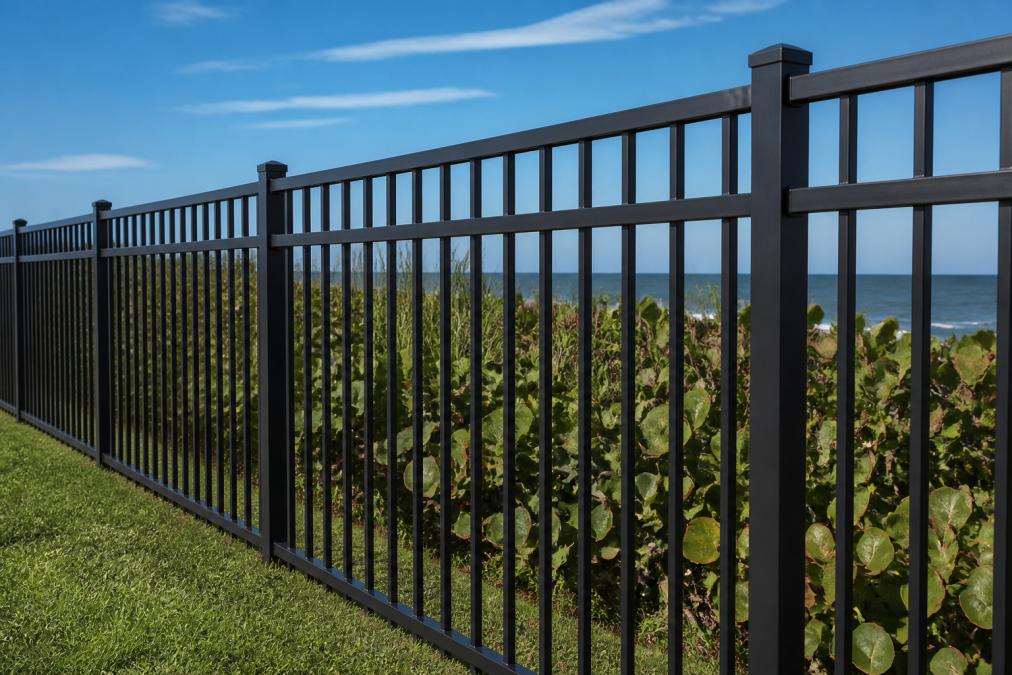
Aluminum dominates in coastal environments where salt spray accelerates steel corrosion 5-10 times faster than inland. Aluminum’s powder-coat finish handles salt exposure indefinitely without special maintenance.
Steel requires premium galvanized coatings but develops white rust within 5-7 years in salt-air zones.
High-Humidity and Wet Climates (Southeast, Pacific Northwest)
Arid and High-UV Regions (Southwest, High-Altitude)
Freeze-Thaw Cycles (Northern and Mountain Regions)
Wind Load and Storm Resistance
Regional Performance Summary
Before selecting a fencing material, check your local building code for frost-line depth requirements and contact your county extension office for regional climate data (average humidity, annual rainfall, freeze-thaw cycles, UV index). Match material choice to your specific regional profile, not generic climate zones.
Conclusion: Which Aluminum Fence Alternative Fits Your Project
Aluminum fence alternatives each solve specific problems. Wood works for budget-conscious homeowners accepting ongoing maintenance. Vinyl suits those prioritizing aesthetics over long-term value. Steel serves high-security applications. Wrought iron delivers custom ornamental designs.
Frequently Asked Questions
What are the main downsides of aluminum fence alternatives compared to aluminum?
Steel and wrought iron offer superior strength but cost significantly more, steel panels range from $293 to over $600 per panel versus $116-$231 for aluminum. Wood requires regular maintenance and replacement every 15-20 years. Vinyl can crack in extreme temperatures and lacks the security strength of metal. Aluminum balances affordability, durability, and minimal maintenance well, making it a strong option for budget-conscious homeowners.
How much does 200 feet of aluminum fence cost installed?
Installed aluminum fencing costs $30-$60 per linear foot, meaning 200 feet typically runs $6,000-$12,000 for professional installation. Wholesale aluminum panels ($116-$231 per panel) allow DIY installation to reduce labor costs significantly. Exact pricing depends on panel height, style, post spacing, and site conditions. Contact Aluminum Fences Direct for a custom quote based on your specific project requirements.
Is aluminum or vinyl fencing more cost-effective in the long run?
Aluminum offers a strong total cost of ownership. While vinyl has a similar upfront cost, aluminum requires zero maintenance and lasts 20-30+ years without fading or cracking. Vinyl can become brittle in cold climates, crack under impact, and may need replacement sooner. Aluminum’s corrosion-resistant powder coating eliminates painting, staining, or sealing costs. Over a 25-year project lifespan, aluminum can save thousands in maintenance labor and materials.
Which fencing material offers the best return on investment for resale?
Aluminum fencing increases curb appeal and property value without the maintenance burden of wood or the brittleness concerns of vinyl. Metal fencing signals durability and security to potential buyers. Steel offers higher impact resistance for security-focused properties but costs 2-3 times more. Aluminum delivers a strong balance: moderate upfront investment, zero maintenance, and proven long-term durability that justifies the cost to future owners.