
Table of Contents
- Why Aluminum Privacy Fence Panels Are Replacing Wood in 2026
- Aluminum Fence Installation Cost: DIY vs. Professional
- Privacy Fence Height Requirements: Pool Codes, HOA Rules, and Local Zoning
- DIY Aluminum Fence Installation: Step-by-Step for Sloped and Uneven Yards
- Aluminum Privacy Fence Specifications: What to Look For
- Maintenance, Durability, and End-of-Life Recycling
- Pros, Cons, and Common Installation Mistakes
- Conclusion
- Frequently Asked Questions
Last Updated: September 27, 2026
Why Aluminum Privacy Fence Panels Are Replacing Wood in 2026
The aluminum metal fencing market was valued at $8,870.2 million in 2021 and is projected to reach $12,318.60 million by the end of 2026, according to Cognitive Market Research’s aluminum fencing market analysis. That growth reflects a straightforward shift: homeowners are tired of replacing rotting wood every decade. An aluminum privacy fence is a fence system built from powder-coated aluminum panels, typically assembled from vertical pickets or horizontal slats set between a top rail and bottom rail.
The core trade-off is upfront cost versus lifespan. Wood is cheaper on day one; aluminum privacy fence panels cost more initially but are maintenance-free for decades.
Aluminum Fence Installation Cost: DIY vs. Professional
Aluminum fence installation cost splits into two very different numbers depending on who does the work. In 2026, professional installation of an aluminum privacy fence runs roughly $25 to $55 per linear foot with labor included, per Barrier Boss USA’s 2026 privacy fence cost breakdown. DIY material costs land around $15 to $30 per linear foot.
| Cost Factor | DIY | Professional |
|---|---|---|
| Material cost per linear foot | $15-$30 | Included in quote |
| Labor per linear foot | $0 | $25-$55 total installed |
| Timeline | 1-2 weekends | 2-6 weeks scheduling |
| Warranty on labor | None | Typically 1-2 years |
Material Costs vs. Labor Rates
Labor is the largest line item in any professional quote, excavation, concrete mixing, panel setting, and gate hanging. Install fence panel kits yourself and you keep that margin.
Hidden Costs: Permits, HOA Fees, and Site Prep
Budgets break on the extras, not the panels. Permit fees vary by municipality and often scale with fence height, HOA review applications sometimes carry a submission fee, and site prep, stump removal, regrading, old fence haul-away, adds cost if your yard is not clear.
Skipping the permit because “it’s just a fence” is the most common mistake we see. Unpermitted fences can be ordered removed at your expense, and an HOA can force a full teardown after installation.
Privacy Fence Height Requirements: Pool Codes, HOA Rules, and Local Zoning
Privacy fence height requirements come from three authorities, and the strictest wins. A typical residential zoning limit is 6 feet in a backyard and 4 feet in a front yard, though this varies by jurisdiction, and pool barriers follow a different standard. Check your zoning ordinance and HOA covenants before ordering, because height determines panel size and post length.
Pool Safety Standards and ICC-ES Compliance
Pool enclosures must meet barrier standards that govern height, gate self-latching hardware, and climb resistance. Look for panels with an ICC-ES evaluation report, which documents independent code compliance. Aluminum Fences Direct panels are designed for pool-code applications, and we recommend confirming your specific state and municipal requirements before purchase. The International Code Council’s code resources publish the underlying model code language inspectors work from.
HOA and Municipal Restrictions on Fence Height
Many HOAs restrict fence style as well as height, dictating picket spacing, color, and whether horizontal privacy slats are permitted. Request the architectural guidelines in writing before you order. A 6-foot panel that meets city code can still fail HOA review on appearance alone.
DIY Aluminum Fence Installation: Step-by-Step for Sloped and Uneven Yards
DIY aluminum fence installation follows the same sequence on flat or sloped ground: lay out the line, set posts in concrete, then hang pre-assembled panels. Most homeowners finish a 100-foot run in a weekend with two people, and the panels arrive assembled, so there is no picket-by-picket work on site. What separates a fence that stays plumb for thirty years from one that leans by year three is almost entirely the footings.
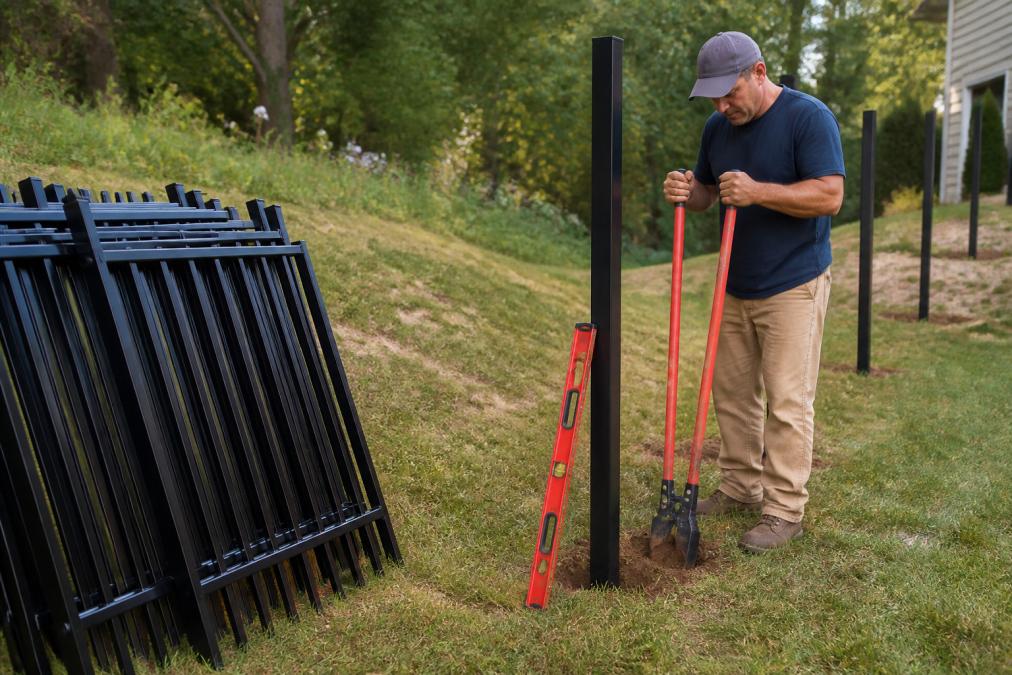
- Call 811 before you dig. Utility marking is free in every state and typically completes within two to three business days.
- String a line between corner posts to establish the fence run and confirm square with the 3-4-5 method.
- Dig post holes 30 to 36 inches deep in most climates, deeper where frost penetrates further. Hole diameter should be roughly three times the post width.
- Set corner, end, and gate posts in concrete first. These carry the load; line posts follow.
- Brace corner posts plumb with stakes and cross-bracing, then pour footings for line posts.
- Let concrete cure 24 to 48 hours before hanging panels. Cool, damp weather extends cure time.
- Hang panels between posts, adjusting for grade as you go.
- Install gate hardware, check swing clearance, and confirm the latch engages from both directions.
- Touch up any scratched powder coat with matching paint before the scratch oxidizes.
In-Ground Post Installation and Concrete Footings
Concrete footings anchor the fence against wind load and frost heave. Set posts roughly one-third of their length below grade and crown the concrete slightly above the soil line so water drains away. Improper footing depth is the leading cause of panel failure in amateur installs.
Foundation and Soil Compatibility: Clay, Sand, and Rock
Soil type changes how a footing behaves:
- Heavy clay. Clay expands when wet and shrinks when dry, pushing posts sideways over years. The fix is a wider footing, roughly 10 to 12 inches in diameter, plus a gravel base under the concrete so water has somewhere to go, and a generous concrete crown.
- Sandy or loamy soil. Sand drains well but grips poorly, and a straight-sided hole lets the concrete plug slide. Bell the bottom wider than the top so the footing is mechanically locked into the soil, the same principle used for deck piers.
- Rock or shallow bedrock. You may not be able to dig to frost depth at all. Core into the rock and set the post in anchoring epoxy, or switch to a surface-mount base bolted to a concrete pad, trading some lateral strength for feasibility.
A quick field test: dig a hole, fill it with water, and watch how fast it drains. Fast drainage points to sand; standing water points to clay. That tells you which footing approach to use before you order concrete.
How Racking Capability Solves Sloped Terrain
Racking capability lets a panel follow your yard’s grade by shifting the vertical pickets within the rails, so the top and bottom rails stay parallel to the slope instead of stepping. On a steep slope, racked panels look intentional; stepped panels look like a mistake.
Measure your total rise before ordering. If the grade changes more than a few inches across a panel width, specify racked panels rather than standard ones, and confirm the racking limit in degrees so you do not exceed it on a steep yard.
Never skip concrete footings to save an afternoon. Posts set in bare soil lean within two seasons, and correcting it means pulling the entire run. Frost heave and clay expansion will find every shortcut you take.
Aluminum Privacy Fence Specifications: What to Look For
The specs that matter most are picket spacing, rail design, alloy grade, and coating thickness. Together they determine privacy, structural integrity, and how the fence holds up over decades, the difference between a 50-year fence and a 15-year one is measurable, not marketing.
Picket Spacing, Rail Design, and Tensile Strength
Picket spacing controls both privacy and code compliance. Narrow spacing blocks sightlines; wider spacing meets pool barrier climb-resistance rules and improves airflow. As a rule of thumb, 3 inches or less reads as a true privacy screen, while 4 inches and wider is visible from an angle and is the spacing pool codes often require.
Powder-Coated Finish and UV Resistance
A powder-coated finish is electrostatically applied and baked on rather than painted, making it far more chip-resistant than liquid coatings. Coating thickness is expressed in mils, and thicker is not automatically better, too thick and the coating can crack at bends. A typical architectural powder coat runs 2 to 4 mils.
| Specification | What to Look For | Why It Matters |
|---|---|---|
| Picket spacing | 3 inches or less (privacy) | Blocks sightlines, meets code |
| Rail design | Beveled, reinforced top rail | Resists bending, sheds water |
| Assembly | Fastener-free | No loose screws over time |
| Alloy grade | 6005-T5 or 6063-T6 | Resists permanent bending |
| Coating thickness | 2-4 mils powder coat | Chip resistance without cracking |
| Finish | UV-resistant, separate finish warranty | Holds color, resists chalking |
| Warranty | Lifetime structural | Signals material quality |
Matching Specs to Your Actual Conditions
Specs only matter against the conditions they face. A coastal property needs a finish and fastener package rated for salt air, where corrosion attacks cut edges and hardware first. A windy, open lot needs deeper footings and a heavier rail. A pool enclosure needs spacing and climb resistance that satisfy the barrier code, not just privacy.
Buy the spec that matches your site. Privacy spacing, alloy grade, rail reinforcement, and coating thickness each solve a specific problem, pick the ones your yard actually has.
Maintenance, Durability, and End-of-Life Recycling
Well-built metal fences last fifty years or more, according to Call Fantastic Fence’s durability guidance. Real-world 2026 performance data shows aluminum privacy panels holding structural integrity and finish appearance with zero maintenance, per Aluminum Fences Direct’s panel comparison guide. A rinse with a garden hose once a season handles almost everything.
Pros, Cons, and Common Installation Mistakes
Aluminum privacy fencing wins on lifespan and maintenance, and loses on upfront price against wood. Here is the full picture.
Pros:
- Does not rust, rot, or attract insects
- Maintenance-free after installation
- Lifetime warranty available on quality panels
- Racking capability handles sloped yards
- Recyclable at end of life
Cons:
- Higher upfront cost than wood
- Dents under heavy impact where wood would splinter
- Not a true sound barrier at standard panel thickness
Common installation mistakes:
- Post holes too shallow for frost depth
- No concrete footing, relying on tamped soil
- Panels ordered without checking grade change
- Skipping the permit or HOA approval
Conclusion
The hard part of an aluminum privacy fence project is not the installation. It is getting the specifications right before you order: height for your pool code, racking for your slope, picket spacing for your HOA. Aluminum Fences Direct ships 100% American-made, pre-assembled panels and gates nationwide, backed by a lifetime warranty and wholesale pricing that skips the middleman markup.
Frequently Asked Questions
How much does 100 feet of aluminum privacy fence cost?
Material costs for 100 linear feet of DIY aluminum privacy fence typically run $1,500 to $3,000, based on 2026 industry estimates of $15 to $30 per linear foot for materials. Professional installation adds labor at $25 to $55 per linear foot. Standard ornamental aluminum averages $40 to $75 per linear foot installed. Get a quote from Aluminum Fences Direct for exact pricing on your panel configuration.
What are the disadvantages of an aluminum privacy fence?
Aluminum privacy fence costs more upfront than wood, and thin-gauge panels can dent from heavy impact. Full seclusion requires horizontal privacy slats or a solid panel insert rather than standard pickets. Improper DIY installation, especially on sloped ground without proper racking, can cause structural failure. However, well-built aluminum fences last fifty years or more with zero maintenance, which offsets the higher initial price.
Can you get true privacy with an aluminum fence?
Yes. Full privacy aluminum fence panels, such as 8-foot-wide by 6-foot-high sections, use horizontal privacy slats or solid inserts to block sightlines completely. Standard picket styles with 3.75-inch spacing offer partial privacy. For pool enclosures and pet containment, choose panels with tight picket spacing and add privacy inserts where seclusion matters most.
Is aluminum fencing more durable than wood or vinyl?
Aluminum outperforms both in longevity. Well-built metal fences last fifty years or more, while wood typically needs replacement in 10 to 15 years and vinyl can crack in extreme cold. Aluminum is rust-proof, UV-resistant, and holds a powder-coated finish without repainting. Aluminum Fences Direct’s products are designed to maintain structural integrity and finish appearance with zero maintenance requirements.