
Table of Contents
- Aluminum vs Steel Fencing for Coastal Homes: 2026 Comparison Table
- Corrosion-Resistant Fencing for Salt Air: How Each Material Performs
- Aluminum Fence Installation Cost 2026: Material and Labor Breakdown
- Structural Rigidity and Wind Load Engineering for Coastal Exposure
- DIY Aluminum Fence Installation Tips for Salt-Air Properties
- Hybrid Fence Systems and Warranty Nuances in Coastal Zones
- Frequently Asked Questions
Last Updated: September 30, 2026
Aluminum vs Steel Fencing for Coastal Homes: 2026 Comparison Table
Aluminum vs steel fencing for coastal homes 2026 comes down to one trade-off: aluminum resists salt air on its own, while steel is stronger but depends on coatings that can fail in coastal exposure. At Aluminum Fences Direct, we ship pre-assembled aluminum panels to coastal homeowners nationwide, so we see how both hold up after years of salt spray.
The pricing gap is real. Aluminum fence panels cost $116 to $231 per panel, while steel fence panels run $293 to over $600, according to Aluminum Fences Direct’s 2026 fencing cost comparison.
Here is the quick verdict before the details:
Winner: Aluminum for most coastal homes. It will not rust, needs no repainting, and costs roughly half of what steel runs per panel. Choose steel only if maximum impact resistance matters more to you than long-term maintenance.
| Factor | Aluminum | Steel |
|---|---|---|
| Cost per linear foot | Get a Quote | 15%-25% more |
| Corrosion resistance | Inherent (no rust) | Coating-dependent |
| Weight | Light, easy to handle | Up to 3x heavier |
| Maintenance | Essentially none | Repainting and rust checks |
| Best for | Salt air, humidity, DIY installs | Inland security, high-impact needs |
Corrosion-Resistant Fencing for Salt Air: How Each Material Performs
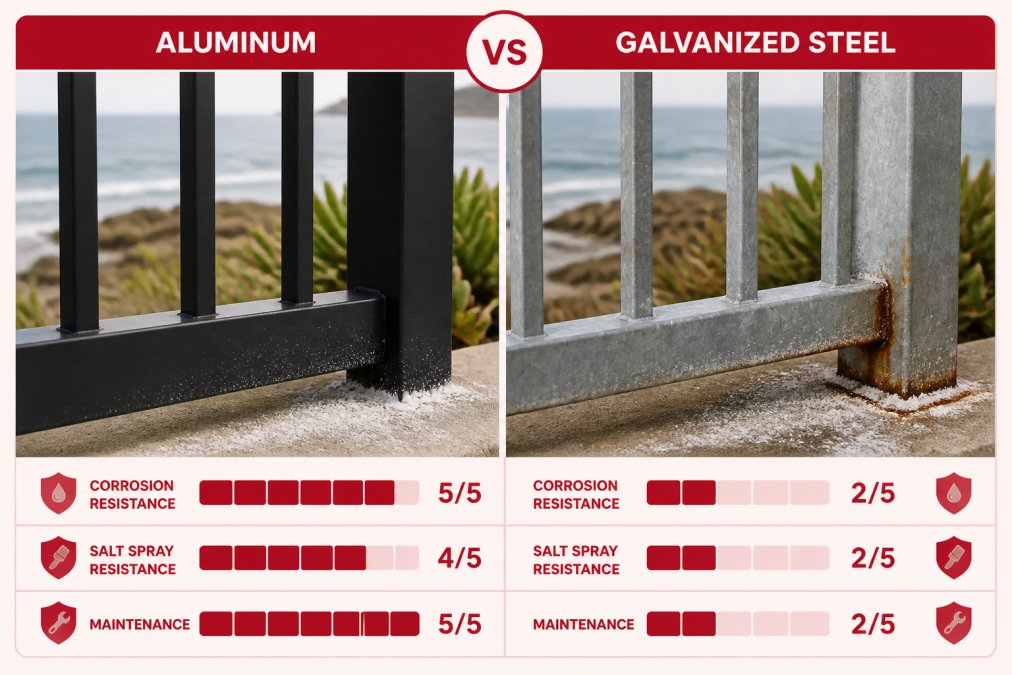
Corrosion-resistant fencing for salt air works on a simple principle: the material either resists oxidation on its own or relies on a protective layer salt spray will eventually attack. Aluminum is the first; steel is the second.
Aluminum’s Natural Oxide Barrier
Aluminum forms a thin oxide layer the moment it meets air. That layer seals the metal underneath and regenerates if scratched, so aluminum does not rust the way iron-based metals do.
This matters most in a coastal environment.
Steel’s Dependence on Galvanized and Powder-Coated Protection
Steel is iron-based, so it rusts when moisture reaches bare metal. Manufacturers fight this with galvanized zinc layers and powder coatings, and a well-applied finish can last years.
A scratched powder coat on a steel panel near the coast is not cosmetic damage. It is the starting point for rust that will spread beneath the finish. Inspect and touch up bare spots annually or the panel’s lifespan drops sharply.
Aluminum Fence Installation Cost 2026: Material and Labor Breakdown
Aluminum fence installation cost in 2026 breaks into two clear buckets: material and labor. Material runs $20 to $45 per linear foot for aluminum, per MaintainFree’s 2026 pricing analysis, while steel typically costs 15% to 25% more per linear foot.
| Cost Component | Aluminum | Steel |
|---|---|---|
| Material per linear foot | Get a Quote | 15%-25% higher |
| Panel cost | Get a Quote | $293-$600+ |
| Labor (if hired) | $15-$30 per linear foot | $15-$30 per linear foot |
| Repainting over 15 years | $0 | $1,500+ typical |
The cheapest fencing decision is not the lowest sticker price. It is the material with the lowest total cost over 15 to 20 years, and in the aluminum vs steel fencing for coastal homes 2026 debate, that is almost always aluminum.
Structural Rigidity and Wind Load Engineering for Coastal Exposure
Structural rigidity is where steel makes its case. Steel is roughly three times stiffer than aluminum, about 200 GPa versus 69 GPa in modulus of elasticity, per Pacific Wood and Iron’s 2026 rigidity comparison. That stiffness translates to less deflection under a given load, which is why steel feels more “solid” when you push on it.
The Numbers That Actually Govern Wind Performance
Residential fence engineering in coastal zones is driven by the design wind speeds in the International Residential Code (IRC) and ASCE 7. Those documents organize the coast into Exposure Categories, B for suburban terrain, C for open terrain, and D for flat, unobstructed stretches directly exposed to open water. Exposure D produces the highest design pressures and applies to many beachfront lots.
How Aluminum and Steel Compare Under Load
Here is where the binary “steel is stronger” framing falls apart.
| Wind-Load Factor | Aluminum | Steel |
|---|---|---|
| Modulus of elasticity | ~69 GPa | ~200 GPa |
| Panel weight | Light | Up to 3x heavier |
| Wind-catching surface | Similar (same picket profile) | Similar |
| Force transferred to posts | Lower (less mass) | Higher (more mass) |
| Typical footing demand | Standard concrete footing | Deeper/wider footing often required |
| Deflection under gust | More flex, recovers | Less flex, higher stress concentration |
Wind load is a system property, not a material property. A properly engineered aluminum fence with correct post spacing and footings will outperform a poorly anchored steel fence every time. Ask any installer for the design wind speed, post spacing, and embedment depth in writing before you sign.
What to Ask Before You Buy
A fence rated for Exposure B inland will not meet the same design pressure on an Exposure D beachfront lot. Confirm the rating matches your actual site exposure, not a generic “coastal” claim.
For DIY installations, follow the manufacturer’s footing and spacing spec exactly, even if it means more concrete and more posts than expected. The panels will outlast the footings if you cut corners there.
DIY Aluminum Fence Installation Tips for Salt-Air Properties
DIY aluminum fence installation tips for salt-air properties start with one rule: protect every cut edge. Aluminum resists corrosion on its own, but any exposed raw cut should still get matching paint to keep the finish uniform.
- Set posts in concrete, not just packed soil. Coastal ground shifts with moisture, and concrete keeps the fence alignment true for decades.
- Leave a small gap between panel bottom and ground. Standing water and salt splash are the two things that shorten any fence’s life.
- Rinse the fence twice a year with fresh water. This removes salt buildup before it can dull the powder coating.
- Check gate hardware each spring. Salt air stiffens hinges faster than inland conditions, and a quick lubricant keeps them swinging.
Wash your aluminum fence after the first big storm of the season, not before. That timing clears the heaviest salt deposit of the year in one pass instead of two.
Hybrid Fence Systems and Warranty Nuances in Coastal Zones
Hybrid fence systems combine a galvanized steel frame with aluminum or composite infill, giving you steel’s rigidity in the structure and aluminum’s corrosion resistance in the visible panels. BarrierBoss’s coastal fencing guidance notes that steel can be engineered with specialized coatings for coastal-grade protection, and hybrids are how that strength gets paired with rust-proof surfaces.
The Warranty Trap Most Coastal Homeowners Miss
This is the part of the buying decision that almost no comparison article covers, and it is where coastal homeowners get burned.
Three clauses to read before you buy:
- Coastal or salt-air exclusion. Look for language that voids or limits coverage for corrosion, rust, or finish failure when the fence is installed near salt water. If the exclusion exists, the warranty is not what the headline claims.
- Maintenance requirements. Many warranties condition coverage on documented periodic cleaning or inspection. Skip the annual rinse and the claim can be denied even for a defect that has nothing to do with salt.
- Finish vs. structure coverage. A warranty may cover the powder coat for a set number of years while covering the underlying metal for life, or the reverse. Know which layer you are actually protected on.
Read the warranty exclusions before you buy any fence for a coastal property. A lifetime warranty that voids when you skip annual inspections, or that excludes salt-air corrosion outright, is not the coverage you think it is. Ask for the warranty document in writing and search it for the words “coastal,” “salt,” and “corrosion.”
Why Aluminum Sidesteps the Warranty Problem
This is the quiet advantage of aluminum in a coastal zone: because corrosion resistance is inherent to the alloy rather than applied as a coating, there is no finish layer to fail, chip, or fall outside warranty coverage. The metal itself does not rust, so a “salt-air corrosion” exclusion has nothing to attach to.
Frequently Asked Questions
Does salt air cause steel fences to rust faster than aluminum?
Yes. Steel relies on galvanized or powder-coated barriers to block moisture, and once those coatings scratch or chip, rust begins. Aluminum forms a natural oxide layer that stops corrosion even when the surface is damaged. In coastal environments with constant salt spray and humidity, aluminum fencing consistently outlasts unprotected steel.
What is the best fence material for coastal areas?
Aluminum is the leading choice for coastal homes because it does not contain iron, so it cannot rust. It handles salt air, humidity, and UV exposure without peeling or corroding. Steel can work if it uses coastal-grade coatings, but it costs more upfront and requires ongoing inspection to catch coating failures before rust sets in.
How does the maintenance of aluminum compare to steel in high-salt environments?
Aluminum fencing needs only occasional rinsing with fresh water to remove salt buildup, typically two to three times per year. Steel requires regular inspections for scratches, touch-up painting, and reapplication of protective coatings. Over a 20-year span, aluminum saves dozens of hours of labor and hundreds of dollars in maintenance products.
Are there specific coatings that make steel viable for coastal homes?
Yes. Galvanized steel with a powder-coated top layer offers the best corrosion protection for steel fencing near the coast. The zinc galvanizing sacrifices itself to protect the steel underneath, and the powder coat adds a second barrier. Even so, any scratch that breaches both layers becomes a rust point that needs immediate repair.
Do aluminum fences increase property value for coastal homes?
Aluminum fencing improves curb appeal and provides security, both of which buyers notice. Coastal buyers especially value low-maintenance materials because they know salt air destroys lesser options. A well-installed aluminum fence signals that the property is protected and easy to care for, which supports resale value in waterfront markets.