
Table of Contents
- Alumisource vs iFenceUSA: Side-by-Side Comparison
- Residential vs Commercial Grade Aluminum Fence: Which Do You Need?
- Material Thickness, Coating Quality, and Structural Integrity
- DIY Aluminum Fence Installation Guide: Complexity and Suitability
- Core Installation Steps and Time Requirements
- The Slope Problem: Where Most DIY Installations Fail
- Post Installation: The Foundation of Durability
- Fastener Installation and Hardware Stress Points
- Gate Hardware: The Weak Link in Most Installations
- Post-Installation Performance: What Happens in Years 2-5
- Aluminum vs Wood Fence Cost Comparison: What You Actually Save
- Warranty Coverage, Maintenance, and Long-Term Performance
- Shipping, Lead Times, and Regional Availability
- Frequently Asked Questions
Last Updated: September 20, 2026
Alumisource vs iFenceUSA: Side-by-Side Comparison
When shopping for aluminum fencing, an aluminum fence comparison of material thickness, coating quality, and assembly methods reveals dramatic differences in durability and long-term cost.
Both Alumisource and iFenceUSA operate in the aluminum fence comparison market but serve different buyer profiles with distinct approaches to quality and pricing.
The right choice depends on whether you prioritize cost savings or installation guidance.
The core difference isn’t features, both offer pre-assembled panels and nationwide shipping. The gap emerges in coating durability, post-installation support, and how well their systems handle sloped or uneven terrain.
Aluminum Fences Direct, however, stands apart as a premier wholesale distributor offering 100% American-made aluminum fencing with a lifetime warranty. Aluminum Fences Direct maintains domestic manufacturing standards and eliminates middleman costs entirely. This approach delivers meaningful advantages for DIY homeowners and contractors seeking durable, maintenance-free solutions without premium pricing.
Residential vs Commercial Grade Aluminum Fence: Which Do You Need?
Residential-grade panels use thinner rail sections for standard backyard applications, while commercial-grade fencing uses heavier-gauge aluminum and reinforced base plates for high-traffic areas and pools.
Aluminum fencing standards and manufacturing specifications indicate that commercial-grade panels feature rail thickness of 1.5 inches or greater, compared to residential grades at 1.25 inches. This seemingly small difference translates to significantly higher impact resistance and longer service life under environmental stress.
Residential grade suits most backyard applications at lower cost. Commercial grade makes sense for heavy foot traffic, strict pool-code compliance, or rental properties where durability impacts maintenance expenses.
Aluminum Fences Direct stocks both residential and commercial grade pre-assembled panels ready to ship.
Choosing residential grade for a commercial application creates liability exposure if someone is injured and your fencing fails to meet code requirements. Always verify your local pool code and property classification before selecting a grade.
Material Thickness, Coating Quality, and Structural Integrity
This is where the real competition happens. [Aluminum fence(/how-to-install-aluminum-fencing-yourself/) manufacturing standards comparison | aluminumfencesdirect.net] shows that coating quality and material thickness are the primary differentiators between brands. Two fences can look identical after installation but perform completely differently after five years of UV exposure and weather cycling.
Specification Comparison Matrix
| Specification | Alumisource Residential | iFenceUSA Residential | Commercial-Grade Standard |
|---|---|---|---|
| Rail Gauge (inches) | 0.125 | 0.125 | 0.156+ |
| Post Wall Thickness (inches) | 0.125 | 0.125 | 0.156 |
| Powder Coat Layers | 1 | 1-2 (varies) | 2-3 |
| Coating System | Standard polyester | Standard polyester | Polyester + UV inhibitor + primer |
| Typical Coating Weight (mils) | 1.5-2.0 | 1.5-2.5 | 2.5-3.5 |
| Expected Finish Life | 3-5 years | 4-6 years | 8-12+ years |
| Corrosion Resistance Rating | ASTM B117 (500 hrs) | ASTM B117 (500-1000 hrs) | ASTM B117 (1000+ hrs) |
A 0.125-inch rail flexes more under wind load than 0.156-inch material. Single-coat finishes chalk and fade within 3-4 years, while multi-layer systems extend service life to 10+ years.
Powder Coating Durability: What the Numbers Mean
ASTM B117 salt-spray testing measures coating durability: 500-hour rating (standard residential) translates to 3-5 years in coastal climates; 1000-hour rating (upgraded residential) provides 6-10 years; 2000+ hour rating (commercial-grade) delivers 12-20+ years.
Material Thickness and Structural Behavior
0.125-inch rail (standard residential) deflects under 40+ mph wind and can rack on slopes. 0.156-inch rail (heavy residential/light commercial) resists wind and racking better, recommended for exposed or windy properties.
The 0.031-inch difference increases cross-sectional area by 25%, translating to less flex, better performance on uneven ground, and longer service life.
Real-World Coating Failure Patterns
Single-coat systems show chalking by year 3-4, visible fading by year 5-6, and significant corrosion by year 7-8. Multi-layer systems remain stable through year 12+ with minimal chalking and no visible corrosion.
Commercial-grade systems chalk by year 10+.
The $2-5 per linear foot premium for upgraded coating isn’t optional if you plan to keep the fence beyond 7 years. On a 200-foot fence, spending $400-1,000 more upfront saves $2,000-3,000 in premature replacement costs.
Aluminum Fences Direct applies multi-layer powder coating as standard across all products, matching commercial-grade durability.
DIY Aluminum Fence Installation Guide: Complexity and Suitability
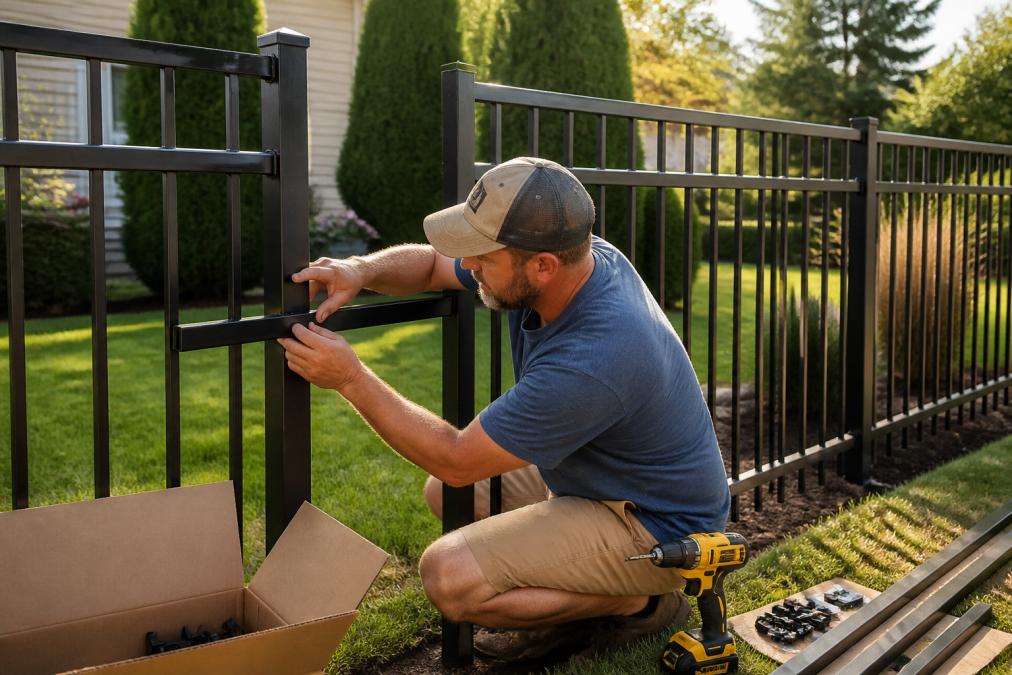
Pre-assembled aluminum panels eliminate 60-70% of traditional installation labor. For most homeowners with basic tool skills this is doable, but terrain-specific details separate a 5-year fence from a 15-year fence.
Core Installation Steps and Time Requirements
Installation involves site layout, post installation with concrete footings, panel positioning, fastener installation, and gate hardware setup. Level ground takes 4-6 hours per 50 linear feet for experienced DIYers; sloped terrain adds 2-4 hours; severely sloped ground adds 4-8 hours or requires step-down sections.
Post installation is critical. Aluminum posts require concrete footings at least 24-30 inches deep (below frost line) to prevent heaving. Inadequate depth is the #1 cause of fence failure in years 2-5.
The Slope Problem: Where Most DIY Installations Fail
This is where supplier choice matters enormously. Sloped properties require either racking (angling panels to follow grade changes) or step-down sections (using different fence heights). Some pre-assembled systems handle this better than others.
Racking requires precise angle measurement, careful panel positioning, and fastener placement perpendicular to rails. Incorrect racking causes visible crookedness and premature fastener failure.
Step-down sections: Using 4-foot fence height in one section and 3-foot in the next, stepping down the slope. This avoids racking but creates visible height transitions that some homeowners find unacceptable.
Aluminum Fences Direct stocks pre-fabricated racking panels for slopes up to 15 degrees with customer support.
Before ordering, measure your property’s elevation change across the fence line using a simple water level or laser level (available at any home improvement retailer for $15-30). Changes exceeding 12 inches over 8-foot sections require racking or step-down planning. Failing to account for slope before ordering creates delays, cost overruns, and installation frustration.
Post Installation: The Foundation of Durability
Post installation determines whether your fence lasts 5 years or 15 years. Here’s what actually happens:
Shallow footings (12-18 inches) cause posts to heave 1-2 inches after 2-3 freeze-thaw cycles, creating gaps, fastener stress, and corrosion. Adequate footings (24-30 inches, below frost line) keep posts stable and fences structurally sound for 15+ years.
Frost line depth varies by region: Southern states 12-18 inches, Mid-Atlantic/Midwest 24-36 inches, Northern states 36-48 inches. Check local building code, this determines whether your fence fails in year 3 or lasts 15+ years.
Fastener Installation and Hardware Stress Points
Steel fasteners corrode in humid climates, causing seizure, failure, and staining. Quality suppliers use stainless steel or hot-dip galvanized fasteners; budget suppliers use plain steel that corrodes within 2-3 years.
Aluminum Fences Direct includes stainless steel fasteners as standard on all residential and commercial panels.
Tighten fasteners snugly with firm hand pressure.
Gate Hardware: The Weak Link in Most Installations
Gate hardware experiences 10x more stress than fence panels, opening and closing 500-1000 times yearly. Budget hardware fails within 2-3 years; quality hardware with sealed bearings and stainless steel components lasts 10+ years.
If you’re installing a gate, plan for hardware replacement at year 5-7 even with quality hardware. Budget $150-300 for replacement hinges and latches. This is cheaper than replacing a sagging gate.
Post-Installation Performance: What Happens in Years 2-5
Months 1-3: Fasteners settle. Check and re-tighten all fasteners at the 1-month mark.
Aluminum vs Wood Fence Cost Comparison: What You Actually Save
Wood fences cost $8-15 per linear foot installed but require annual staining ($1-3 per linear foot) and replacement every 15-20 years. Over 25 years, a 200-foot wood fence costs $11,000-15,500 total. Aluminum costs $15-25 per linear foot with zero maintenance and lasts 25-30+ years, totaling $3,000-5,000.
Warranty Coverage, Maintenance, and Long-Term Performance
Aluminum Fences Direct includes lifetime warranty on all aluminum components.
The maintenance advantage of aluminum over wood is worth $3,000-5,000 over 25 years. Factor this into your cost comparison, not just the initial purchase price.
Shipping, Lead Times, and Regional Availability
Aluminum Fences Direct ships within 3-5 days from regional warehouses.
| Supplier | Inventory Model | Lead Time | Shipping Speed | Regional Advantage |
|---|---|---|---|---|
| Aluminum Fences Direct | Regional warehouses | 3-5 days | Priority | Nationwide |
Frequently Asked Questions
What are the main differences between Alumisource and iFenceUSA aluminum fencing?
Coating thickness, powder-finish durability, and fastener quality vary between suppliers. The aluminum metal fencing market values these differentiators heavily, assembly methods, coating quality, and material thickness are the primary factors that separate brands.
Should I choose residential or commercial grade aluminum fencing?
Residential grade suits standard backyard enclosures, pool codes, and pet containment with standard picket spacing and rail thickness. Commercial grade offers heavier-duty construction, thicker rails, and enhanced corrosion resistance for high-traffic areas, rental properties, or industrial applications. Most DIY homeowners choose residential grade unless they need pool-code compliance or enhanced security. Check your local building codes and pool regulations, they often specify minimum rail thickness and picket spacing requirements.
How much can I save by choosing aluminum fencing over wood?
Aluminum eliminates ongoing maintenance costs: no staining, sealing, or rot repairs. While initial material costs vary by supplier and region, aluminum’s maintenance-free powder-coated finish saves hundreds annually compared to wood. Direct-to-consumer wholesale suppliers reduce material costs further by eliminating middleman markups, making DIY installation even more economical.
Can I install pre-assembled aluminum fence panels myself without experience?
Yes. Pre-assembled panels are designed for DIY installation, no welding or complex assembly required. Basic tools (level, drill, post-hole digger) and fundamental carpentry skills are sufficient. However, structural integrity depends on proper anchoring and level installation. Uneven ground or racking (leaning) can compromise panels if not set correctly. Review installation guides carefully, ensure posts are plumb and level, and secure fasteners fully. Many DIY installers report high satisfaction when they follow manufacturer instructions precisely.
What warranty and maintenance should I expect from aluminum fencing?
Quality aluminum fencing typically carries lifetime warranties on the frame and powder-coated finish against rust and corrosion. Maintenance is minimal: occasional rinsing with water removes dirt and salt spray residue. UV protection in the coating preserves color and finish. Unlike wood, aluminum requires no staining, sealing, or structural repairs. Fasteners and hardware may need periodic tightening, but the overall maintenance-free nature of aluminum is a primary purchasing driver in the market.