
Table of Contents
- Do Aluminum Fences Meet Pool Safety Code Requirements?
- Pool Fence Height Requirements: 48 Inches and Beyond
- Self-Closing Pool Gate Hardware That Passes Inspection
- Aluminum Pool Fence Installation Cost: What Drives the Price
- DIY Installation vs. Hiring a Contractor
- Retrofitting an Existing Fence to Meet Pool Code
- Your Final Compliance Checklist Before You Buy
- Conclusion
- Frequently Asked Questions
Last Updated: October 4, 2026
Do Aluminum Fences Meet Pool Safety Code Requirements?
Yes, are aluminum fences allowed for pool enclosures? They are, across the United States, and aluminum is among the most popular materials for the job, but your fence must meet specific safety rules, not just look the part.
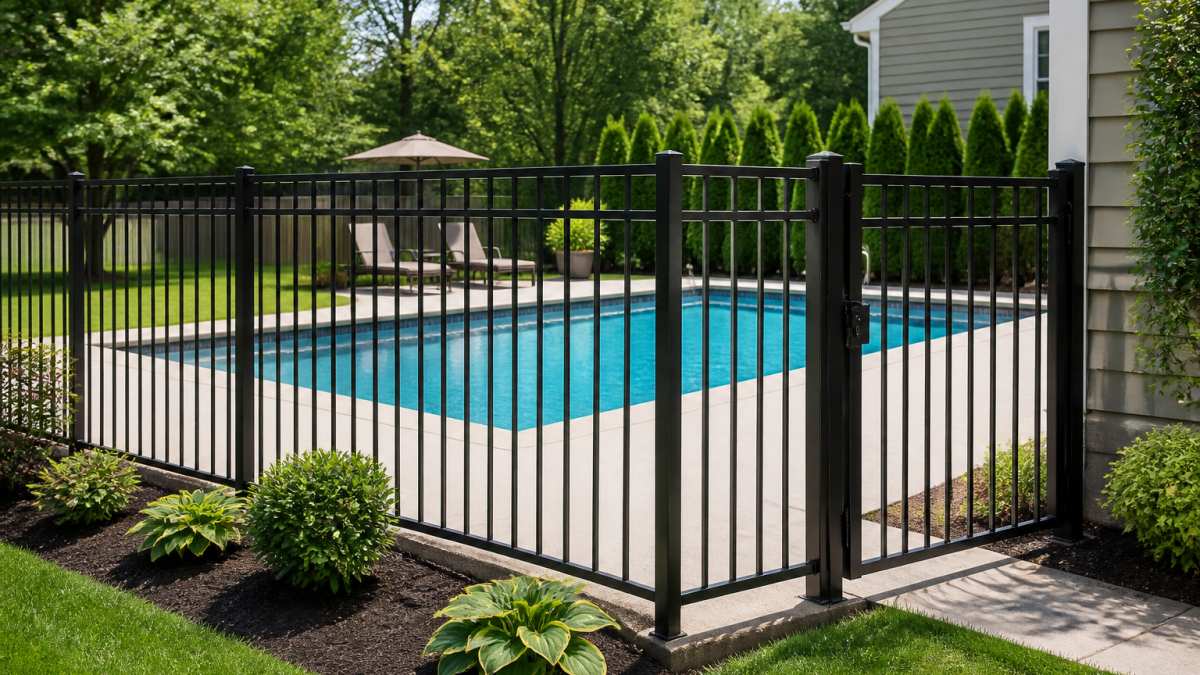
At Aluminum Fences Direct, we supply pre-assembled aluminum panels to homeowners who want to pass inspection without paying contractor labor. Aluminum resists rust, holds up to pool chemicals, and can be built to exact code specs.
But here is what most guides get wrong. A code-compliant design does not guarantee a passing inspection. Vanguard Aluminum Fences guidance on pool facts notes that even fences built to standard can fail if installation does not match local mounting and gate rules.
So the real question is not “is aluminum allowed?” It is “does my specific fence meet my specific code?”
BOCA Code and the 4-Inch Sphere Test
BOCA pool code is a set of safety standards many local building departments use as the basis for pool barrier rules. It sets the numbers inspectors check.
The most famous is the 4-inch sphere test. A 4-inch ball must not pass through any gap in the fence. According to Fence Workshop’s pool fence guidance, the maximum gap between pickets is 4 inches.
That single number decides whether a fence is safe or not.
What Local Code Enforcement Actually Checks
Inspectors look at more than picket spacing. They check height, gate hardware, ground clearance, and rail placement.
Every jurisdiction writes its own version of the rules. Pool Guard USA’s Texas pool fence requirements recognizes aluminum as a recommended barrier material alongside wrought iron and mesh.
That is why a fence that passes in one town can fail in the next one over.
Pool Fence Height Requirements: 48 Inches and Beyond
The pool fence height requirement in most codes is a 48-inch minimum, which is 4 feet. According to Ultra Fence pool fencing standards, 48 inches is the standard minimum height for a compliant residential pool barrier.
Standard aluminum panels come in 48-inch and 54-inch heights. The taller option helps if your local code or HOA asks for more.
Height gets measured from the finished ground, not the base of the post. A slope can quietly drop your fence below the minimum at one corner.
A fence that measures 48 inches at the gate can measure 44 inches on a downhill run. Inspectors check the lowest point, not the average. Set posts deep enough to keep the top rail level across the whole run.
Picket Spacing and Horizontal Rail Rules
Two measurements keep an aluminum pool fence compliant:
- Picket spacing: no gap wider than 4 inches, so a small child cannot slip through.
- Horizontal rail spacing: at least 45 inches between rails, so the fence cannot be climbed like a ladder.
Ultra Fence confirms the 45-inch rail rule for ornamental aluminum fences. It is the rule people forget, and the one that fails inspections most often.
Self-Closing Pool Gate Hardware That Passes Inspection
The gate is where most pool fences fail. Self-closing pool gate hardware must close and latch on its own, every time, without a push from you. Two features matter:
- Self-closing hinges that pull the gate shut from any open position.
- A self-latching mechanism that catches without help, placed high enough that a young child cannot reach it.
Gates must also open outward, away from the pool, so a child pushing on the gate cannot fall toward the water.
Test your latch by opening the gate just 2 inches and letting go. If it does not click shut on its own, it will fail inspection. Adjust the hinge tension before the inspector arrives, not after.
Aluminum Pool Fence Installation Cost: What Drives the Price
Aluminum pool fence installation cost depends on three things: the fence itself, the gate hardware, and who installs it.
Industry pricing data puts pool-code-compliant aluminum fencing at $48 to $82 per linear foot in 2026, per Fence My Pool’s cost breakdown. That figure covers materials and typical installation.
Here is what moves that number up or down:
| Cost Factor | What Changes | Effect on Price |
|---|---|---|
| Fence height | 48-inch vs. 54-inch panels | Taller panels cost more |
| Gate type | Standard vs. self-closing | Self-closing hardware adds cost |
| Installation | DIY vs. contractor | Labor can double the total |
| Layout | Flat vs. sloped ground | Slopes need more posts and labor |
| Finish | Standard vs. custom powder-coat | Custom colors add cost |
The biggest swing is labor. Installing the panels yourself can help reduce overall costs.
DIY Installation vs. Hiring a Contractor
Pre-assembled panels have made DIY pool fencing realistic for most homeowners: the panels arrive built, so you set posts, level the run, and hang the gates.
Hiring a contractor is the right call for steep slopes, complicated gates, or if you simply do not want the work; expect labor to be the largest single cost either way. A flat, straight run is a weekend job, while a sloped yard with custom angles is where it gets hard.
Retrofitting an Existing Fence to Meet Pool Code
Most pool fence content assumes you are starting from bare dirt. Plenty of homeowners already have a fence that is close to compliant, and the question is whether to fix it or replace it. That question starts with a triage.
Step 1: Triage the Existing Fence
Before you price a single retrofit part, sort your fence into one of three buckets. The bucket decides everything that follows.
Bucket A, Structurally sound and close to compliant. The fence is the right material, stands at or near the required height, and misses on hardware or spacing.
A quick test for Bucket A versus B: stand on the pool side and ask whether a determined four-year-old could get a foothold.
Step 2: Match the Fix to the Failure
Each retrofit fix below addresses a specific inspection failure. Match the fix to the failure, not the fence.
| Inspection failure | Retrofit fix | When it works | When it does not |
|---|---|---|---|
| Picket gaps over 4 inches | Add a secondary picket layer or a welded mesh panel behind the existing pickets | Existing pickets are sound and the frame can carry the added weight | Gaps are so wide the added layer looks like a separate fence, or the frame flexes under the load |
| Standard hinges that do not close the gate | Replace with self-closing hinges rated for the gate weight | Gate is square, the posts are solid, and the gate swings freely | Gate is sagging or out of square, self-closing hinges will not fix a binding gate |
| Gate latches but does not self-latch | Install a self-latching mechanism, or replace the latch assembly | The gate closes cleanly and the strike plate can be repositioned | The gate does not return to the same position every time |
| Latch release too low | Raise the latch or add a reach-restricting shield on the pool side | The gate frame allows a higher mounting point | The gate is a style that cannot accept a raised latch without a new frame |
| Climbable horizontal rails | Add a bottom rail to reduce the open space, or add climb-resistant mesh | The rail spacing is the only failure | The rails themselves are the ladder, mesh over them does not remove the foothold |
| Ground clearance too large at a low point | Add a bottom rail or a ground-level filler panel | The gap is localized to one section | The whole run follows a slope and needs re-posting |
Two fixes fail more often than the others.
Self-closing hinges on a binding gate. A self-closing hinge works by spring tension pulling the gate closed. If the gate binds on the post or drags on the ground, the spring loses that fight and the gate stops short of the latch.
Mesh over climbable rails. Mesh closes the picket gaps but does not remove the horizontal rails underneath. If the rails are the climbable feature, mesh is cosmetic, the footholds the inspector looks for are still there.
Step 3: Run the Cost Comparison Honestly
Retrofitting can be an option, but the cost comparison with replacement should be carefully considered. Price the retrofit parts and your time against a replacement panel run of the same length: if the retrofit lands above roughly half the cost of replacement and the existing fence is already in Bucket B, replacement is usually the better spend.
There is also a paperwork cost. A patched fence is harder to document, while a replacement comes with a manufacturer’s spec sheet stating the height, picket spacing, and rail spacing in writing, what an inspector and an insurer both want to see.
Retrofit only when the existing fence already meets the height and material rules. If it is too short or too climbable to fix without rebuilding the panel geometry, replacement may be a more straightforward solution.
Step 4: Get the Retrofit Inspected as a Barrier
A retrofit is a new barrier as far as the code is concerned. Treat it that way.
- Pull the permit before you start, the same as a new install. An unpermitted retrofit can fail at resale even if it passes inspection today.
- Have the finished fence inspected as a complete barrier, not a set of parts. The inspector tests the gate, measures the gaps, and checks the height at the lowest point, the same as a new fence.
- Keep the retrofit receipts and the inspection approval together. If the fence is ever questioned, that file is your evidence.
The retrofit decision is a triage, not a parts list. Sort the fence into Bucket A, B, or C first. Bucket A gets fixed. Bucket C gets replaced. Bucket B is a judgment call, and the honest answer is usually replacement once you price the fixes and the paperwork.
Your Final Compliance Checklist Before You Buy
Run this checklist before you order anything. It saves you a failed inspection and a second round of shipping.
- Confirm your local minimum height (48 inches is standard, but check)
- Verify picket gaps are 4 inches or less
- Check rail spacing is at least 45 inches apart
- Confirm gates are self-closing and self-latching
- Make sure gates open outward, away from the pool
- Measure ground clearance at the lowest point of the run
- Pull the permit before installation, not after
- Check your homeowner’s insurance for barrier requirements
- Keep your spec sheet for the inspector
That last point matters more than people think. A fence that fails code can leave you exposed on liability if an accident happens, compliance is about protecting your household and your coverage, not just passing inspection.
Conclusion
Pool code varies by town, and one wrong measurement can fail an inspection. Meeting the rules requires careful attention to details like height, picket gaps, rail spacing, and gate functionality.
Aluminum Fences Direct supplies 100% American-made aluminum fencing with a lifetime warranty, pre-assembled panels, and wholesale pricing shipped to your door. You get code-ready materials without the middleman markup.
Get a quote from Aluminum Fences Direct and build a pool fence that passes inspection the first time.
Frequently Asked Questions
What is the code for a fence around a pool?
Most residential pool codes require a minimum 48-inch height, a maximum 4-inch gap between pickets, and at least 45 inches of vertical space between horizontal rails to prevent climbing. Gates must be self-closing and self-latching, opening outward away from the pool. Your local municipality may add stricter rules, so always confirm with your building department before ordering materials.
Does aluminum fencing meet BOCA pool safety standards?
Yes. Aluminum fence panels are engineered to meet or exceed BOCA code requirements, including the 48-inch minimum height and 4-inch picket spacing. Aluminum is also corrosion-resistant, which matters near pool chemicals and splash zones. Check that your specific panels carry documentation confirming code compliance, and verify local amendments that may go beyond the base standard.
What are the downsides of aluminum fencing for a pool enclosure?
While aluminum fencing is known for being low-maintenance and rust-resistant, it can dent under heavy impact. Installation errors, such as improper post depth or gate alignment, can cause a code-compliant design to fail final inspection. While the initial cost may be higher than some alternative materials, its durability and long lifespan offer value.
How much is an aluminum pool fence?
The cost of pool-code-compliant aluminum fencing depends on factors such as height, style, and finish. Labor adds significantly if you hire a contractor. Request a quote from your supplier to get exact pricing for your layout and gate count.