
Table of Contents
- Best Aluminum Fence Brands for Homeowners: Quick Comparison
- Aluminum Fences Direct: American-Made Wholesale Leader
- Jerith Manufacturing: Premium Finish Technology
- Ameristar Fence Products: Security-Focused Design
- Residential vs Commercial Grade Aluminum Fence: What You Need to Know
- Aluminum Fence Installation Cost and DIY Aluminum Fence Kits
- Why Coating Quality and Assembly Design Matter More Than Price
- Conclusion
- Frequently Asked Questions
Last Updated: September 29, 2026
Best Aluminum Fence Brands for Homeowners: Quick Comparison
Choosing the right aluminum fence brand matters more than most homeowners realize. According to Aluminum-Fence.com’s 2026 market analysis, aluminum fencing costs between $25 and $45 per linear foot for residential installations. But price alone tells you almost nothing about what you’re actually getting.
Most guides compare brands by appearance and price, but the real difference is coating quality and assembly design, factors that determine whether a fence fails in five years or lasts thirty.
Quick Picks:
- Best Overall: Aluminum Fences Direct, American-made wholesale pricing with lifetime warranty
- Premium Finish: Jerith Manufacturing, industry-standard coating technology for lasting durability
- Security-Focused: Ameristar Fence Products, strong structural design for residential protection
- Modern Aesthetics: Sleek Fence, contemporary slat designs with rapid installation systems
Aluminum Fences Direct: American-Made Wholesale Leader
Aluminum Fences Direct eliminates the middleman, offering wholesale pricing on 100% American-made, pre-assembled fences that cut installation time significantly.
The lifetime warranty on all materials and finishes is rare in this market and signals confidence in the engineering and coating process.
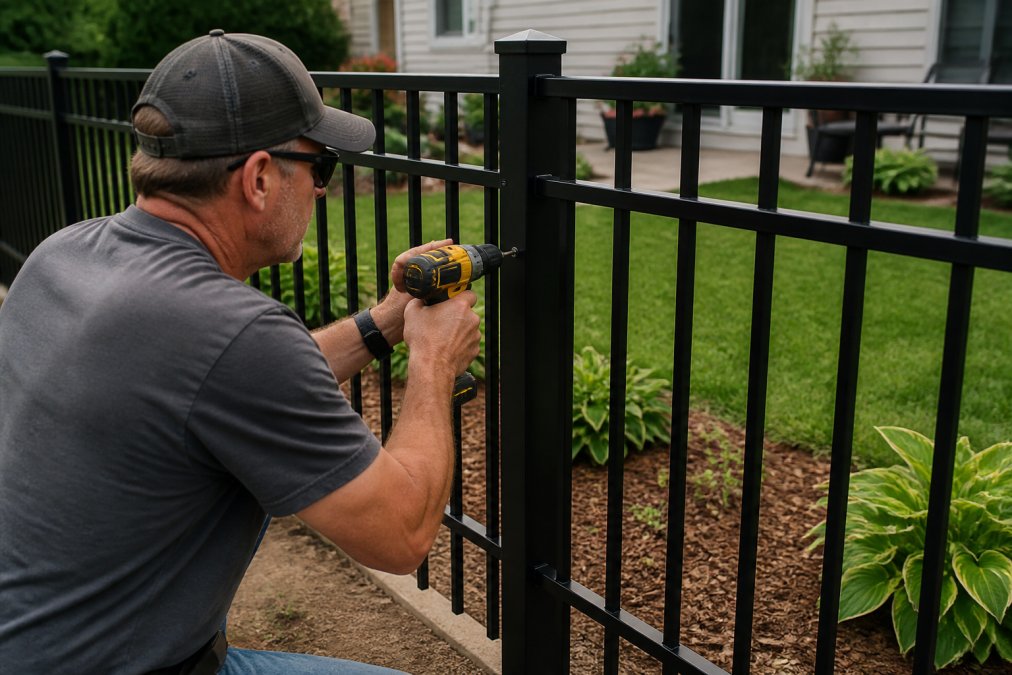
Panels arrive ready to install with no cutting, welding, or field assembly.
Customization options include picket spacing (critical for pool code compliance), rail height, and rackable panels that adjust to ground grade without gaps.
Jerith Manufacturing: Premium Finish Technology
Jerith’s FencCoat finish technology is an industry standard for quality benchmarks.
Jerith’s powder-coated finish resists UV degradation; after five years, panels maintain gloss and color retention comparable to two-year-old panels from lesser manufacturers.
Jerith excels in ornamental styles with hidden fasteners for seamless appearance, ideal for homeowners prioritizing curb appeal.
Jerith requires local distributor ordering with regional pricing variation and typically needs professional installation.
Homeowners prioritizing long-term finish durability and aesthetic variety who don’t mind paying a premium for established brand reputation and are willing to hire professional installers.
Ameristar Fence Products: Security-Focused Design
Ameristar’s Echelon line uses PermaCoat powder coating and ForeRunner rail design to withstand coastal and high-wind environments.
Ameristar uses 6063-T6 aluminum alloy with thicker extrusions and tighter tolerances, handling wind loads that would flex lighter-gauge alternatives.
Ameristar panels meet BOCA standards and pool code compliance with self-closing hinges and mag-latch systems.
Bolted connections allow field adjustment for uneven terrain without replacing entire sections.
Ameristar’s weakness: their panels typically require professional installation. The structural rigidity means panels are heavier than lightweight alternatives, and proper alignment demands experience. DIY installation is possible but challenging for first-time fence builders.
Residential vs Commercial Grade Aluminum Fence: What You Need to Know
The distinction between residential and commercial grade comes down to material thickness, fastener quality, and coating durability. Understanding this difference prevents buying overkill or undersizing your project.
Residential-grade aluminum uses thinner extrusions (0.080-0.100 inches) and is adequate for property boundaries, pet enclosures, and pool fencing.
Commercial-grade uses heavier extrusions and multi-layer coating, costing 30-50% more and is overkill for most homeowners.
The real question: what’s your actual use case? A pet enclosure requires different specifications than a high-traffic pool area. Spherical Insights’ 2026 aluminum fencing market analysis identifies residential-grade specifications as the sweet spot for 85% of homeowner applications.
Pool fencing demands specific picket spacing (typically 4 inches maximum) and gate compliance. Check your local building department requirements before ordering. Some jurisdictions require 6-inch spacing for certain pool configurations. This affects which brands offer compliant panels without custom fabrication.
Ordering the wrong grade creates two problems: residential-grade panels in a high-traffic commercial setting will deteriorate faster, and commercial-grade in a residential setting wastes money on features you won’t use. Verify your actual requirements before selecting a brand.
How Terrain and Soil Type Affect Your Aluminum Fence Selection
Terrain complexity is the hidden variable that determines both installation difficulty and long-term performance. Most homeowners underestimate how slope, soil composition, and drainage patterns impact fence durability and installation cost.
Sloped yards require rackable panels that adjust to ground grade. If your property slopes more than 10 degrees, confirm your brand provides rackable panels before ordering.
Rocky soil requires shallower footings (18-24 inches); clay soil retains water and accelerates corrosion. Ensure posts are set in concrete with adequate drainage. Ask manufacturers for soil-type recommendations.
High water table or poor drainage accelerates corrosion. Specify stainless steel fasteners and gravel-base drainage; clarify upfront whether manufacturers charge extra.
Uneven terrain with multiple grade changes may require stepped sections. Request a site survey from your manufacturer before ordering.
Before contacting manufacturers, walk your property line with a level and note the elevation change. Measure the slope in feet of rise per 100 feet of run. Slopes under 10 degrees are manageable with standard rackable panels; slopes over 15 degrees may require stepped sections or professional installation. This information helps manufacturers recommend the right panel configuration and cost estimate.
Freeze-thaw cycles stress fasteners and connections. Bolted assembly allows seasonal tightening; riveted connections don’t and may develop rattle.
Terrain and soil type are as important as brand selection. Request detailed installation guidance specific to your property conditions.
Aluminum Fence Installation Cost and DIY Aluminum Fence Kits
The installation cost difference between DIY and professional installation is substantial. Hiring a contractor typically costs $50-100 per linear foot in labor alone. For a 100-linear-foot project, that’s $5,000-10,000 in labor costs before materials.
DIY kits eliminate labor costs but require 20-40 hours of work, or 4-6 hours per 100 linear feet.
What makes DIY feasible: pre-assembled panels and hidden fastener systems. You’re not welding or cutting aluminum. You’re connecting pre-fabricated sections using bolts and brackets. The skill barrier is lower than traditional fence installation.
The material cost for DIY kits ranges widely based on customization and brand. Contact Aluminum Fences Direct for quotes tailored to your project specifications.
Ground preparation is the real wildcard. If your property has significant slope, rocky soil, or clay that requires excavation, costs rise. Some DIYers rent post-hole diggers ($40-60 per day) or hire help for the foundation work while handling panel assembly themselves. This hybrid approach splits the difference between full DIY and professional installation.
| Installation Method | Material Cost | Labor Cost | Total | Timeline |
|---|---|---|---|---|
| Full DIY with kit | $2,500-5,000 | $0 | $2,500-5,000 | 20-40 hours |
| Hybrid (DIY + foundation help) | $2,500-5,000 | $500-1,500 | $3,000-6,500 | 15-25 hours |
| Professional installation | $2,500-5,000 | $5,000-10,000 | $7,500-15,000 | 3-5 days |
Long-Term Cost of Ownership: Aluminum vs. Wood and Vinyl
Upfront cost is only half the story. Homeowners comparing aluminum to wood or vinyl fencing need to understand the 10-year and 20-year total cost of ownership, which is where aluminum’s true value emerges.
Wood fencing ($15-30 per linear foot installed) requires staining or sealing every 2-3 years at $1-3 per linear foot, plus board replacement every 5-8 years as rot and weathering compromise structural integrity. A 100-linear-foot wood fence costs roughly $2,000-3,000 initially, then $200-600 annually in maintenance. Over 20 years, total cost reaches $6,000-15,000 including two or three full replacements.
Vinyl fencing ($20-40 per linear foot installed) has minimal maintenance but is vulnerable to UV fading and brittleness in cold climates. Vinyl panels rarely last beyond 15 years in harsh weather. A 100-linear-foot vinyl fence costs $2,500-5,000 upfront with negligible annual maintenance, but replacement after 15 years adds another $2,500-5,000.
Request a maintenance schedule from your aluminum fence manufacturer. Brands confident in their coating durability will provide specific guidance on cleaning frequency and inspection intervals. This data helps you forecast long-term costs accurately.
One caveat: this analysis assumes residential-grade aluminum with quality powder coating. Budget aluminum brands with single-layer coatings may degrade faster and require recoating after 10-15 years, which costs $5-15 per linear foot and narrows the long-term advantage over vinyl.
Why Coating Quality and Assembly Design Matter More Than Price
Here’s where most homeowners make expensive mistakes. YouTube’s 2025 aluminum fence buying guide emphasizes that many bids for aluminum fencing appear identical on paper, but performance differences are rooted in coating quality and assembly design.
Request coating specifications and application method before ordering. Ask specifically about primer type, base coat thickness, and topcoat durability. Brands confident in their process will provide detailed technical data. Vague answers are a red flag.
Conclusion
The best aluminum fence brands for homeowners balance three factors: coating durability, assembly design, and installation accessibility. Aluminum Fences Direct leads because it combines American-made quality with wholesale pricing and pre-assembled panels that reduce DIY complexity. The lifetime warranty and customization options address the most common homeowner concerns: longevity and terrain compatibility.
Frequently Asked Questions
Are there different grades of aluminum fencing?
Yes. Residential-grade aluminum fence is designed for standard backyard use, pool enclosures, and pet containment with lighter-duty construction. Commercial-grade aluminum fence features heavier rail designs, increased tensile strength, and enhanced security features for high-traffic areas and perimeter protection. Residential grade typically uses 6063-T6 aluminum alloy with standard powder-coating finishes, while commercial applications demand thicker wall sections and advanced coating systems. Your choice depends on your property’s use case and local building codes.
What is the typical aluminum fence installation cost?
Industry pricing ranges from $25 to $45 per linear foot for materials, depending on style, height, and coating quality. Installation labor adds significantly to this cost when hiring professionals. DIY aluminum fence kits eliminate labor expenses entirely, allowing homeowners to save thousands by assembling pre-manufactured panels themselves. Total project cost depends on your fence length, terrain complexity, and whether you choose wholesale direct-to-consumer options or local retailer pricing. Contact Aluminum Fences Direct for a custom quote based on your specific requirements.
Why should I choose aluminum fence over steel or wrought iron?
Aluminum offers superior corrosion resistance without rusting, requires zero maintenance compared to steel’s regular painting, and weighs significantly less for easier installation. Wrought iron delivers ornamental beauty but demands constant upkeep to prevent rust and degradation. Aluminum maintains its finish indefinitely with powder-coating technology, provides better weather-resistant performance, and costs substantially less over the fence’s lifetime. For DIY homeowners, aluminum’s lightweight construction makes self-installation feasible, while steel and wrought iron typically require professional help.
Do aluminum fence panels meet pool code compliance requirements?
Many aluminum fence brands offer pool-code compliant options that meet BOCA standards and ASTM testing requirements for picket spacing, rail height, and gate specifications. Picket spacing typically must not exceed 4 inches to prevent child entrapment. Before purchasing, verify that your chosen brand’s specific panels meet your state’s pool fencing regulations, as requirements vary by jurisdiction. Aluminum Fences Direct can help you select panels that satisfy local codes and pass inspection.