
Table of Contents
- Quick Comparison: Top Aluminum Fence Panels for Pets
- What to Look for in Pet-Safe Aluminum Fence Panels
- Puppy Picket Aluminum Fence: What It Is and Who Needs It
- Choosing the Right Aluminum Fence Height for Dogs
- DIY Aluminum Fence Installation: Stepped vs. Racked Panels
- Powder Coating, Maintenance, and Long-Term Durability
- Top Aluminum Fence Panels for Pets
- Which Aluminum Fence Panel Is Right for Your Pet?
- Frequently Asked Questions
Last Updated: September 10, 2026
Quick Comparison: Top Aluminum Fence Panels for Pets
The best aluminum fence panels for pets balance three things: picket spacing tight enough to prevent escape, height matched to your dog’s jump, and a coating that survives weather and scratching.
This guide from Aluminum Fences Direct breaks down the specs that keep dogs contained, then compares five options.
| Product | Starting Price | Picket Spacing | Best For |
|---|---|---|---|
| Aluminum Fences Direct Residential Pet-Safe Panels | $125 per panel | Pet-specific options | DIY homeowners wanting wholesale pricing |
| Fence Depot Aluminum Pet Fencing | Quote-based | Standard with rounded pickets | Owners prioritizing injury prevention |
| Onguard Aluminum Fencing | Quote-based | Multiple spacing options | Buyers who want a proven brand |
| Titan Fence Aluminum Pet Solutions | Quote-based | Closely spaced | HOA-restricted communities |
| Amazon Basics Garden/Pet Barrier Panels | $40-$60 per set | Modular | Small pets, temporary containment |
What to Look for in Pet-Safe Aluminum Fence Panels
A pet-safe aluminum fence panel is a pre-assembled section of aluminum pickets and rails with spacing and height that prevent dogs from squeezing through, digging under, or jumping over. Two specs decide whether it works: the aluminum grade and the picket gap.
Residential vs. Commercial Grade Aluminum
Residential grade aluminum handles the pressure an active dog puts on a panel. Commercial grade uses thicker rails and posts for high-traffic public spaces, costing more without adding much for a typical yard.
For most pet owners, residential grade is the right call.
Picket Spacing and Small Dog Safety
Picket spacing is the distance between vertical bars, and it determines whether a small dog stays in. A gap wide enough for a dog’s head but not its shoulders is a strangulation risk, not just an escape route (avma.org).
Standard decorative spacing runs wider than most small breeds need. Look for pet-specific spacing on anything under 20 lbs, and measure your dog’s shoulders, not chest, before ordering.
Ordering standard decorative spacing for a puppy under 15 lbs is a common mistake. Puppies grow, but the fence doesn’t, and a dog that fits through at 8 weeks may still squeeze through at 8 months if the gap is wrong.
Puppy Picket Aluminum Fence: What It Is and Who Needs It
A puppy picket aluminum fence is a panel with narrower picket spacing, designed to keep small and young dogs from slipping through. It’s the same aluminum construction as a standard panel, just tighter.
Who needs it? Anyone with a dog under roughly 20 lbs, a puppy of any breed, or a breed known for squeezing through tight spaces. If your dog’s shoulders are wider than the gap, standard spacing works fine; if not, puppy picket is worth the small upcharge.
The trade-off is visual. Tighter spacing reads as a more solid barrier, which some homeowners prefer and some HOAs restrict. Check your community guidelines before ordering.
Choosing the Right Aluminum Fence Height for Dogs
Aluminum fence height for dogs comes down to jump capability, not breed size. A 36-inch fence contains most small and medium breeds, 48 inches handles most large dogs, and 60 inches or taller is for known jumpers and climbing breeds (akc.org).
But height is only half the spec. The other half is picket spacing, and the two must be chosen together. A 48-inch panel with wide spacing holds a Labrador and loses a Chihuahua; a 36-inch panel with tight spacing does the reverse.
| Dog Size | Example Breeds | Minimum Height | Picket Spacing |
|---|---|---|---|
| Under 15 lbs | Chihuahua, Yorkie, Maltese | 36 in | 1.5 in or tighter (puppy picket) |
| 15-25 lbs | Beagle, Corgi, Shih Tzu | 36-42 in | 2 in or tighter |
| 25-60 lbs | Border Collie, Boxer, Aussie | 48 in | Standard (3.75-4 in) is fine |
| 60-90 lbs | Labrador, German Shepherd | 48-60 in | Standard |
| Over 90 lbs or known jumpers | Malinois, Husky, Greyhound | 60-72 in | Standard, plus lean-in top |
| Climbers and escape artists | Husky, Malamute, Coonhound | 72 in | Standard, plus roller bar or coyote roller |
- Jump height is not fence height. A dog that clears 48 inches from a running start may not from a standstill. Measure from a standing start and add 6 inches of buffer.
- Climbing is separate from jumping. Breeds with strong rear-leg drive and paw dexterity (Huskies, Malamutes, some Shepherds) climb a picket fence like a ladder. Height alone won’t stop them, a lean-in top, roller bar, or smooth top rail does.
- Digging is a third problem. A dog that can’t jump a 48-inch panel will tunnel under a bottom rail sitting on the ground. Pair height with a bottom rail close to grade, a buried rail, or a dig-proof add-on.
- HOA rules can cap your height. Many communities limit front-yard fencing to 48 inches and side or rear to 72. Confirm the cap before ordering a panel you can’t legally install.
Measure your dog’s jump from a standing start, not a running one, and add 6 inches of buffer. Then measure the widest point of the dog’s shoulders, not the chest, and compare that to the picket gap. Both numbers have to pass before the panel is right.
If your dog is a known jumper or climber, budget for the taller panel and anti-climb top from the start, retrofitting costs more.
DIY Aluminum Fence Installation: Stepped vs. Racked Panels
DIY aluminum fence installation on sloped ground comes down to two panel types: stepped and racked. Stepped panels follow the slope in stair-step increments, each section level. Racked panels pivot at the rails so pickets follow the grade at an angle.
Stepped suits steep or uneven ground where you want each section level. Racked suits gentle, consistent slopes and keeps the top rail parallel to the ground. Most yards need a mix.
DIY vs. Professional Installation: Cost and Time
DIY installation saves the labor line item, the single biggest cost in a fence project. A contractor charges for crew time, travel, and materials markup; installing pre-assembled panels yourself removes all three.
The trade-off is your weekend. A typical backyard takes a full weekend for a first-timer, longer with slopes or gates. Panels arrive pre-assembled, so the work is layout, post-setting, and hanging gates.
Pre-assembled panels are what make DIY realistic for a first-timer. If you’re cutting and welding pickets on site, hire a pro. If the sections arrive ready to set, you can handle it.
Powder Coating, Maintenance, and Long-Term Durability
Powder coating is a dry finish baked onto the aluminum that keeps a fence looking new for decades (the EPA). It resists chipping, fading, and rust far better than paint, and needs no repainting.
Maintenance is close to zero: rinse once or twice a year and wipe off bird droppings or tree sap before they bake on. Aluminum doesn’t rot, and a powder-coated finish doesn’t rust, even in coastal air.
Durability comes down to the alloy and coating together. A high-strength alloy with a proper powder coat holds structural integrity through freeze-thaw cycles and summer heat, which is why a lifetime warranty is realistic on quality panels and not bargain ones.
Top Aluminum Fence Panels for Pets
Five panels make this list, ranked by how well they handle real dogs, yards, and budgets.
Aluminum Fences Direct Residential Pet-Safe Panels
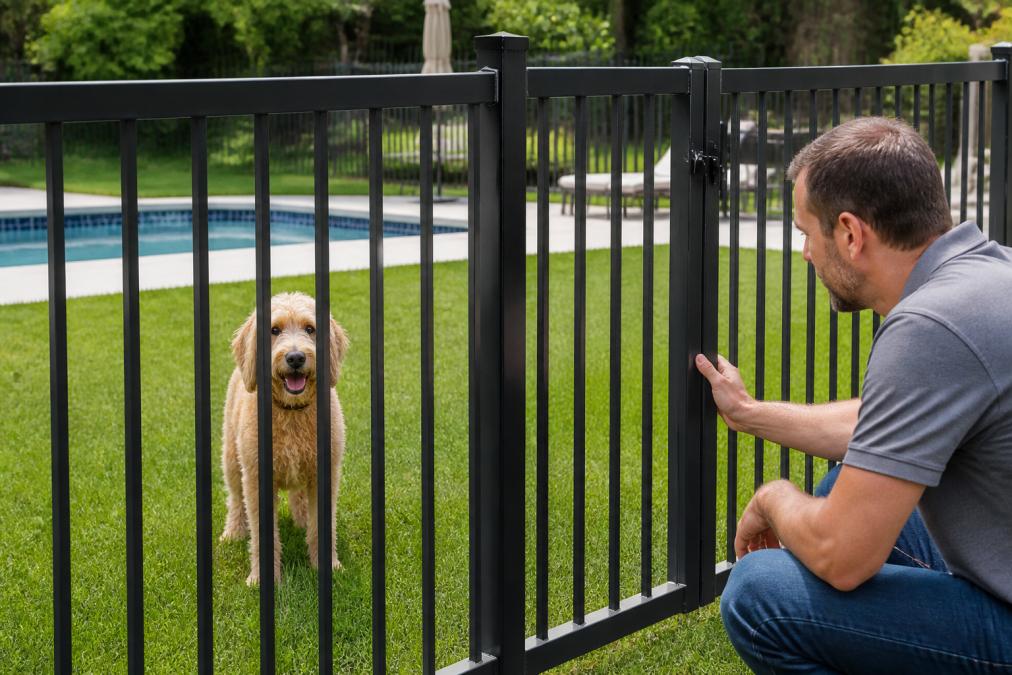
Our top pick for most pet owners: 100% American-made aluminum panels with pet-specific spacing options, pre-assembled for DIY installation. Residential grade construction is durable, and panels come in heights from 36 to 72 inches.
The powder coating resists rust and chipping, and every fence carries a lifetime warranty. Pricing depends on quantity, dates, and delivery, direct-from-distributor, no middleman or contractor markup. The one drawback: you install it yourself, so budget a weekend.
DIY homeowners who want American-made materials, pet-specific spacing, and wholesale pricing without a contractor in the middle.
Fence Depot Aluminum Pet Fencing
Fence Depot’s pet fencing stands out for rounded picket points. If your dog runs the fence line or jumps at the rails, rounded tops reduce puncture injury risk. The aluminum is rust-proof and rated for an estimated 20 to 30-year lifespan.
Pricing requires a custom quote, which slows comparison shopping. A solid pick if injury prevention is your top priority.

Onguard Aluminum Fencing
Onguard is a high-volume residential brand with a strong distributor reputation. Panels use a high-strength aluminum alloy and offer multiple picket spacing options to dial in containment for your dog’s size. Gate hardware compatibility is broad, which matters if you’re adding a self-closing latch.
The catch is availability: Onguard sells through regional distributors, so stock and lead times vary. Confirm inventory before committing.
Titan Fence Aluminum Pet Solutions
Titan solves a specific problem: containing pets while satisfying strict HOA visibility rules. Pickets are closely spaced to prevent squeeze-through, but the design stays open enough to pass architectural review in most communities.
The limitation: Titan leans service-based, so DIY options are narrow. Ask upfront whether they’ll sell panels only.
Amazon Basics Garden/Pet Barrier Panels
For small pets or temporary containment, these modular panels are hard to beat on price. At 33 inches tall with a rustproof coating and a stake system, they go up in minutes with no tools.
They are not a permanent fence. At 33 inches they won’t hold a large or high-jumping dog, and the stake system isn’t built for a dog that leans. Use them for a puppy play area or garden border, not perimeter security.

Which Aluminum Fence Panel Is Right for Your Pet?
Match the panel to your dog, not the lowest price. A 36-inch panel with standard spacing is wasted on a 70-lb jumper, and a 72-inch commercial-grade fence is overkill for a 10-lb lap dog.
- Dog under 20 lbs: Pet-specific or puppy picket spacing (1.5-2 in), 36-48 inches tall, bottom rail close to grade
- Dog 20-60 lbs: 48 inches, standard spacing, bottom rail close to grade
- Dog over 60 lbs or a known jumper: 60-72 inches, plus dig-proof add-ons
- Climbers (Husky, Malamute, Coonhound): 72 inches, plus a lean-in top or roller bar
- HOA community: Titan or a closely spaced panel that passes architectural review
- Temporary or budget setup: Amazon Basics panels for small dogs only
Escape-Proofing Accessories That Actually Matter
The panel is the foundation, but accessories stop a determined dog. Budget for these add-ons, roughly in order of how often they solve a real escape problem:
- Dig guards (bottom-rail extensions). A galvanized or powder-coated L-bracket bolted to the bottom rail, extending 12-18 inches into the ground at 90 degrees. A digging dog hits the horizontal plate and stops. The single most effective add-on for diggers, and far cheaper than a concrete footer.
- Self-closing, self-latching gate hardware. A standard latch is a suggestion, not a barrier. A self-closing hinge with a magnetic or gravity latch means the gate can’t be left open by a kid, delivery driver, or gust of wind. Look for hardware rated for the gate weight and adjustable for post sag.
- Bottom-rail extensions for gap-prone grades. On sloped ground, a racked panel can leave a triangular gap at the low corner. An extension closes it without re-engineering the panel.
- Corner and end post reinforcement. Dogs push at corners and gates first. A thicker wall post at corners and gate posts (end or terminal posts) resists the leverage a large dog generates.
- Anti-climb tops. A lean-in section angled toward the yard, or a roller bar that spins when a paw grabs it, defeats climbing breeds. Typically bolt-on additions to a standard panel.
DIY vs. Professional Installation: The Real Cost-Benefit
The answer depends on your slope, gate count, and tolerance for a weekend of digging.
DIY makes sense when:
- Your ground is level or gently sloped (racked panels handle it)
- You have two or fewer gates
- You’re comfortable with a post-hole digger and mixing concrete
- You can dedicate a full weekend to layout, post-setting, and gate hanging
Hiring a pro makes sense when:
- Your yard has significant grade changes needing stepped panels and custom post heights
- You need more than three gates or a double-drive gate
- You have irrigation, gas lines, or tree roots in the fence line
- You want the work warrantied by a single party
The cost math: DIY removes the labor line item, typically the largest single cost in a fence project. A contractor charges for crew time, travel, and materials markup; installing pre-assembled panels yourself removes all three. The trade-off is your weekend and the risk of a post set out of plumb.
Pre-assembled panels are what make DIY realistic for a first-timer. If you’re cutting and welding pickets on site, hire a pro. If the sections arrive ready to set, you can handle it. Budget for dig guards and self-latching gate hardware from the start, not as an afterthought.
Installing Around Landscaping Without Killing It
A fence line cutting through a garden bed or tree root zone is a common pain point most product pages ignore. A few rules:
- Keep post holes at least 3 feet from a mature tree trunk. Cutting major roots within that radius can destabilize and kill the tree over the next few seasons.
- Reroute the fence line around established beds rather than through them. A small jog costs one extra panel and saves a decade of plant growth.
- Hand-dig near irrigation and gas lines. Call 811 before digging anywhere, and hand-dig the last 12 inches near any marked utility.
- Set posts in concrete, not tamped soil, in heavily watered beds. Saturated soil shifts posts over time, and a leaning post pulls the whole panel out of alignment.
For most pet owners who want a permanent, low-maintenance fence at wholesale pricing, Aluminum Fences Direct is the pick. The panels are American-made, pre-assembled, backed by a lifetime warranty, and shipped directly to your site, which makes the DIY route realistic in the first place.
Frequently Asked Questions
Are aluminum fence panels safe for dogs?
Yes, when specified correctly. The main safety factors are picket spacing and top design. Standard 3-7/8 inch spacing can let small dogs squeeze through, so look for puppy picket panels with 1-5/8 inch or 2 inch spacing. Rounded or smooth top rails reduce injury risk for dogs that jump. Powder coated aluminum has no sharp edges and does not splinter like wood, making it a safe, durable containment choice.
What is a puppy picket fence and why do I need one?
A puppy picket aluminum fence adds extra pickets in the lower section, typically 12 to 24 inches up from the bottom rail, to close the gaps between standard pickets. This prevents small dogs and puppies from squeezing through or getting their heads stuck. If your dog weighs under 25 pounds or is a puppy, puppy picket spacing is the single most important spec to get right.
How tall should an aluminum fence be to keep my dog contained?
Match fence height to your dog’s jump. Small breeds under 15 inches tall do well with 36 to 42 inch fencing. Medium dogs usually need 48 inches. Large or athletic breeds that jump should have 54 to 60 inches. For dogs that climb, add a smooth top rail or angled top. When in doubt, go one height step taller than your dog’s standing height plus jump estimate.
Can aluminum fence panels be installed on uneven terrain?
Yes. Stepped installation sets each panel level and steps the fence down a slope, which works well on grades over 10 degrees. Racked installation angles the pickets to follow the slope for a smooth look on gentle grades. Most pre-assembled panels from wholesale suppliers can be racked or stepped in the field. Tell your supplier about your slope before ordering so panels arrive with the right hardware.
What are the downsides of aluminum fences for pets?
Aluminum is not chew-proof, so determined diggers or chewers may still test it. Standard picket spacing is too wide for small dogs without a puppy picket upgrade. Aluminum also offers less privacy than wood or vinyl. On the plus side, it does not rust, rot, or need repainting, and residential grade panels are durable, which handles most dogs pressing or jumping against them.