
Table of Contents
- Why Material Choice Matters for Pool Safety
- Quick Comparison of Pool Fence Materials
- 1. Aluminum: The Permanent, Maintenance-Free Choice
- 2. Removable Mesh: The Flexible Safety Barrier
- 3. Glass: Unobstructed Views with Tempered Safety
- 4. Wood: Traditional Privacy at a Lower Cost
- 5. Vinyl: The Easy DIY Option for Pool Areas
- 6. Wrought Iron: Classic Strength with Higher Maintenance
- 7. Aluminum-Mesh Hybrid: Combining Permanence and Flexibility
- Installation Considerations and Safety Risks
- Climate and Smart Home Integration
- Making the Right Choice for Your Family
- Frequently Asked Questions
Last Updated: September 5, 2026
Why Material Choice Matters for Pool Safety
Drowning remains a leading cause of unintentional injury death for young children, and a compliant fence is your first line of defense (the CDC). The material you choose determines not just aesthetics, but how effectively the barrier prevents climbing, resists weathering, and stands up to daily use. At Aluminum Fences Direct, we evaluate pool fence materials against ASTM safety standards, climb resistance, and long-term durability, not just curb appeal.
A pool fence is one part of a complete layer of protection. The U.S. Consumer Product Safety Commission pool safety guidelines recommend a fence at least 4 feet high with vertical spacing that prevents a child from squeezing through or gaining a foothold. Mesh, metal, and glass all meet this baseline, but they differ sharply in maintenance, visibility, and whether they remain effective as children grow.
Before comparing options, know your local building code requirements. Many municipalities enforce specific height, gate, and latch rules, so confirm compliance before purchasing any material. The right choice balances safety, budget, and how the fence integrates with your yard. Below, we break down seven materials, starting with the most permanent and low-maintenance solution.
Quick Comparison of Pool Fence Materials
Selecting the right fence comes down to weighing durability against flexibility, and cost against maintenance. The table below summarizes how each material performs across the criteria that matter most for child safety and homeowner satisfaction.
| Material | Best For | Maintenance Level | Climb Resistance | Key Tradeoff |
|---|---|---|---|---|
| Aluminum | Permanent, code-compliant safety | None | High (vertical pickets) | Not removable |
| Removable Mesh | Temporary barriers, renters | Low | High (tension-based) | Requires pro tensioning |
| Glass | Unobstructed supervision | Moderate (cleaning) | Very High (smooth) | Highest cost |
| Wood | Privacy on a budget | High (sealing/staining) | Moderate | Splinters, weathering |
| Vinyl | Quick DIY projects | Low | Moderate | Less strong than metal |
| Wrought Iron | Classic, heavy security | High | High | Rust risk |
| Aluminum-Mesh Hybrid | Full-time safety + flexibility | Low | High | Limited availability |
This listicle focuses on the top six materials plus a hybrid option, giving you a complete picture of the tradeoffs. For most homeowners seeking a permanent, maintenance-free barrier, aluminum is the strongest contender, which we examine first.
1. Aluminum: The Permanent, Maintenance-Free Choice
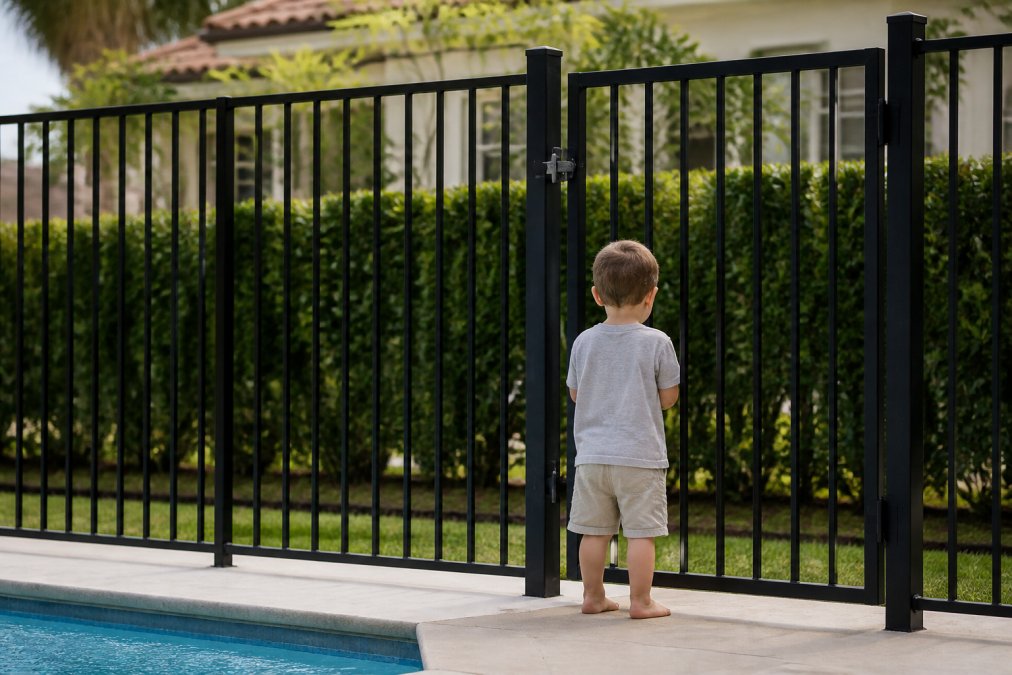
Aluminum fencing is the best all-around pool fence material for homeowners who want a permanent, code-compliant barrier that never needs painting or sealing. Its powder-coated finish resists rust and corrosion, making it ideal for the harsh, wet environment around a pool. Vertical pickets with tight spacing create a non-climbable surface that meets standard pool safety height requirements.
Our top pick is Aluminum Fences Direct because they supply 100% American-made, pre-assembled panels designed for straightforward DIY installation. This direct-to-consumer wholesale model eliminates the middleman, letting you save thousands compared to contractor quotes. Every fence is backed by a lifetime warranty, which signals confidence in the material’s durability over decades of exposure to sun, chlorine, and weather.
Aluminum’s combination of zero maintenance, vertical climb resistance, and a lifetime warranty makes it a cost-effective permanent safety barrier over a long horizon.
The one limitation is that aluminum is not removable. If you want to open up the pool area for adult gatherings, you will need a separate gate or a secondary access point. For year-round protection of toddlers and pets, however, nothing beats its durability and compliance with pool fence safety requirements.
2. Removable Mesh: The Flexible Safety Barrier
Removable mesh pool fencing offers a flexible, temporary barrier that can be taken down when the pool is in active use. These systems use high-strength, tear-resistant mesh stretched between corrosion-resistant poles. The tension-based design creates a surface that is difficult for toddlers to climb, and the mesh is UV-resistant to prevent sun damage over time.
The primary advantage of mesh is its ability to provide an active safety layer without a permanent visual or physical barrier. Families with young children often install mesh for the toddler years, then remove it once kids can swim or when adults want unobstructed access. This makes mesh a popular choice for renters or those who want to preserve an open backyard aesthetic.
Mesh fences rely on correct tension for their climb resistance. Improperly tensioned panels can sag, creating footholds for a determined child. Professional installation is strongly recommended to meet safety standards.
The tradeoff is visibility. While some mesh is transparent, it still reduces the clear sightline you get with glass or aluminum. For a permanent-feel option that stays up year-round, a high-tension mesh from a specialized brand can work, but it generally costs more than basic temporary fencing.
3. Glass: Unobstructed Views with Tempered Safety
Glass pool fencing delivers the clearest sightline of any material, allowing parents to supervise the pool from anywhere in the yard without a visual barrier. Panels are made from tempered safety glass, which is impact-resistant and shatters into small, blunt pieces if broken, reducing injury risk. The smooth, frameless surface offers no footholds, making it exceptionally difficult for children to climb.
This material is the premium choice for high-end aesthetics. It does not block views of the pool or landscaping, and it can make a small yard feel larger. Corrosion-resistant hardware and self-closing gates are standard, ensuring the fence meets the same safety standards as metal options.
The drawbacks are significant: glass is the most expensive option and requires professional installation due to the weight and precision needed for mounting. It also demands regular cleaning to remove water spots, smudges, and debris that obscure the very view you paid to preserve. For homeowners prioritizing aesthetics and unobstructed supervision above all, glass is unmatched.
4. Wood: Traditional Privacy at a Lower Cost
Wood fencing offers a classic, natural look at a lower upfront material cost than metal or glass. For pool safety, the key is to use vertical slats with spacing narrow enough to prevent a child from squeezing through or gaining a climbing foothold. Solid privacy panels also block the pool from view, which some homeowners prefer for security.
The appeal of wood is its affordability and customizability. It can be stained to match a home’s exterior, and it provides a solid barrier that feels substantial. For DIY homeowners, wood is a familiar material to work with, and repairs are straightforward.
Wood requires the most maintenance of any material. It must be stained or sealed every few years to prevent rot, warping, and splinters. A weathered board can develop sharp edges or gaps that compromise both safety and appearance.
Where wood falls short is its long-term durability in a pool environment. Constant moisture and chlorine exposure accelerate decay, and the fence’s structural integrity depends on diligent upkeep. When comparing cost over a 15-year period, the maintenance labor and replacement boards often make wood more expensive than a maintenance-free aluminum fence.
5. Vinyl: The Easy DIY Option for Pool Areas
Vinyl fencing is a lightweight, low-maintenance option that appeals to DIY homeowners seeking a quick installation. Panels are typically made from extruded PVC and feature a smooth, splinter-free surface. Many systems snap together without specialized tools, making them an accessible weekend project.
Vinyl does not rot, rust, or require painting, which gives it a maintenance advantage over wood. It is also available in a range of styles, including picket designs with vertical spacing that can meet pool safety requirements. For a semi-permanent barrier that is easy to install and remove, vinyl kits offer a practical middle ground.
The main weakness is structural robustness. Lightweight vinyl is not as strong as aluminum or mesh under impact, and extreme heat can cause warping over time. A child leaning or pushing against the panels may create gaps. Vinyl suits homeowners who want a neat, low-cost perimeter, but for rigorous, year-round child safety, a metal or professionally tensioned mesh fence is a stronger choice.
6. Wrought Iron: Classic Strength with Higher Maintenance
Wrought iron fencing provides a timeless, elegant appearance and exceptional structural strength. The rigid bars are difficult to bend or break, offering a high level of perimeter security. With vertical pickets and no horizontal rails near the bottom, wrought iron is also highly resistant to climbing. fencing solutions.
For homeowners who value a traditional look, wrought iron adds a sense of permanence and property value that few materials match. It is a heavy, load-bearing system that can withstand significant force, making it a reliable barrier for active yards.
The significant drawback is maintenance. Wrought iron is prone to rust, especially in the humid, chlorine-laden air around a pool. It requires regular sanding and repainting with a rust-inhibitive primer to maintain both its appearance and structural integrity. If the paint chips and rust sets in, the metal can weaken over time. In contrast, powder-coated aluminum provides a similar aesthetic with none of the rust risk, making it a superior modern alternative for most pool owners.
7. Aluminum-Mesh Hybrid: Combining Permanence and Flexibility
A hybrid system pairs a permanent aluminum frame with removable mesh panels, giving you the durability of metal with the flexibility of mesh. The rigid frame ensures the structure is always in place and code-compliant, while the mesh sections can be removed for pool access or seasonal storage.
This option addresses the main limitation of both aluminum and mesh. You get a permanent, climb-resistant barrier that does not rely on tension for its safety, plus the ability to open up the space when needed. It is a thoughtful solution for families who want year-round protection without compromising on adult use of the pool area.
Hybrid systems are less common and may require custom ordering. They also carry a higher cost than a standard aluminum or mesh fence alone. For homeowners who value both permanent safety and flexibility, however, this combination is worth the investment.
When comparing aluminum vs mesh pool fence options, consider your long-term plan. Aluminum is a permanent structure that adds property value; mesh is a temporary safety tool. A hybrid gives you both but at a premium.
Installation Considerations and Safety Risks
Installation quality directly determines whether any fence meets its safety rating. A properly installed fence is rigid, with no gaps under the bottom, and a gate that is self-closing and self-latching with a latch out of a toddler’s reach. These are non-negotiable details for barrier compliance.
DIY installation is feasible for aluminum and vinyl systems, especially those with pre-assembled panels. The challenge is ensuring the posts are set in concrete at the correct depth and spacing, particularly on sloped or uneven ground. Mistakes here compromise the entire barrier’s stability.
Mesh and glass fencing carry higher safety risks if installed incorrectly. Mesh requires precise tension to prevent sagging, and glass panels must be mounted with engineered hardware to handle wind loads and impact. For these materials, professional installation is the safer route to ensure the fence performs as designed.
Climate and Smart Home Integration
Material performance varies significantly by climate, a factor many guides overlook. In hot, sunny regions, UV-resistant powder-coated aluminum and mesh hold up well, while vinyl can warp and wood can dry and crack. In coastal areas, salt air accelerates corrosion in wrought iron, making aluminum’s rust resistance essential.
In colder climates, freeze-thaw cycles can shift posts if they are not set deep enough. Materials must also withstand ice and snow loads without bending. Aluminum and glass handle these conditions well, provided the installation accounts for frost depth.
A growing trend is integrating the fence with smart pool alarms. A fence is a passive barrier; an alarm adds an active layer. Many homeowners now install sensors on gates that alert them when a door is opened. Pairing a compliant fence with a smart alarm provides a stronger layer of protection for toddler drowning prevention.
Making the Right Choice for Your Family
Choosing the right pool fence material is a decision between permanence and flexibility, budget and maintenance. For most families, aluminum offers the best balance: it is maintenance-free, durable, and meets all standard safety requirements. If you need a temporary barrier for the toddler years, removable mesh is the proven solution.
Before purchasing, verify your local pool fence safety requirements, as they dictate height, gate, and latch specifications. Measure your pool area carefully and account for slopes. If you are handy, pre-assembled aluminum panels from a wholesale supplier can save you a significant amount versus a contractor.
=== FAQ ANSWERS (ARTICLE CONTENT, AUDIT EACH ONE SEPARATELY, SAME RULES) ===
[1] Q: What is the safest type of pool fence?
A: The safest pool fence combines a non-climbable surface with a self-closing, self-latching gate. Mesh and aluminum both meet ASTM safety standards when installed correctly. Aluminum’s vertical pickets prevent footholds, while mesh’s tension-based system resists pulling. For maximum safety, pair any fence with a layer of protection approach: door alarms, pool covers, and constant adult supervision.
[2] Q: Does a pool fence need to meet specific safety standards?
A: Yes. Most local building codes require pool barriers to meet ASTM F2286 standards for mesh fencing, which covers gate tension, latch hardware, and vertical climb resistance (astm.org). Typical requirements include a minimum height of 48 inches, vertical spacing that prevents climbing, and gates that self-close and self-latch. Check your local building code requirements before purchasing.
[3] Q: What is a child-safe removable pool fence?
A: A child-safe removable pool fence is a mesh barrier with tension-based poles that can be taken down when the pool is in use. These fences provide a non-climbable surface with UV-resistant materials, making them effective for toddler drowning prevention while offering flexibility.
[4] Q: Is aluminum or mesh pool fence better for child safety?
A: Both aluminum and mesh pool fences are effective when they meet ASTM safety standards. Aluminum offers a permanent, non-climbable barrier that adds property value and requires zero maintenance. Mesh provides a removable, tension-based system with superior visibility. Choose aluminum for a permanent solution and mesh if you need flexibility for pool access.
[5] Q: What is the best child-proof pool fence?
A: The best child-proof pool fence is one that is at least 48 inches tall, has a self-closing and self-latching gate, and features a non-climbable surface. Aluminum fencing excels with vertical pickets that resist climbing and powder-coated surfaces that withstand weather. For DIY homeowners, pre-assembled aluminum panels offer professional-grade safety with straightforward installation.
Frequently Asked Questions
What is the safest type of pool fence?
The safest pool fence combines a non-climbable surface with a self-closing, self-latching gate. Mesh and aluminum both meet ASTM safety standards when installed correctly. Aluminum’s vertical pickets prevent footholds, while mesh’s tension-based system resists pulling. For maximum safety, pair any fence with a layer of protection approach: door alarms, pool covers, and constant adult supervision.
Does a pool fence need to meet specific safety standards?
Yes. Most local building codes require pool barriers to meet ASTM F2286 standards for mesh fencing, which covers gate tension, latch hardware, and vertical climb resistance. Typical requirements include a minimum height of 48 inches, vertical spacing that prevents climbing, and gates that self-close and self-latch. Check your local building code requirements before purchasing.
What is a child-safe removable pool fence?
A child-safe removable pool fence is a mesh barrier with tension-based poles that can be taken down when the pool is in use. These fences provide a non-climbable surface with UV-resistant materials, making them effective for toddler drowning prevention while offering flexibility.
Is aluminum or mesh pool fence better for child safety?
Both aluminum and mesh pool fences are effective when they meet ASTM safety standards. Aluminum offers a permanent, non-climbable barrier that adds property value and requires zero maintenance. Mesh provides a removable, tension-based system with superior visibility. Choose aluminum for a permanent solution and mesh if you need flexibility for pool access.
What is the best child-proof pool fence?
The best child-proof pool fence is one that is at least 48 inches tall, has a self-closing and self-latching gate, and features a non-climbable surface. Aluminum fencing excels with vertical pickets that resist climbing and powder-coated surfaces that withstand weather. For DIY homeowners, pre-assembled aluminum panels offer professional-grade safety with straightforward installation.
Choosing the right fence is the most important safety decision you will make for your pool area. It must be durable enough to last, strong enough to resist climbing, and compliant enough to pass inspection. Aluminum Fences Direct offers 100% American-made, pre-assembled aluminum panels with a lifetime warranty, shipped directly to your door at wholesale pricing. Get a quote today and secure your pool with a fence that will last a lifetime.
This article was written using GrandRanker