
Table of Contents
- Why Pre-Assembled Panels Beat Kits for Online Ordering
- Residential Aluminum Fence vs Commercial Grade: What to Buy
- Aluminum Fence Cost per Foot: What Drives the Final Price
- How to Measure and Check Your Property Line
- DIY Aluminum Fence Installation Guide: Step-by-Step
- Aluminum vs. Steel vs. Vinyl: Which Material Saves More?
- Permits, HOA Rules, and Pool Codes: Check Before You Buy
- Ordering, Shipping, and What to Inspect on Delivery
- Frequently Asked Questions
Last Updated: September 8, 2026
Ordering aluminum fence panels online used to mean gambling on flat-pack kits with dozens of loose rails and confusing hardware. Pre-assembled panels eliminate that risk entirely. At Aluminum Fences Direct, we ship pre-assembled sections that arrive ready to mount, which is why many DIY homeowners now choose to buy pre-assembled aluminum fence panels online instead of wrestling with component kits. The pre-assembled approach cuts installation time dramatically and reduces the chance of assembly errors that compromise structural integrity.
The decision comes down to a single question: do you want to build a fence on site, or install one? Pre-assembled panels are a factory-welded, ready-to-install solution that preserves the ornamental look of custom fencing while removing the most tedious part of the project.
Why Pre-Assembled Panels Beat Kits for Online Ordering
Flat-pack fence kits force you to become an assembler before you can become an installer. Each rail must be measured, cut, and secured to the pickets, and any mistake in that process weakens the entire section. Pre-assembled panels arrive with every picket and rail already welded into a single rigid unit, so the only job left is mounting them to your posts.
The quality difference shows up in the details. Factory assembly creates consistent, corrosion-resistant joints that hold up well. You also avoid the hidden cost of kit assembly: the hours spent on your knees with a level and a drill. Pre-assembled sections can significantly reduce total project time compared to building each panel from scratch.
Pre-assembled panels shift the hard work to the factory, where welding is done under controlled conditions. Your job starts at the post, not the workbench.
Residential Aluminum Fence vs Commercial Grade: What to Buy
Residential aluminum fence vs commercial grade is not a marketing distinction; it is a real difference in material gauge and rail design. Residential grade uses lighter extrusions that suit property perimeters and pool enclosures, while commercial grade steps up to heavier wall thicknesses and additional rails for high-traffic or security-sensitive sites (aluminum.org).
For most homeowners, residential grade is the right call. It meets pool code requirements, resists corrosion, and handles wind loads typical of backyard installations. Commercial grade makes sense when the fence borders a business, a common area, or anywhere it will face repeated impact. If you are fencing a single-family yard, paying for commercial-grade thickness usually means buying capacity you will never use.
| Grade | Best For | Typical Rail Count | Installation Effort |
|---|---|---|---|
| Residential | Backyards, pools, pet runs | 2-3 rails | Light DIY |
| Commercial | Businesses, HOA common areas | 3-4 rails | Moderate DIY or pro |
Aluminum Fence Cost per Foot: What Drives the Final Price
Aluminum fence cost per foot depends on far more than the panel price alone. The variables that move your total most are panel height, picket spacing, post materials, concrete, gate hardware, and shipping, and most online shoppers see only the panel price until the final invoice.
Panel-Level Cost Drivers
Height is the largest single factor in panel pricing. A 4-foot fence uses less material than a 6-foot version, and the price difference is roughly proportional to the material volume. Picket spacing also matters: ornamental spacing around 4 inches uses more aluminum than wider spacing, which raises cost per foot. Finally, corners and gates add components such as post caps and gate hardware that flat runs do not require.
The Hidden Costs: Posts, Concrete, and Hardware
Panel price is a significant portion of the total project cost. The remaining portion comes from materials and labor that online retailers do not always highlight:
-
Posts. Aluminum posts vary in cost depending on height and wall thickness. Steel posts may be an alternative but require galvanizing or painting to resist rust.
-
Concrete. Each post hole requires concrete mix. Budget for concrete, plus the cost of a mixer rental if you do not own one.
-
Gate hardware and hinges. A single gate kit (hinges, latch, closer) is an additional cost. If you need two gates, this cost will increase.
-
Post caps, brackets, and fasteners. Decorative caps, mounting brackets, and fasteners add to a typical project.
-
Shipping. Pre-assembled panels are heavy. Shipping pre-assembled panels is an additional cost, varying by distance and delivery options.
Total Project Cost Estimate
For a typical residential aluminum fence, the total project cost includes panels, posts, concrete, gate hardware, caps, brackets, fasteners, and shipping. The per-foot estimate is useful only for comparing panel costs; it does not reflect the true installed cost.
How to Budget Accurately
Because material pricing changes with market conditions and your specific layout affects component counts, the accurate way to budget is to request a detailed quote for your exact linear footage, height, and gate count rather than relying on a per-foot estimate. Many suppliers offer wholesale pricing, and some provide itemized breakdowns showing posts, hardware, and shipping separately so you can see where your money goes.
When comparing quotes from different suppliers, ensure each one includes posts, concrete recommendations, and shipping in the total. A quote that shows only panel price is incomplete and will lead to sticker shock at checkout.
Build a spreadsheet with your panel count, post count, gate count, and estimated concrete volume. Request quotes from at least two suppliers and compare the line-item totals, not just the panel price. This prevents budget surprises and helps you spot which supplier is padding costs on hardware or shipping.
How to Measure and Check Your Property Line
Measuring for a fence starts with the property line, not the fence line. Confirm your boundary markers first, because installing panels even a foot onto a neighbor’s lot can trigger disputes and removal orders. Check your plat map or survey records, then locate the physical markers.
Once the boundary is confirmed, measure the terrain as carefully as the distance. Run a measuring wheel or tape along the planned fence line and record the distance in feet, but also note the elevation change. Divide the total distance by the panel width you plan to order, typically 6 feet, to calculate how many panels you need. Account for gates separately, and always add one extra panel for cutting or unexpected grading issues. fence installation guide.
Assessing Slope and Uneven Ground
Pre-assembled aluminum panels are rigid units, which means they cannot bend to follow a slope. On sloped terrain, you have three options:
-
Step the fence. Install panels at different heights as the ground rises or falls, creating a stair-step profile. This is the most common approach for residential slopes under 12 inches of elevation change per panel. You will need rackable sections (panels designed to tilt slightly) or custom-height panels for the transition zones.
-
Grade the ground. For gentle slopes, you can cut and fill to create a level run. This requires more site prep but produces a uniform fence line. Measure the slope with a transit level or smartphone level app to determine how much earth movement is needed.
-
Use adjustable post brackets. Some manufacturers offer brackets that allow vertical adjustment of the rail mounting points, accommodating slopes up to 6 inches per panel without cutting the panels themselves. This option is more expensive but avoids the need for custom sections.
Before ordering, walk the entire perimeter with a level and note where the ground rises or falls more than 2 inches per 6-foot panel width. If your property has significant slope, contact the supplier with a sketch or photos showing the elevation changes. Many will recommend rackable panels or stepped installation at no additional panel cost, only the labor differs.
Skipping the property line check is the most common DIY fence mistake. A fence installed on the wrong side of the boundary can be ordered removed, and you will eat the full material cost. Equally costly: ordering standard panels for sloped ground, then discovering on delivery day that they do not fit your terrain.
Measuring on Uneven Ground
If your yard has low spots, high spots, or rocky outcrops, measure the fence line in sections. Break the perimeter into 50-foot segments and note the highest and lowest points in each segment. This gives you a realistic picture of how much grading or stepping you will need. Many DIYers underestimate terrain challenges and end up with panels that do not fit, leading to costly returns or on-site modifications that compromise the fence integrity.
DIY Aluminum Fence Installation Guide: Step-by-Step
A DIY aluminum fence installation guide works because the panels do the heavy lifting. With pre-assembled sections, the process follows a predictable sequence that most homeowners complete over a weekend.
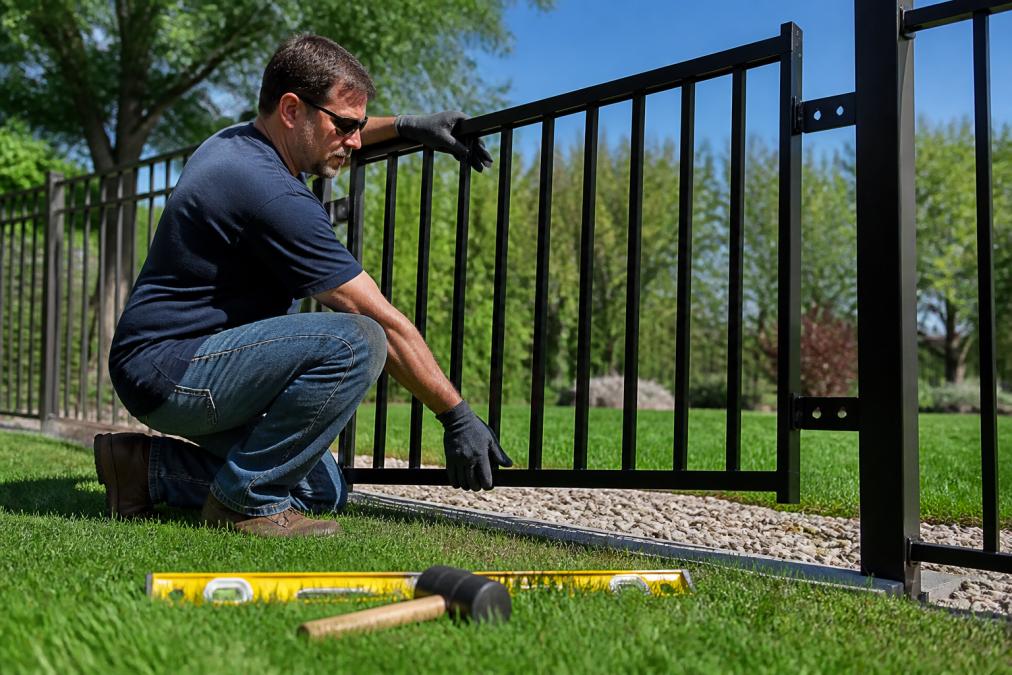
- Set the posts. Dig holes below the frost line, set the posts in concrete, and let them cure for 24 hours.
- Mark the mounting brackets. Attach brackets to each post at the rail heights specified for your panel design.
- Hang the first panel. Rest the pre-assembled section on the brackets, check it with a level, and secure the mounting brackets.
- Continue panel by panel. Work in one direction, checking each section for plumb before tightening.
- Install the gate. Mount the gate hardware according to the included instructions, then hang the gate and adjust the latch.
- Add post caps. Finish each post with a cap to keep moisture out of the hollow extrusion.
The entire process avoids cutting, welding, or fitting rails. If you can handle a post-hole digger and a cordless drill, you can complete this installation.
Aluminum vs. Steel vs. Vinyl: Which Material Saves More?
The aluminum vs. steel vs. vinyl comparison comes down to lifetime cost, not just the sticker price. Steel costs less upfront but rusts over time unless galvanized and painted, and field scratches become rust spots (galvanizeit.org). Vinyl resists moisture but can crack in cold weather and often looks hollow or plastic next to real metal.
Aluminum sits in the middle with the best long-term value. The powder-coated finish and aluminum alloy core resist corrosion without maintenance, and the material never rots, warps, or rusts through. While vinyl may have a lower initial price, aluminum fencing typically holds its appearance and structural integrity far longer, which makes it the more economical choice over a 20-year horizon.
Permits, HOA Rules, and Pool Codes: Check Before You Buy
Local zoning rules and HOA covenants can override your plans before you place an order. Many municipalities require a permit for fences over a certain height, and pool codes add specific requirements for gate latching and climbability. Check with your local building department before purchasing.
For pools, the safety standard is strict: the fence must be at least 4 feet high with a self-closing, self-latching gate (poolsafety.gov). Pre-assembled aluminum panels with narrow picket spacing are pool code compliant because they offer no footholds and the gate hardware supports the required latching mechanism. Aluminum Fences Direct panels are designed with these requirements in mind.
Ask your local inspector about setback requirements before you dig. Knowing the allowed height and placement saves you from ordering panels that cannot legally go where you planned.
Ordering, Shipping, and What to Inspect on Delivery
When you buy pre-assembled aluminum fence panels online, the ordering process is straightforward: measure your perimeter, choose your panel style and height, and request a quote. Most manufacturers ship nationwide, with delivery times varying by production schedule and your location.
On delivery day, inspect every crate before the driver leaves. Check for bent rails, scratched powder coating, or damaged welds, and note any issues on the bill of lading. Most reputable suppliers, including Aluminum Fences Direct, stand behind their products with a lifetime warranty, and documenting damage at the curb makes any replacement claim simple.
Frequently Asked Questions
Is it cheaper to buy premade fence panels or build your own?
Pre-assembled aluminum fence panels can be a more cost-effective choice when you factor in labor. Building panels from scratch requires more installation time. Pre-assembled panels arrive ready to mount, cutting installation time significantly. For most DIY homeowners, the time saved and reduced error rate can make pre-assembled panels a more cost-effective choice.
How do I measure my yard for pre-assembled fence panels?
Measure the total linear footage of your property perimeter using a measuring wheel or tape. Divide that number by the panel width (typically 6 feet) to estimate how many panels you need. Account for the width of fence posts, which are usually installed separately. Mark the location of gates, corners, and slopes on your diagram. If your yard has uneven ground, you may need rackable panels that adjust to the grade. Double-check your measurements before ordering to avoid costly shipping delays.
What are the downsides of aluminum fences?
Aluminum fencing costs more upfront than basic chain link or wood. It also offers less privacy than solid wood or vinyl because of the open picket style. While the powder-coated finish is rust-resistant, scratches from yard equipment may need touch-up paint to prevent corrosion over time. For pool enclosures, the open design requires you to follow specific spacing rules to remain code compliant. Despite these factors, the maintenance-free nature and long lifespan make it a strong investment for most properties.
Will pre-assembled panels work on a sloped yard?
Yes, but you need to plan for the slope. Standard pre-assembled panels are designed for level ground. For slopes, look for rackable panels that allow the internal pickets to pivot, letting the panel follow the grade while keeping the rails parallel to the ground. This prevents gaps under the fence that pets or wildlife could squeeze through. Measure the elevation change across your property line and confirm the rackable range of the panels with the manufacturer before ordering.
Purchasing a fence is a balance of material cost, installation effort, and long-term durability. Pre-assembled aluminum panels tip that balance in your favor by removing assembly labor and delivering a corrosion-resistant, maintenance-free result. Aluminum Fences Direct combines 100% American-made fabrication, wholesale pricing, and a lifetime warranty, so you can secure your property without hiring a contractor. Get a quote today and see what factory-direct pricing does for your project budget.