
Table of Contents
- Commercial Grade Aluminum Fencing for Business: What Sets It Apart
- Commercial Grade vs. Residential Aluminum Fence: Key Differences
- Top Commercial Grade Aluminum Fencing Solutions
- Feature Comparison Table
- ASTM Standards for Aluminum Fencing and Building Code Compliance
- Aluminum Fence Installation Cost and ROI for Businesses
- Durability, Maintenance, and Long-Term Performance
- How We Evaluated Commercial Grade Aluminum Fencing
- Frequently Asked Questions
Last Updated: September 18, 2026
Commercial Grade Aluminum Fencing for Business: What Sets It Apart
The aluminum metal fencing market reached $4.93 billion in 2026, with projections to grow at a 6.5% compound annual growth rate through 2030 The Business Research Company’s Aluminum Metal Fencing Market Report. For business owners evaluating perimeter security solutions, commercial grade aluminum fencing has emerged as the standard choice over traditional steel and wrought iron installations. At Aluminum Fences Direct, we’ve analyzed what separates commercial-grade systems from residential alternatives, and the differences matter significantly when security and durability are non-negotiable.
Commercial grade aluminum fencing delivers what residential options cannot: industrial-strength construction designed to withstand high-impact environments, heavy foot traffic, and demanding security requirements. The distinction isn’t cosmetic. It’s structural.
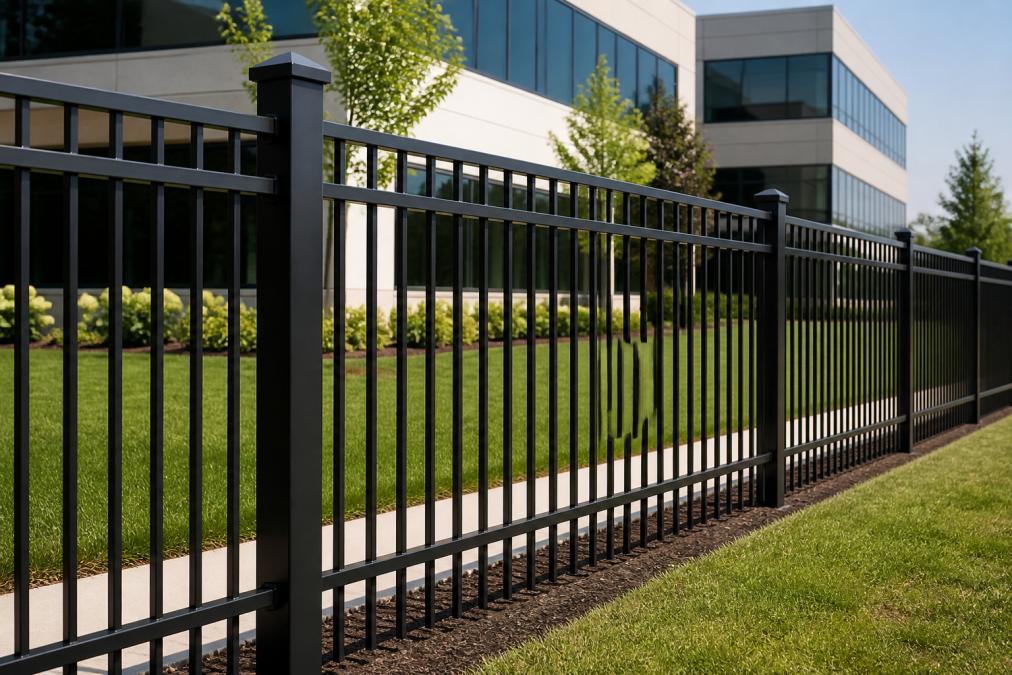
The domestic fencing market is projected to reach $14.90 billion by 2033, growing at 5.4% annually Grand View Research’s U.S. Fencing Market Analysis, driven largely by infrastructure upgrades and heightened security demands. Businesses are shifting away from low-maintenance material preferences toward solutions that combine durability with compliance requirements. Commercial grade aluminum fencing addresses both.
Here’s what matters: commercial panels support up to 500 pounds of pressure per installation FenceTown’s Commercial Panel Specifications, meaning they handle impacts, climbing attempts, and environmental stress that would compromise residential-grade systems. The welded construction, double-punched rails, and reinforced post spacing create a security barrier that satisfies municipal building codes and insurance requirements simultaneously.
Commercial grade aluminum fencing isn’t an upgrade, it’s a different product category designed for perimeter security, not privacy. The engineering, materials, and installation standards are fundamentally different from residential alternatives.
Commercial Grade vs. Residential Aluminum Fence: Key Differences
The gap between commercial and residential aluminum fencing extends far beyond price. Residential fencing prioritizes aesthetics and basic privacy. Commercial grade prioritizes impact resistance, code compliance, and long-term security performance.
Residential aluminum panels typically feature 1-1/8″ rails with standard post spacing of 6 feet. Commercial grade systems use heavier gauge aluminum with reinforced horizontal rails, vertical picket construction, and post spacing engineered for load-bearing capacity. A retail plaza that replaced aging steel fencing with aluminum commercial-grade systems saw significantly reduced maintenance compared to the previous installation TRD Outdoor’s Commercial Fencing Case Study, demonstrating real-world durability advantages.
Residential fencing meets basic neighborhood covenants. Commercial fencing meets ASTM standards, municipal building codes, and often insurance underwriting requirements. The powder-coated finish on residential panels provides adequate UV protection. Commercial-grade powder coating is engineered for enhanced exposure without degradation.
When evaluating commercial grade vs. residential options, request the gauge thickness and rail dimensions. Commercial systems will show 1-3/8″ or larger rails; residential typically stops at 1-1/8″. That single specification difference determines whether your fence meets commercial building code requirements.
Post spacing illustrates another critical difference. Residential installations space posts 6 feet apart. Commercial systems often space posts 4-5 feet apart, reducing panel flex and increasing impact resistance. The racking capability, a fence’s ability to handle slope and uneven terrain, is engineered differently too. Commercial panels maintain security gaps under the fence even on sloped properties, while residential panels may create vulnerabilities.
Cost reflects these differences. Residential panels may have a lower initial cost, but commercial-grade systems are designed for a longer service life, which can reduce replacement cycles and total cost of ownership.
Top Commercial Grade Aluminum Fencing Solutions
1. Aluminum Fences Direct Commercial Grade
Aluminum Fences Direct offers commercial-grade aluminum fencing solutions engineered for businesses seeking wholesale pricing without middleman markup. Heavy-duty construction handles high-traffic areas, with pre-assembled panels shipped nationwide for direct installation or contractor setup.
The commercial-grade line features maintenance-free powder-coated finishes, multiple height options, and customizable configurations for specific property layouts. What separates this option: 100% American-made materials and fabrication, lifetime warranty coverage, and wholesale pricing designed for DIY installation or contractor deployment. Pre-assembled sections reduce on-site labor, which is where most fencing projects exceed budget.
Pros:
- Eliminates middleman markup through direct-to-customer distribution
- Lifetime warranty on all aluminum components
- Pre-assembled panels reduce installation complexity
- Wholesale pricing competitive with bulk orders
- Nationwide shipping and direct-to-site delivery
Cons:
- Requires self-installation or third-party contractor hire
- Customization lead times vary by order complexity
Best for: Businesses and property managers prioritizing cost efficiency without sacrificing durability or warranty coverage.
2. Ultra Aluminum Fencing Systems
Ultra Aluminum Fencing manufactures comprehensive commercial and industrial-grade aluminum fencing engineered for high-durability applications. Their systems span multiple style options with corrosion-resistant finishes suitable for varied climates.
The product line targets large-scale commercial projects requiring specific aesthetic and security standards. Ultra’s engineering approach focuses on tensile strength and impact resistance, making their systems suitable for high-security perimeter applications. Pricing requires direct quote based on project specifications.
Pros:
- Wide variety of design options and color finishes
- Trusted brand reputation for industrial-grade strength
- Engineered for high-security applications
Cons:
- Pricing not transparently listed online
- Quote-based model requires sales consultation
Best for: Large commercial installations where aesthetic customization and industrial-grade specifications are primary requirements.
3. Elite Fence Commercial Grade Aluminum
Elite Fence produces heavy-gauge ornamental aluminum fencing designed specifically for municipal, school, and business security applications. Their commercial-grade panels use 1-1/8″ x 1-3/4″ rail construction, available in 4′, 5′, and 6′ heights with matching gate systems.
American-made heavy-gauge aluminum construction ensures compliance with commercial building codes. Matching single entry and double drive gates integrate seamlessly with perimeter panels. This is purpose-built security fencing, not residential-grade material repurposed for commercial use.
Pros:
- Strong rail dimensions engineered for commercial strength
- Comprehensive gate system integration
- Proven track record with schools and municipalities
Cons:
- Limited to specific commercial-grade dimensions
- Quote-based pricing model
Best for: Municipal projects, schools, and parks requiring high-security specifications and code-compliant installations.
4. Fence Depot Commercial Aluminum
Fence Depot specializes in commercial-grade aluminum fencing focused on business security and low-maintenance property management. Their systems emphasize durable structural integrity for perimeter security in high-traffic commercial environments.
Powder-coated finishes provide long-term UV protection and corrosion resistance.
Pros:
- Focus on long-term durability and security
- Professional-grade materials and design
- Powder-coated finish engineered for commercial environments
Cons:
- Requires professional consultation for quotes
- Service area may be geographically limited
5. Frederick Fence Commercial Aluminum
Frederick Fence provides both supply and professional installation services for commercial-grade aluminum fencing. Their approach emphasizes tenant and customer safety alongside aesthetic appeal, combining high-quality materials with expert installation expertise.
Pros:
- End-to-end service from selection to installation
- Professional installation expertise
- Focus on property security and compliance
Cons:
- Service area may be geographically restricted
- Installation labor adds to total project cost
Feature Comparison Table
| Provider | Installation Model | Best For | Standout Feature | Warranty |
|---|---|---|---|---|
| Aluminum Fences Direct | DIY or contractor | Cost-conscious businesses | Wholesale pricing, pre-assembled panels | Lifetime |
| Ultra Aluminum Fencing | Contractor-installed | Large-scale projects | Design customization options | Varies |
| Elite Fence | Contractor-installed | Schools and municipalities | Heavy-gauge rail specs | Varies |
| Fence Depot | Professional installation | Full-service security | Durability focus | Varies |
| Frederick Fence | Professional installation | Turnkey solutions | Expert installation support | Varies |
ASTM Standards for Aluminum Fencing and Building Code Compliance
Failing a building code inspection after installation means removing and replacing panels at full cost. Always request ASTM certification documentation before purchase. Your building department will specify which standards apply to your property classification.
Compliance requirements vary by jurisdiction. Schools typically demand higher security standards than office parks. Retail properties have different requirements than industrial sites. Your local building department provides the specification sheet; commercial-grade suppliers should be able to confirm their products meet those exact requirements.
Aluminum Fence Installation Cost and ROI for Businesses
Calculate total cost of ownership over 20 years: material cost plus installation plus zero maintenance equals your real comparison figure. Aluminum’s initial investment can be offset when you factor in what you’ll save on repairs, repainting, or replacement.
Commercial-grade aluminum fencing can increase property value and may reduce insurance premiums through enhanced perimeter security. These financial benefits can help offset the installation investment.
Durability, Maintenance, and Long-Term Performance
Commercial grade aluminum fencing is designed for a long service life with minimal maintenance requirements. The powder-coated finish provides UV protection and corrosion resistance without periodic repainting, staining, or sealing.
How We Evaluated Commercial Grade Aluminum Fencing
Our evaluation prioritized real-world performance criteria: durability under commercial use, compliance with ASTM standards and building codes, installation flexibility, warranty coverage, and total cost of ownership over 20 years.
Frequently Asked Questions
What are the key differences between commercial grade and residential aluminum fencing?
Commercial grade aluminum fencing uses heavier gauge materials, stronger welded construction, and thicker rails to withstand high-impact environments. Residential fencing is lighter and designed for lower-traffic areas like backyards. Commercial panels feature reinforced post spacing and are designed for enhanced load-bearing capacity, while residential options prioritize aesthetics. Commercial grade also includes enhanced corrosion resistance and industrial-strength fasteners for perimeter security applications.
How much does commercial grade aluminum fencing installation cost?
Installation costs depend on panel height, linear footage, site conditions, terrain slope, and whether you choose DIY installation or professional labor. Material pricing varies by supplier and order volume. For accurate aluminum fence installation cost estimates, contact suppliers directly for quotes based on your specific project requirements, delivery location, and installation timeline. Wholesale distributors often offer lower per-panel pricing for larger orders.
What building codes and ASTM standards apply to commercial aluminum fencing?
ASTM standards for aluminum fencing establish specifications for material composition, welding quality, coating durability, and structural performance. Most commercial installations must comply with local building codes regarding fence height, post spacing, and setback requirements. Schools, parks, and office complexes often have additional safety regulations. Always verify compliance with your local building department and request documentation from manufacturers confirming adherence to applicable ASTM standards before installation.
Is commercial grade aluminum fencing worth the investment for my business?
Yes, commercial grade aluminum fencing provides long-term value through durability, low maintenance, and enhanced security. The powder-coated finish resists corrosion and UV damage, eliminating rust and rot concerns. Unlike steel, aluminum requires no painting or sealing. For businesses managing perimeter security, controlling access, or protecting assets, the investment can provide long-term value through maintenance-free operation. Wholesale pricing options can reduce upfront material costs significantly.