
Table of Contents
- Assessing Damage and Deciding Whether to Repair or Replace
- Tools Needed for Aluminum Fence Repair
- Repairing Minor Dents and Scratches
- How to Straighten Bent Aluminum Fence Pickets
- Aluminum Fence Panel Replacement: Step-by-Step
- Addressing Corrosion and Oxidation
- Safety Precautions and When to Hire a Professional
- Frequently Asked Questions
Last Updated: September 22, 2026
Damaged aluminum fence panels don’t always mean a full replacement. Many repairs are straightforward enough for a DIY homeowner to handle, saving thousands in labor costs. This guide from Aluminum Fences Direct covers exactly how to fix damaged aluminum fence sections, from assessing the damage to executing repairs yourself.
Assessing Damage and Deciding Whether to Repair or Replace
The critical distinction is between cosmetic damage and structural compromise. This distinction separates a safe repair from a liability.
Structural integrity assessment: The safety-first framework
A fence with compromised structural integrity poses a hazard, it can collapse under wind load, fail if struck, or become unstable enough to injure someone.
Signs of structural compromise:
- Vertical posts that are leaning or wobbly. Push firmly at the post level. If it moves more than 1/4 inch side-to-side, the post must be replaced or reset.
- Horizontal rails that are bent, cracked, or separated from posts. A bent rail can be straightened if the metal hasn’t cracked, but a cracked rail must be replaced.
- Cracks that run perpendicular to the picket direction (across the width). These indicate stress fractures. Replacement is required.
- Corrosion that has created holes or thinned the metal visibly. If you can see daylight through a corroded section, structural strength is compromised and replacement is needed.
- Multiple pickets missing or severely bent in the same section. If more than 3-4 consecutive pickets are damaged, the rail is likely bearing excessive load. The entire panel should be replaced.
How to test for structural integrity:
- The push test: Push firmly at different heights. The fence should not flex or sway.
- The tap test: Use a rubber mallet to tap rails and posts. Listen for a solid, clear sound; a dull thud indicates internal corrosion.
- The visual inspection: Look for gaps between pickets and rails or visible cracks.
- The age and history check: Fences older than 15-20 years or those hit by vehicles, fallen trees, or severe storms are more likely to have internal damage.
When repairs make sense
Minor surface damage is your sweet spot for DIY repair. Small dents, scratches, and cosmetic issues respond well to aluminum repair epoxy or filler compounds. According to Aluminum Fences Direct’s repair methodology, these products fill in surface imperfections without compromising structural integrity.
When replacement is the better choice
Here’s where most people hesitate: if more than 20% to 25% of your fence is heavily damaged, or if any structural component shows signs of compromise, replacement becomes cost-effective and necessary. Long Fence’s repair-versus-replace guidance explains that even high-quality repairs fail when structural integrity has been compromised across significant portions of the installation.
Structural compromise, leaning posts, cracked rails, corrosion holes, or stress cracks, always requires replacement, regardless of damage percentage. Cosmetic damage below 20-25% of the fence can be repaired safely. Above that threshold, or if structural integrity is in question, replacement saves money and eliminates liability long-term.
If you’re uncertain whether damage is structural or cosmetic, hire a professional inspector before attempting repair. The cost of an inspection ($100-$300) is far less than the liability of a fence failure.
Tools Needed for Aluminum Fence Repair
Essential tools:
- Rubber mallet (for straightening without denting further)
- Wooden block (to distribute mallet force evenly)
- Adjustable wrench or socket set (for removing fasteners)
- Pliers (for bending and holding metal)
- Screwdriver set (Phillips and flathead)
- Work gloves (leather or nitrile, to prevent cuts)
- Protective eyewear (metal shards fly when you work)
For cosmetic repairs:
- Aluminum repair epoxy or metal filler compound
- Sandpaper (80-grit and 220-grit)
- Touch-up paint and primer
For panel replacement:
- Socket wrench or adjustable wrench
- Screwdriver (for rail fasteners)
- Plumber’s snake or flexible rod (to help slide out old pickets)
- Level (to ensure new panel sits straight)
Aluminum is soft and bends easily. Avoid steel tools that can gouge the surface. Rubber mallets and wooden blocks are your best friends for straightening without creating new damage.
Repairing Minor Dents and Scratches
Step 1: Clean the damaged area thoroughly. Wipe away dirt and debris. Sand lightly with 80-grit sandpaper if rough or weathered.
How to Straighten Bent Aluminum Fence Pickets
Bent pickets are common after impact or weather damage. If the aluminum hasn’t cracked, straightening is possible.
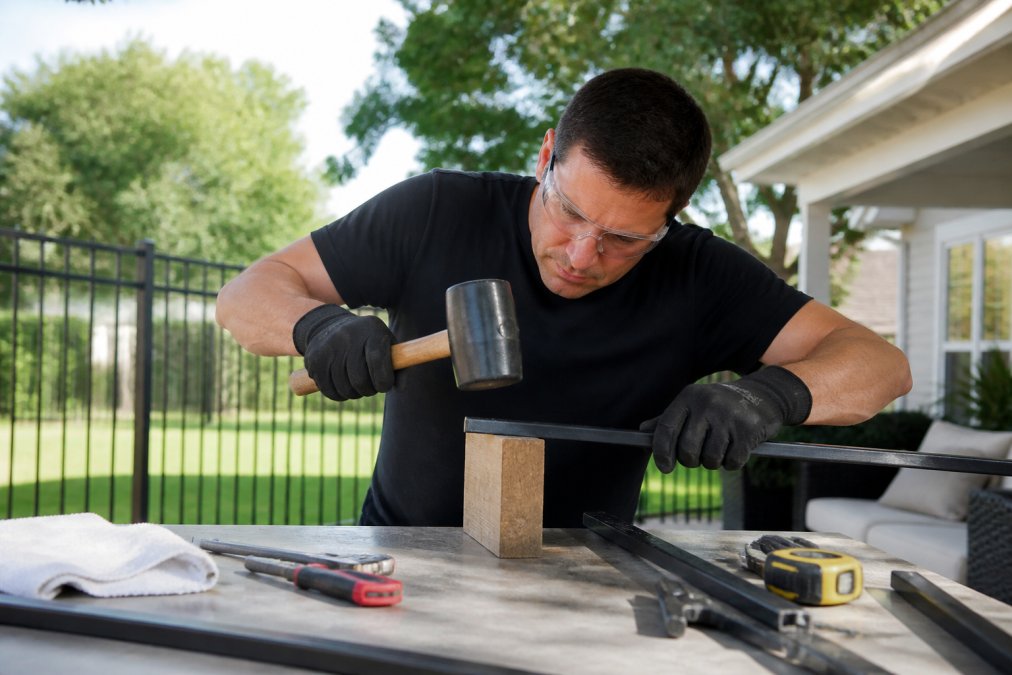
If you hear a cracking sound while straightening, stop immediately. The aluminum has likely fractured internally. Continuing will break it completely. Replace the picket instead.
Aluminum Fence Panel Replacement: Step-by-Step
When a panel is beyond repair, replacement is straightforward if you follow the process.
Removing the damaged panel
Step 1: Locate all fasteners holding the panel. Most use screws or bolts at the top and bottom rails.
Installing the replacement
Step 1: Position the new panel into the rails. Align it carefully and use a level to check that it’s plumb.
DIY homeowners who are comfortable with basic hand tools and have time to invest. Professional installation is faster but costs significantly more.
Addressing Corrosion and Oxidation
Aluminum oxidation appears as white or gray powder. Understanding how it works is essential because cosmetic oxidation can become structural if left untreated.
How aluminum oxidation works and why it matters
Aluminum naturally forms a thin protective oxide layer when exposed to air. When this layer is damaged, exposed aluminum reacts with moisture and oxygen to form new, porous oxide.
Identifying the stage of corrosion
Stage 1: Light surface oxidation (cosmetic, easily reversible)
- White or gray powder that wipes off easily
- No pitting or roughness
- Can be cleaned and sealed in one afternoon
Stage 2: Moderate oxidation (cosmetic but accelerating)
- Thicker white coating that doesn’t wipe off completely
- Slight roughness or texture
- Requires sanding and protective coating to prevent progression
Stage 3: Heavy oxidation with pitting (structural risk)
- Deep pits or holes visible in the aluminum surface
- Black or dark gray discoloration beneath the white powder
- Metal feels thin or weak when tapped
- Replacement is recommended
Stage 4: Perforation (structural failure)
- Holes completely through the aluminum
- Metal crumbles or flakes when touched
- Fence is no longer structurally sound
- Replacement is the only option
Treatment by corrosion stage
For light oxidation (Stage 1):
- Scrub with a soft-bristled brush and white vinegar (5% acetic acid).
- Rinse thoroughly and dry completely.
- Apply a clear protective coating to seal the aluminum.
- Reapply every 2-3 years or after heavy rain/salt exposure.
This takes 30 minutes and costs under $15.
For moderate oxidation (Stage 2):
- Sand with 80-grit sandpaper until smooth and shiny.
- Wipe clean and dry completely (at least 2 hours).
- Apply aluminum primer immediately.
- Once dry, apply protective topcoat in two thin coats.
This takes 1-2 hours plus drying time and costs $20-$40.
For heavy oxidation with pitting (Stage 3):
- Sand with 80-grit sandpaper to assess pitting depth.
- If shallow (less than 1/16 inch), sand with 220-grit, apply aluminum repair epoxy, then prime and paint.
- If deep (more than 1/16 inch) or extensive, replacement is more reliable than professional welding.
Prevention: The long-term strategy
Prevention is far easier and cheaper than treatment. All aluminum benefits from regular maintenance.
Annual maintenance routine:
- Inspect in spring and fall for white powder, discoloration, or pitting.
- Clean with mild soap and water using a soft brush.
- Dry completely to prevent oxidation.
- Reapply protective coating every 2-3 years.
- Address damage immediately by sealing with primer and paint within 24 hours.
Environmental factors that accelerate corrosion:
- Salt spray (near ocean or roads treated with salt): Requires annual cleaning and coating reapplication.
- High humidity (swamps, tropical climates): Ensure good air circulation around the fence.
- Acidic rain or pollution (industrial areas): Clean more frequently.
- Shade and poor drainage: Improve drainage and trim vegetation to increase air circulation.
If you live in a high-corrosion environment (coastal, high-humidity, or heavy salt exposure), consider upgrading to powder-coated aluminum panels or applying a marine-grade protective coating. The upfront cost is 10-20% higher, but the fence will last 5-10 years longer without maintenance.
Never use steel wool or steel brushes to clean aluminum. Steel particles embed in the aluminum and become corrosion sites. Use soft brass brushes or plastic brushes only.
Safety Precautions and When to Hire a Professional
Metal work carries risks. Protect yourself.
Safety gear you need:
- Work gloves (leather or cut-resistant material)
- Safety glasses or face shield
- Dust mask if sanding or grinding
- Steel-toed boots
- Long sleeves
When to call a professional:
Hire a contractor if the fence has deep structural damage, posts are compromised, or you’re uncomfortable with the work. Welding repairs and corrosion assessment require professional expertise.
Frequently Asked Questions
Is it better to repair or replace an aluminum fence panel?
Repair is cost-effective for isolated damage affecting less than 20% of your fence. If more than 25% of the fence is heavily damaged, replacement becomes more viable because structural integrity may be compromised across multiple sections. According to industry guidance, repairs may fail if the majority of the structure is compromised. Calculate the cost: repairs average $200 to $500 per section, while full panel replacement depends on your specific setup. Get a quote to compare both options for your situation.
What tools do I actually need to fix a damaged aluminum fence?
Essential tools include a rubber mallet, pliers, adjustable wrench, screwdriver set, and safety gear like work gloves and protective eyewear. For minor surface damage, you’ll need aluminum repair epoxy or filler compound. For panel replacement, add a level, clamping tools, and potentially a plumber’s snake for alignment. Most DIY homeowners already own basic tools; specialized items like epoxy fillers and mallets cost under $50 combined. Check your toolkit first before purchasing.
Can I straighten a bent aluminum picket myself, or do I need to replace it?
Minor bends can often be straightened using a rubber mallet and wooden block to avoid further damage. For severely kinked pickets, replacement is usually faster and more reliable. To replace, unscrew the rail, slide the damaged picket out, and slide in a new one. This takes 15-20 minutes per picket and costs significantly less than calling a professional. If the bend is near fasteners or the picket won’t slide freely, replacement is your safer option.
How do I know if my aluminum fence has structural damage I can’t see?
Inspect the fence posts for movement, rust staining, or loose brackets. Check rails for sagging or gaps between sections. Press on panels to feel for flex or instability. Metal fatigue from repeated stress shows as micro-cracks near fasteners or joints. If posts shift when you push the fence, or if panels don’t align properly, structural issues exist. In these cases, professional assessment is worth the cost before attempting repairs, as hidden damage can compromise safety and warranty coverage.