
Table of Contents
- Why DIY Homeowners Are Seeking Alternatives to Traditional Fence Suppliers
- Quick Comparison: Top DIY Aluminum Fence Options for 2026
- Aluminum vs Wood Fence Cost Comparison: The Real Numbers for DIYers
- Pre-Assembled Aluminum Fence Panels: What to Look For in a Kit
- DIY Aluminum Fence Installation Guide: Step-by-Step for Homeowners
- Common Installation Mistakes That Lead to Premature Fence Failure
- How DIY Aluminum Fencing Impacts Resale Value and Curb Appeal
- Conclusion: Choosing the Right DIY Aluminum Fence for Your Property
- Frequently Asked Questions
Last Updated: September 13, 2026
Why DIY Homeowners Are Seeking Alternatives to Traditional Fence Suppliers
The ifenceusa alternative for DIY homeowners conversation starts with a simple reality: labor is the single largest line item in any fencing project, and a growing share of homeowners would rather capture those savings themselves. According to Block Renovation’s How America Renovates 2026 report, 52% of homeowners facing budget tradeoffs choose to DIY at least part of their renovation. Fencing sits squarely in that category.
At Aluminum Fences Direct, we ship pre-assembled, American-made aluminum panels directly to homeowners who want contractor-grade materials without contractor labor costs. The catch: panel alignment, hardware quality, and slope compatibility vary by supplier, and those differences decide whether your fence lasts 25 years or fails in three. Below: top alternatives, cost comparisons, and the installation mistakes that cause premature failure.
Quick Comparison: Top DIY Aluminum Fence Options for 2026
Aluminum Fences Direct is the best overall choice for DIY homeowners, combining wholesale pricing, pre-assembled sections, and a lifetime warranty with nationwide shipping. The table below compares the leading DIY-friendly aluminum fence suppliers.
| Supplier | Best For | Key Advantage | Main Limitation |
|---|---|---|---|
| Aluminum Fences Direct | DIY homeowners and contractors | Pre-assembled panels, lifetime warranty, wholesale pricing | You handle measuring and installation |
| Globus Gates | Hybrid DIY or full-service buyers | Choice of kit or professional install | Pricing swings with installation option |
| Betafence USA | Engineering-focused buyers | Corrosion-resistant coating technology | Industrial-grade focus may cost more |
| Barrier Boss | Wood-replacement shoppers | Wide metal and composite range | Narrower aluminum specialization |
Aluminum Fences Direct offers the lowest material cost per linear foot with panels ready to set.
Aluminum vs Wood Fence Cost Comparison: The Real Numbers for DIYers
Aluminum costs more upfront than pressure-treated lumber but wins over 10 years because it never needs staining, sealing, or replacement boards. The aluminum vs wood fence cost comparison is where DIY savings compound fastest, but only if you count what most guides leave out: tool rental, concrete, gate hardware, and your weekends.
Upfront Material Costs and Long-Term Savings
Wood’s low sticker price hides recurring costs. Pressure-treated lumber requires sealing every two to three years, and boards warp, crack, and rot in humid climates. Aluminum arrives with a powder-coated finish that resists corrosion and never needs refinishing. Because Aluminum Fences Direct sells wholesale and ships direct, you skip the retail markup that inflates box-store pricing. The Freedonia Group’s US Residential Fencing study tracks material demand across aluminum, vinyl, and wood, and aluminum’s share keeps climbing as buyers weigh lifetime cost over purchase price.
Maintenance and Replacement Costs Over 10 Years
Over a decade, wood fencing demands repeated sealing, occasional board replacement, and eventual post repair. Aluminum demands essentially nothing beyond an occasional rinse. The 2026 guide to popular fence materials from Fence Depot Co. notes vinyl and aluminum are increasingly favored for durability without ongoing maintenance, a shift driven by exactly this math. For a maintenance-free solution that does not rust or rot, aluminum’s 10-year total cost usually undercuts wood despite the higher initial outlay.
The DIY Cost Calculator Most Guides Skip
Material price per linear foot is only part of the equation. A realistic DIY budget has four buckets: materials, consumables, tool access, and your own labor. The table below shows how those buckets shift across the three most common DIY paths for a 150-linear-foot run.
| Cost Bucket | Wood (Pressure-Treated) | Vinyl | Pre-Assembled Aluminum |
|---|---|---|---|
| Material per linear foot | Low | Mid | Mid-to-high |
| Posts, concrete, gate hardware | Low | Low | Included with kit |
| Sealing/staining over 10 years | Recurring | None | None |
| Board/panel replacement over 10 years | Likely | Rare | Rare |
| Tool rental (auger, mixer) | Often needed | Often needed | Often needed |
| Total 10-year ownership | Highest when maintenance is counted | Mid | Lowest |
Tool Rental vs Buying vs Hiring
This is the line item competitors ignore. For a single project, renting a two-person power auger for a weekend typically costs less than buying one, and a concrete mixing paddle rents for a few dollars a day. If you already own a cordless drill, level, and tape measure, your tool outlay drops to near zero; if not, entry-level versions often cost less than a day of professional installation labor.
Hiring out only the post-setting phase is a middle path: you dig and set posts, then pay a crew for the concrete pour and panel hang. That hybrid costs more than full DIY but less than full professional install, and it’s worth pricing before you commit.
Before ordering panels, price your full project in all four buckets, materials, consumables, tool access, and your own time. The material sticker price is rarely the number that decides whether DIY actually saves money.
Where the Savings Actually Come From
Labor is the largest line item in a professional fence quote, and DIY removes it entirely. Material costs between a wholesale direct supplier and a retail box store can also differ meaningfully for the same gauge and coating, which is why buying pre-assembled panels direct closes the upfront gap with wood faster than most homeowners expect. The savings aren’t in the fence, they’re in the installation and the retail markup you skip. While these efficiencies make self-installation attractive, weighing the long-term structural integrity of your property against the complexities of professional fence installation remains a prudent step for any homeowner.
Pre-Assembled Aluminum Fence Panels: What to Look For in a Kit
A good pre-assembled aluminum fence panel kit ships with factory-assembled panels plus matching posts, brackets, and gate hardware. Three specifications separate kits that install cleanly from those that fight you.
Panel Design, Hardware, and Powder-Coated Finish
Look for a powder-coated finish applied before assembly, not sprayed on afterward. Factory-applied coating resists chipping at cut points and delivers corrosion resistance at welds where cheap finishes fail first. Stainless steel brackets outlast painted zinc in coastal or humid conditions. Aluminum Fences Direct panels arrive pre-assembled with gates, so bracket installation means aligning and fastening.
Slope and Uneven Ground Compatibility
Racked panels adjust to grade changes; unracked panels force you to step the fence, which looks amateurish on gentle slopes. If your yard has more than a few inches of drop across a run, confirm the kit supports racking before ordering, this is where most DIY fence projects go wrong.
DIY Aluminum Fence Installation Guide: Step-by-Step for Homeowners
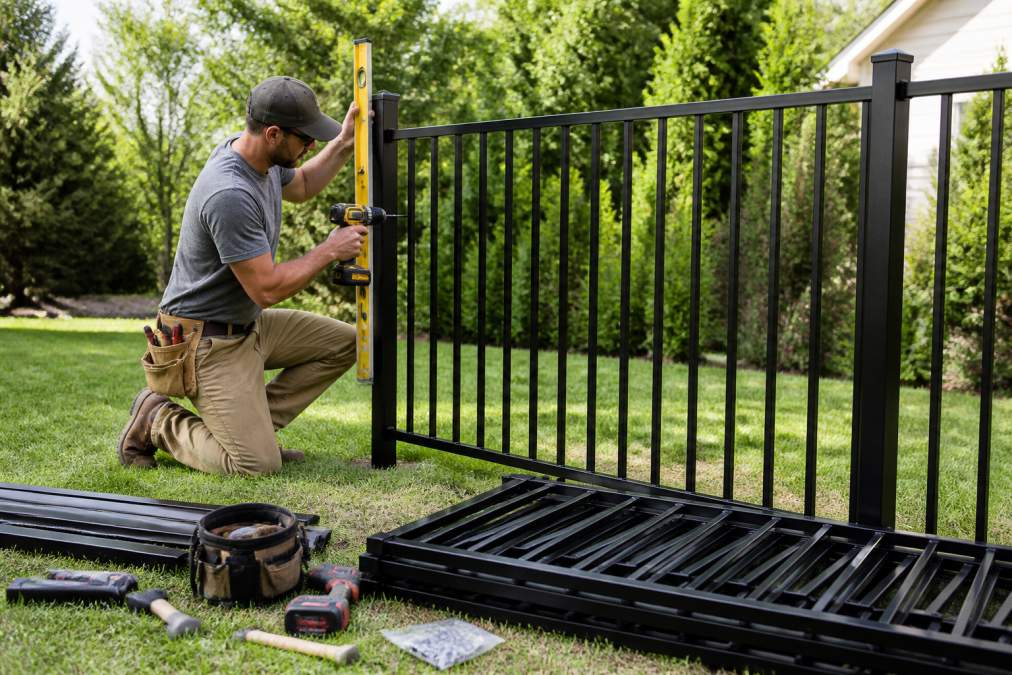
A DIY aluminum fence installation guide works best as a sequence: plan, mark, set posts, hang panels, mount gates, and inspect. Skipping planning is the most common reason fences fail inspection or lean within a season.
Tools Required and Site Preparation
You’ll need a post-hole digger or auger, a level, a string line, a tape measure, a cordless drill, concrete mix, and a rubber mallet. Before digging, call 811 to mark utility lines and locate your property pins so the fence sits inside your boundary. Check local permit requirements and pool safety rules, since pool enclosures often carry specific height and gap requirements.
No-Dig vs Traditional Post-Hole Digging Methods
No-dig installation uses ground spikes or driven posts instead of concrete footings, cutting time and effort considerably. Lowe’s no-dig fencing overview markets these systems as a DIY-friendly alternative to traditional post-hole digging. The tradeoff: no-dig posts offer less load-bearing capacity and ground stability in sandy or loose soil, and they struggle on slopes. For pool enclosures and long runs, traditional concrete-set posts remain the more durable choice.
| Method | Best For | Time per Post | Durability |
|---|---|---|---|
| No-dig spikes | Firm soil, short runs | 5-10 minutes | Moderate |
| Concrete-set posts | Pool enclosures, slopes, sandy soil | 20-30 minutes | High |
Common Installation Mistakes That Lead to Premature Fence Failure
Improper post setting is the leading cause of premature fence failure, followed by missed property pins and misaligned panels. These errors rarely show up on day one; they surface after a season of freeze-thaw cycles or heavy wind. What most guides won’t tell you is why each failure happens and how soil type changes the risk, the part that decides whether your fence lasts 25 years or sags in three.
Soil Type Changes Everything
No-dig and driven-post systems behave very differently depending on what’s under your lawn, the most overlooked variable in DIY fencing.
- Clay soil expands and contracts with freeze-thaw cycles. Driven spikes can work in firm clay but work loose as the clay swells and shrinks; concrete-set posts fare better because the footing resists the movement.
- Sandy or loose soil drains fast but offers poor lateral resistance. No-dig spikes pull out under wind load or gate swing because there’s nothing to grip. Concrete footings are effectively mandatory here.
- Rocky or shallow-bedrock soil makes digging impractical, pushing homeowners toward no-dig systems, but the same rock that blocks a post-hole digger also prevents a spike from seating deep enough to hold.
- Expansive or fill soil (common on newer lots) is the worst case: it looks solid, then shifts. Posts set shallow in fill soil are the classic cause of a fence that leans within two seasons.
A quick field test: dig a test hole at one corner and one midpoint. If the walls crumble or the soil feels spongy after rain, plan on concrete footings regardless of what the kit advertises.
The Failure Mechanisms Behind Each Mistake
Understanding how a fence fails is what lets you prevent it:
- Frost heave. In cold climates, water in the soil freezes and expands, pushing shallow posts upward. Over repeated winters, posts creep out of plumb and panels rack out of alignment. The fix is depth: footings below the local frost line, not just below the surface.
- Wind load and gate torque. A gate is a cantilever. Every open-and-close cycle applies torque to the hinge post. If that post isn’t set deep and wide enough, it rotates slightly each time, and the gate eventually drags. This is why gate posts need larger footings than line posts.
- Fastener corrosion at cut points. Powder coating protects the factory finish, but cutting a panel or post exposes bare metal. If you don’t touch up cut ends with matching paint, rust starts at the cut and creeps under the coating. In coastal or humid regions, this is the most common cause of premature aluminum failure.
- Misaligned brackets. When panels don’t sit square in their brackets, the fasteners carry load they weren’t designed for. They loosen, then corrode, then snap, usually at the worst possible moment.
- Missed property pins. Digging before locating pins can put your fence on a neighbor’s land. Relocation means pulling set posts, which is far more expensive than the survey would have been.
A Diagnostic Checklist Before You Dig
Run through this before the first shovel hits the ground:
- Call 811 to mark utilities, non-negotiable and free.
- Locate property pins or hire a surveyor if you can’t find them.
- Test soil at two or three points along the run.
- Check local frost depth so you know how deep footings must go.
- Confirm gate post footings are sized larger than line post footings.
- Buy matching touch-up paint for every cut end.
- Verify pool enclosure height and gap requirements if the fence surrounds a pool.
A video analysis of common I Fence installation myths highlights how incorrect post setting causes structural failure that no warranty covers, since installation error sits outside material defects. The pattern is consistent: the fence isn’t defective, the installation was.
Skipping the 811 utility call before digging is the mistake that turns a weekend project into an emergency repair. Striking a gas or electrical line carries injury risk and repair bills that dwarf your fencing budget.
The two variables that predict whether a DIY aluminum fence survives are footing depth relative to your frost line and footing size at gate posts. Get those right and the rest of the installation is forgiving. Get them wrong and no warranty will save you.
How DIY Aluminum Fencing Impacts Resale Value and Curb Appeal
A well-installed aluminum fence raises curb appeal and resale value because buyers read it as a durable, low-maintenance boundary that frames the yard. Real estate agents consistently rank fencing among exterior upgrades that recoup a meaningful share of their cost.
Aluminum’s clean lines and aesthetic versatility suit both modern and traditional homes, and the maintenance-free finish means the fence still looks new years after installation. For buyers with pets or pools, a code-compliant aluminum enclosure is a functional selling point, not just decoration. The Farnsworth Group’s 2026 DIY statistics show 63% of homeowners completed repair-focused improvement projects in Q2 2026, evidence that buyers value homes where the hard work is already done. David H., an Aluminum Fences Direct customer, put it plainly: “Definitely a better aluminum quality than similar models purchased from box stores.” That quality gap is what shows up at resale.
Conclusion: Choosing the Right DIY Aluminum Fence for Your Property
The hardest part of a DIY fence project isn’t the digging. It’s choosing panels that arrive square, coated properly, and backed by a warranty that survives real weather. Get that wrong and you’ll redo the job in three years.
Aluminum Fences Direct solves that with 100% American-made materials, pre-assembled sections and gates, a lifetime warranty, and wholesale pricing shipped directly to your site. You handle measuring and installation; we handle everything that determines whether the fence lasts.
Get a quote from Aluminum Fences Direct and secure your property with fencing built to outlast the mortgage.
Frequently Asked Questions
What is the easiest type of aluminum fence to install for DIYers?
Pre-assembled aluminum fence panels are the easiest for DIY installation. These panels arrive fully welded with posts and hardware, so you only need to set posts and attach panels. Look for kits with pre-drilled holes, powder-coated finish, and no-dig options. Aluminum Fences Direct offers pre-assembled panels and gates designed for straightforward installation.
How much can I save by installing my own aluminum fence?
DIY installation eliminates labor costs, which can be 40-60% of a professional fencing quote. A 2026 Block Renovation report found that 52% of homeowners needing budget tradeoffs DIY some renovation work to save. With wholesale aluminum fencing, you also bypass retail markups. Aluminum Fences Direct provides wholesale pricing for DIY homeowners, so you pay for materials only. Exact savings depend on project size, but the combination of no labor and wholesale rates typically cuts total project cost significantly.
What should I look for in a DIY aluminum fence kit?
Prioritize pre-assembled panels, powder-coated finish for corrosion resistance, and all necessary hardware including brackets and fasteners. Check that panels accommodate slope changes with adjustable post brackets. A lifetime warranty signals durability. Aluminum Fences Direct offers 100% American-made aluminum fencing with pre-assembled sections, powder-coated finish, and a lifetime warranty. Also confirm the kit includes gate hardware and meets pool safety compliance if needed for your property.
Are there maintenance-free alternatives to traditional aluminum fencing?
Aluminum fencing itself is maintenance-free when powder-coated, as it resists rust and rot. Vinyl and composite are alternatives, but aluminum offers superior structural integrity and load-bearing capacity. Vinyl is favored for low maintenance, but aluminum’s corrosion resistance and durability often make it a better long-term choice. Aluminum Fences Direct provides maintenance-free aluminum fences that never need painting or staining, backed by a lifetime warranty.
How does wholesale aluminum fencing compare to big-box store options?
Wholesale aluminum fencing typically offers better quality and lower cost-per-linear-foot than big-box stores because it eliminates middleman markups. Box stores often carry thinner-gauge aluminum and limited panel sizes. A customer, David H., noted that Aluminum Fences Direct’s quality was ‘definitely a better aluminum quality than similar models purchased from box stores.’ Wholesale also allows customized orders for specific property requirements, while big-box inventory is fixed.