
Table of Contents
- The Real Numbers Behind DIY Aluminum Fencing
- Aluminum Fence Installation Cost: DIY vs. Hiring a Pro
- How to Measure for Aluminum Fencing Before You Order
- Best Tools for Installing Aluminum Fence Panels
- The Toughest Parts of DIY Aluminum Fencing (and How to Handle Them)
- What Aluminum Fencing Delivers That Wood and Iron Cannot
- Conclusion: Who Should Install Their Own Aluminum Fence
- Frequently Asked Questions
Last Updated: September 15, 2026
The Real Numbers Behind DIY Aluminum Fencing
The global aluminum metal fencing market is projected to reach $12.32 billion by the end of 2026, up from $8.87 billion in 2021, according to [Cognitive Market Research’s aluminum fencing(/pool-code-compliant-aluminum-fencing-requirements/) market analysis | cognitivemarketresearch.com]. That growth reflects a broader shift: homeowners are choosing aluminum over wood and iron, and many are installing it themselves. Is DIY aluminum fencing worth it? For most able-bodied homeowners with a level or gently sloped yard, the answer is yes, because pre-assembled panels from a wholesale supplier like Aluminum Fences Direct cut out installation labor, which is the single largest line item in any fencing quote. The catch is that “worth it” depends on four variables: your soil, your slope, your local permit rules, and how honestly you account for tool and time costs. Below, we break down the real numbers, the hidden costs, and the failure points that separate a smooth install from a frustrating one.
Aluminum Fence Installation Cost: DIY vs. Hiring a Pro
Aluminum fence installation cost splits into materials and labor. Buying wholesale and installing yourself eliminates the labor bucket, but you take on tool rental, concrete, and your own time. A cost-benefit analysis only works if you price all three.
Where the Savings Actually Come From
The savings come from labor, not materials. Professional quotes bundle excavation, footings, panel assembly, gate hanging, and cleanup into one number, typically the largest share of the project. Aluminum Fences Direct ships pre-assembled sections and gates directly to your site, removing the assembly step that drives up contractor hours. For a homeowner replacing 150 linear feet of fencing, that labor gap is where the real money sits.
The Hidden Costs Nobody Mentions
Here’s what most guides skip: DIY installation does not always produce net savings. As Globus Gates’ analysis of DIY fence economics notes, homeowners must weigh reduced labor against the total investment in tools, time, and the risk of installation errors that affect long-term durability. Budget for these before you commit:
| Hidden Cost | Typical Trigger | Impact If Ignored |
|---|---|---|
| Post-hole digger or auger rental | Rocky or compacted soil | Hours of manual digging, bent posts |
| Concrete for footings | Every post, frost-depth dependent | Shifting posts, failed inspections |
| Replacement panels | Miscuts or dropped sections | Added material cost, project delay |
| Permit fees | Pool enclosures, height limits | Stop-work orders, fines |
| Gate hardware upgrades | Self-closing pool gates | Code failure, re-inspection fees |
Skipping concrete footings to save a weekend is the most common DIY mistake. Posts set in bare soil lean within a season, and a leaning fence line is far more expensive to fix than to build correctly the first time.
How to Measure for Aluminum Fencing Before You Order
Measuring determines whether your panels fit on the first delivery. Walk the full layout with a tape and notepad, recording every corner, gate opening, and grade change. Measure in three passes: total linear run, each straight section between corners, and the rise or fall across every section. Aluminum fencing is ordered in fixed panel widths, so measurements decide how many panels and posts you need. Round gate openings to the nearest standard width and note which posts will be terminal, corner, or line. If ground moves more than a few inches across a panel, flag that section for rackable panels. Get this wrong and you will be reordering, adding cost and weeks. Aluminum Fences Direct offers customized orders tailored to specific property requirements, so accurate measurements let you order once and install once.
Best Tools for Installing Aluminum Fence Panels
The best tools for installing aluminum fence panels are a post-hole digger or power auger, a spirit level, a string line, a rubber mallet, a cordless drill with correct driver bits, and a hacksaw or angle grinder for trimming. Add a wheelbarrow and mixing hoe for concrete footings, plus safety glasses for every cut.
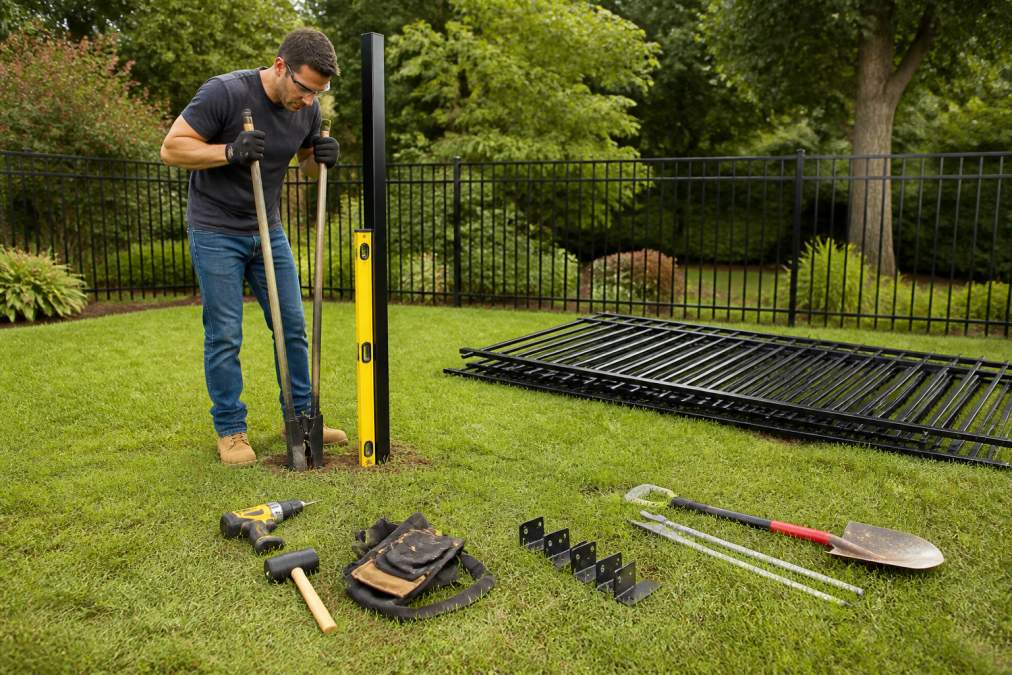
The Tool ROI Math Most Guides Skip
Vendor content tends to quote the material price and stop there, skewing the “money-saver” narrative, the tools you do not already own are a real line item. A realistic way to price it:
| Tool | Typical Access | When It Pays for Itself |
|---|---|---|
| Power auger (one-man, gas) | Rental, roughly a half-day rate | The moment you hit clay, caliche, or compacted gravel, manual digging on 30+ posts can run a full weekend |
| Two-foot magnetic torpedo level | Buy, low cost | Every post you set; a cheap level produces a crooked line you stare at for 20 years |
| 100-ft string line and line level | Buy, low cost | Any run longer than two panels; keeps post tops on a single plane |
| Cordless drill with driver bits | Often already owned | Bracket and gate hardware; matched bits prevent stripped stainless screws |
| Hacksaw or angle grinder with metal blade | Buy or already owned | Any cut panel or gate opening; a grinder is faster but throws hot shavings |
| Concrete mixer or mixing hoe and wheelbarrow | Rental or buy | Any pour over roughly 10 posts; hand-mixing 60-lb bags in a wheelbarrow is the slowest step on the job |
| Post-hole digger (manual) | Buy, low cost | Small jobs under ~10 posts in soft soil; useless in rock |
A power auger rental pays for itself the moment you hit clay or compacted gravel; a cheap level costs you a crooked line you will stare at for twenty years. Buy fasteners and gate hardware matched to your panel system, mismatched fasteners are a leading cause of gate sag. If you already own a drill and level, incremental tool spend is small. If you own nothing, price the full kit first: for a 150-linear-foot job, the tool delta alone can erase a meaningful share of the labor savings.
Difficulty Rating by Skill Level
Not every DIY aluminum fence job is the same. Self-select before you buy:
- Beginner (level ground, soft soil, no pool): Manual post-hole digger, bagged concrete, pre-assembled panels, standard gate. A confident homeowner can finish a short run in a weekend.
- Intermediate (gentle slope, some rock, standard gate): Add rackable panels, a power auger rental, and a second set of hands for panel lifts. Expect two weekends.
- Advanced (steep grade, rock or hardpan, pool enclosure, double drive gate): Core-drilling or hydraulic auger, engineered footings to frost depth, self-closing/self-latching gate hardware, and an inspection. This is where DIY savings shrink fastest and error cost is highest.
Skipping concrete footings to save a weekend is the most common DIY mistake. Posts set in bare soil lean within a season, and a leaning fence line is far more expensive to fix than to build correctly the first time.
The Toughest Parts of DIY Aluminum Fencing (and How to Handle Them)
Three things trip up first-time installers: slope, permitting, and pool code. Each has a straightforward fix if you plan before delivery day.
Sloped Yards and Rackable Panels
Rackable panels are aluminum fence sections engineered to follow ground slope by shifting the angle between pickets and rails. On a steadily dropping yard, racked panels follow the grade without stair-stepping, preserving structural integrity and curb appeal. For sharper drops, step the panels instead: keep each section level and drop the next at the post.
Permits, HOA Rules, and Pool Codes
Photograph your property lines and any existing survey markers before you dig. Utility locate services mark buried lines for free in most areas, and hitting an irrigation line or gas line is the one DIY mistake that turns a weekend project into an insurance claim.
What Aluminum Fencing Delivers That Wood and Iron Cannot
Where Aluminum Actually Fails (and How to Fix It)
Repairability vs. Wood and Iron
The real ROI of aluminum is not the purchase price. It is the absence of repainting, restaining, and replacement over a 20-year horizon, plus the fact that a damaged section can be unbolted and swapped instead of rebuilt.
Conclusion: Who Should Install Their Own Aluminum Fence
Frequently Asked Questions
What are the downsides of DIY aluminum fencing?
The main downsides are the upfront investment in tools, the physical labor involved, and the risk of installation errors that can affect long-term durability. Homeowners also need to handle permitting and HOA approvals themselves, which adds time and paperwork. If your yard has significant slope or rocky soil, the project gets harder fast. Industry analysis from Globus Gates (2026) notes that DIY savings shrink once you factor in tool purchases and the value of your own time.
How much can I save on labor by installing aluminum fence panels myself?
The savings come from eliminating installation labor, which is typically the largest line item in a fencing quote. Aluminum Fences Direct supplies pre-assembled panels directly to homeowners, cutting out the middleman markup that contractors and retailers add. Exact savings depend on your fence layout, total linear feet, and local labor rates. Request a quote from Aluminum Fences Direct to compare material costs against contractor bids in your area.
Is it difficult for a beginner to install an aluminum fence?
Pre-assembled panels have made aluminum fencing a viable project for novices. The work involves laying out the fence line, digging and setting posts in concrete footings, leveling each section, and attaching panels with fasteners. The hardest parts are keeping posts plumb on uneven ground and meeting pool code requirements. Budget a full weekend for a typical backyard and watch installation videos before you start.
How does DIY aluminum fencing hold up compared to a professional installation?
The panels themselves perform the same regardless of who installs them. Powder-coated aluminum does not rust or rot, and it carries a lifetime warranty from Aluminum Fences Direct. The variable is installation quality: posts set below the frost line in proper concrete footings will hold for decades, while shallow or unlevel posts can shift. Follow the manufacturer’s depth and spacing specs, and a careful DIY job matches professional results.