
Table of Contents
- Powder Coated Aluminum Fence Pros and Cons: The Honest Verdict
- Aluminum Fence Cost: What You Pay Upfront and Over Time
- How Long Does Aluminum Fencing Last?
- Aluminum vs Vinyl Fence: Which Holds Up Better?
- Coating Quality, Standards, and Warranty Details
- Repairing Scratches, Chips, and Coating Damage
- Coastal, Poolside, and High-Salt Exposure
- Decision Framework: Is Powder Coated Aluminum Fencing Worth It for Your Home?
- Frequently Asked Questions
Last Updated: October 8, 2026
Powder Coated Aluminum Fence Pros and Cons: The Honest Verdict
Powder coated aluminum fencing is made from aluminum panels and posts coated with an electrostatically applied, heat-cured powder finish.
Aluminum Fences Direct ships American-made aluminum fencing directly to DIY homeowners and contractors. The global aluminum metal fencing market reached $4.93 billion in 2026 and is projected to hit $6.35 billion by 2030, according to The Business Research Company’s Aluminum Metal Fencing Market Report 2026.
Here is what powder coating does, where it falls short, and how to decide if it fits your yard.
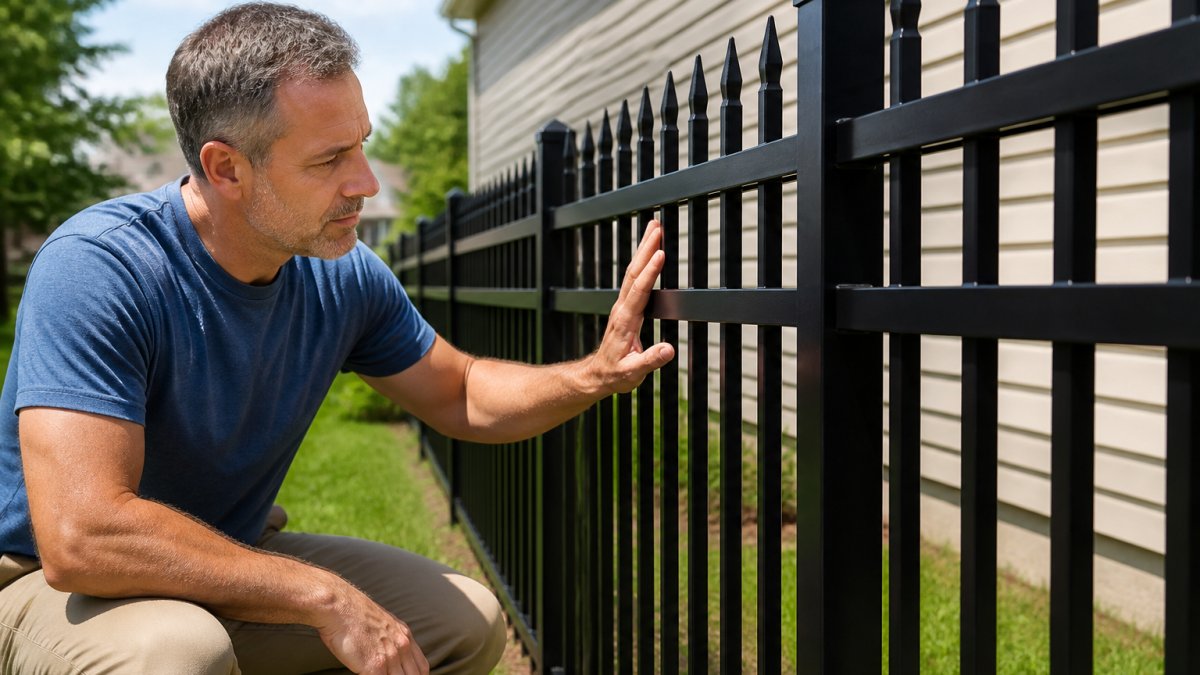
What Powder Coating Actually Does to the Metal
Powder coating sprays electrically charged pigment onto grounded aluminum, then bakes it into a hard, uniform skin, thicker and more even than liquid paint.
That matters for three reasons:
- Corrosion resistance. The coating seals the aluminum from moisture, the main driver of corrosion on any fence.
- UV resistance. A quality finish holds its color instead of chalking or fading in direct sun.
- Impact resistance. The cured film flexes slightly instead of cracking when a mower kicks a stone at it.
Aluminum will not rust the way steel does, and the powder coating adds a protective finish on top of that advantage.
Where Powder Coating Falls Short
The finish is not indestructible, and the failure modes are predictable. Deep scratches that reach bare metal can allow oxidation to start underneath the coating edge. A Facebook group post raised the concern that powder coating on aluminum fencing could tarnish or lose its luster in hot sun, though it included no test data, treat that as a caution, not a proven rule.
Cheap powder coating is the most common failure point. Panels with a thin or uneven coating chip at the edges, and once moisture gets under the film, it lifts. Ask any supplier for the coating thickness and cure spec before you buy.
Aluminum Fence Cost: What You Pay Upfront and Over Time
Aluminum fence cost breaks into four buckets: materials, shipping, site preparation, and labor. Most homeowners only see the first when comparing quotes, which is why a panel’s sticker price poorly predicts the project’s actual cost.
Here is how the money typically splits:
| Cost Bucket | Typical Share of Project | What Drives It |
|---|---|---|
| Materials (panels, posts, gates, hardware) | 45-60% | Panel height, rail count, finish grade, number of gates |
| Shipping and freight | 5-12% | Distance, order size, whether panels ship assembled |
| Site prep and posts | 10-20% | Terrain slope, soil type, frost depth, concrete volume |
| Labor (if contracted) | 20-35% | Local rates, linear footage, gate count, terrain difficulty |
For a rough market reference, one supplier lists residential aluminum panels at $116 to $231 each depending on size, design, and grade, per Iron Fence Shop’s residential panel guide.
What Actually Moves the Number
- Linear footage. The biggest driver. A 100-foot and a 300-foot run do not scale linearly, because gates and corners add fixed costs.
- Height and rail count. A 4-foot, 2-rail panel costs less than a 6-foot, 3-rail panel. Pool enclosures usually require the taller, code-compliant option.
- Terrain. Flat ground is fast to set; sloped or rocky ground means more post work, concrete, and labor hours.
Lifetime Cost: Where Aluminum Separates Itself
The upfront number is only half the story; the other half is lifetime spend. Wood and vinyl often look cheaper on day one and more expensive by year fifteen.
| Material | Upfront | Recurring Cost | Typical Replacement Cycle |
|---|---|---|---|
| Powder-coated aluminum | Higher | Occasional cleaning, rare touch-ups | 20-30+ years |
| Pressure-treated wood | Lower | Staining or sealing every 2-3 years, board replacement | 10-15 years |
| Vinyl | Lower | Occasional washing, panel replacement after impact | 15-20 years |
| Powder-coated steel | Similar or lower | Touch-ups, rust repair in wet climates | 15-25 years, climate dependent |
Wood is the clearest example: staining every few years never goes away, and the fence still needs replacing sooner. Aluminum front-loads the cost and then mostly stops asking for money.
DIY vs. Contracted Installation
Labor is the largest controllable line item. Install pre-assembled panels yourself and you keep that 20-35%, but the trade-off is time, tools, and the risk of setting a post out of plumb. Pre-assembled sections and gates make a first-time DIY install realistic on flat and moderately sloped ground; steep grades, rocky soil, and long runs are where a contractor earns the charge.
Ask any supplier for a full bill of materials before you compare quotes. A low panel price means nothing if posts, gates, and hardware are priced separately and marked up.
A powder-coated steel quote can come in lower than aluminum. That is one comparison, not a benchmark, and steel brings its own rust risk in wet climates, over a full replacement cycle, that risk usually erases the upfront savings.
How Long Does Aluminum Fencing Last?
A high-quality powder-coated aluminum fence can last 20 to 30 years or more with minimal maintenance, according to Globus Gates’ overview of powder-coated aluminum fencing. Lifespan depends on product quality, climate, and how well the coating holds up.
What shortens that number:
- Thin or uneven coating that chips early
- Coastal air with high salt content
- Physical damage from trimmers and mowers
What extends it: a thick, evenly cured finish, proper drainage around posts, and quick touch-ups on any scratch that reaches metal.
Aluminum vs Vinyl Fence: Which Holds Up Better?
Aluminum wins on structure and lifespan in most residential settings. Vinyl wins on upfront price and privacy, but gets brittle in cold and can crack on impact.
Here is the practical split:
- Aluminum: stronger, will not rot, holds a powder-coated color, and looks like wrought iron. Better for pool enclosures and pet containment where strength matters.
- Vinyl: solid privacy, lower entry price, but it fades, cracks in freezing temperatures, and cannot be repaired as cleanly.
If you want a fence that still looks sharp in fifteen years with almost no work, aluminum is the better long-term value. If you need full privacy on a tight budget in a mild climate, vinyl is a reasonable compromise.
Coating Quality, Standards, and Warranty Details
Coating quality is where most buyers get burned, because it is invisible at the point of sale. Two fences can look identical in a showroom and perform completely differently after five summers.
Ask these questions before you buy:
- What is the coating thickness in mils?
- Is the finish heat-bonded and cured, or air-dried?
- What does the warranty actually cover: the metal, the finish, or both?
A finish that resists UV fading, moisture penetration, and flaking is the standard to hold suppliers to, as described in Iron Fence Shop’s guide to residential aluminum panels.
Get the coating spec in writing before you order. A supplier who cannot tell you the mil thickness or the cure method is selling you a finish you cannot verify.
Repairing Scratches, Chips, and Coating Damage
Most coating damage is fixable in under an hour. Small scratches that stay in the film usually need nothing; scratches that reach bare metal need a touch-up to stop oxidation spreading under the coating edge.
The repair process:
- Clean the area with soap and water, then let it dry fully.
- Lightly sand the exposed metal with fine grit to remove any oxidation.
- Wipe away dust with a clean cloth.
- Apply a matching touch-up paint in thin coats.
- Let it cure fully before exposing it to weather.
For larger chips, order a touch-up kit in your fence’s exact color when you buy the fence. Matching later is harder than matching at purchase.
Coastal, Poolside, and High-Salt Exposure
Salt air is the hardest test a fence finish faces, and where powder-coated aluminum separates itself from steel. Aluminum does not rust, and a quality powder coating adds a barrier that keeps salt and moisture off the metal.
For poolside and coastal installs:
- Rinse the fence with fresh water a few times a year to wash off salt buildup.
- Check post bases for standing water and improve drainage if needed.
- Touch up any scratch promptly, since salt accelerates oxidation at exposed metal.
Aluminum is the right material for salt exposure. Steel, even galvanized steel, will eventually show rust in these conditions.
Decision Framework: Is Powder Coated Aluminum Fencing Worth It for Your Home?
For most homeowners, powder coated aluminum fencing is worth it: it resists rust and corrosion, holds its color, needs only occasional soap-and-water cleaning, and can last decades. But “most homeowners” is not your home. Use the questions below to find where you land.
1. What Is Your Climate?
Coastal, humid, and freeze-thaw climates favor aluminum over wood and vinyl: salt air and repeated freezing break down wood and make vinyl brittle, while aluminum does not rust and a quality powder coating keeps salt and moisture off the metal. Dry, mild climates open up more options.
2. What Do You Need the Fence to Do?
This is where most buyers get it wrong. Aluminum is a barrier, not a wall. Match the material to the job:
- Pet containment. Aluminum is strong and will not rot or splinter. Choose panel spacing tight enough for your dog, and add a bottom rail if you have a digger.
- Pool enclosure. Aluminum is the standard choice. It resists chlorine and salt, holds up to splash, and meets most local pool barrier height and self-closing gate requirements. Check your local code before ordering.
- Security. A taller aluminum fence with spear-top pickets and a locking gate is a real deterrent. It is not a privacy fence, and it is not a substitute for a locked gate and lighting.
3. What Is Your Budget and Timeline?
If you want the lowest upfront number, vinyl or wood may win. If you want the lowest cost over twenty years, aluminum wins because it needs no repainting, staining, or replacement. If you are flipping a house in six months, a cheaper fence may make more sense. If you plan to stay, the math favors aluminum.
4. Will You Install It Yourself?
If yes, you can cut the labor cost entirely. Pre-assembled panels and gates make a DIY install realistic for a first-timer, even on sloped ground with the right post-setting technique. If not, budget for labor and get at least three quotes.
The Short Answer by Household
| If You… | Aluminum Is… |
|---|---|
| Live near salt water or a pool | Strong yes |
| Have dogs or young children | Strong yes |
| Want low maintenance for decades | Strong yes |
| Need full privacy | No, choose vinyl or wood |
| Are flipping in under a year | Probably no, cheaper fence wins |
| Have a strict HOA | Yes, if approved in writing first |
Powder coated aluminum fencing pays off when you plan to stay in your home long enough to benefit from low maintenance and long lifespan, and when your needs are containment, security, or appearance rather than full privacy. If privacy is the priority, this is the wrong material, no matter how good the coating is.
The pros and cons come down to this: you pay more upfront than vinyl, and you get a fence that resists rust, holds its finish, and asks almost nothing of you for decades.
Frequently Asked Questions
Is powder-coated aluminum fencing worth it for a home?
For most homeowners, yes. Powder-coated aluminum fencing resists rust, does not rot, and needs no repainting. A high-quality fence can last 20 to 30 years or more with minimal maintenance, according to Globus Gates. The upfront cost is higher than wood, but you avoid the recurring expense of staining, sealing, or replacing rotting boards. If you live in a humid or coastal climate, the corrosion resistance alone often justifies the investment.
How long does powder-coated aluminum fencing last?
A high-quality powder-coated aluminum fence can last 20 to 30 years or more with minimal maintenance, according to Globus Gates. Lifespan depends on product quality, coating thickness, and local conditions such as salt exposure or intense UV. The powder coating itself is heat-bonded to the aluminum, which helps it resist fading, moisture penetration, and flaking compared with liquid paint. Choosing a manufacturer that offers a lifetime warranty gives you added protection.
Does powder-coated aluminum fencing rust or fade?
Aluminum does not rust because it contains no iron. The powder coating adds a protective finish that resists UV fading, moisture penetration, and flaking, according to Iron Fence Shop. However, a Facebook group post raised concern that powder coating on aluminum could tarnish or lose luster over time in hot sun. That concern lacks supporting test data, but it highlights why coating quality matters. A properly applied, heat-bonded finish from a reputable manufacturer will hold up far better than a thin or poorly cured coating.
Can powder-coated aluminum fencing be repaired if it gets scratched?
Yes, minor scratches and chips can be repaired. Touch-up paint matched to your fence color is the simplest fix for small nicks. For deeper damage where bare aluminum is exposed, clean the area, apply a primer designed for aluminum, then apply the touch-up coat. Repairing scratches promptly prevents moisture from working under the coating and causing bigger problems.
Is aluminum fencing a good choice around a pool?
Aluminum fencing is one of the best choices for pool enclosures. It will not rust from splashed water or humid air, and the powder coating protects against corrosion. Aluminum panels are also lightweight, which makes installation easier for DIY homeowners. If your state or local code requires a specific barrier height and gate self-latching mechanism, check those requirements before ordering. Many aluminum fence suppliers offer pool-code compliant panels and gates.