
Table of Contents
- What Wholesale Aluminum Fencing Actually Costs You
- DIY vs. Professional Installation: Where the Real Savings Are
- Residential vs. Commercial Aluminum Fence Thickness Explained
- How to Measure for Aluminum Fencing Before You Order
- Durability, Corrosion Resistance, and Long-Term Value
- Pool Code Compliance and Local Zoning: What Wholesale Buyers Must Know
- Is Wholesale Aluminum Fencing Worth It? The Honest Verdict
- Frequently Asked Questions
What Wholesale Aluminum Fencing Actually Costs You
Wholesale aluminum fencing is the practice of purchasing fence panels, posts, and hardware directly from a manufacturer or primary distributor, bypassing retail markup to access lower per-unit pricing. At Aluminum Fences Direct, we’ve watched homeowners and contractors consistently save thousands by understanding exactly where the money goes before they place an order.
The honest answer to whether wholesale aluminum fencing is worth it comes down to one thing: total landed cost versus local contractor quotes. Most buyers focus only on the material price. That’s a mistake.
Material Costs vs. Retail Markup
Box stores and local fence supply yards carry aluminum fencing at retail prices that include distributor margins, regional warehousing costs, and retail overhead. Wholesale pricing cuts those layers out. The result is a meaningful difference per linear foot, which compounds significantly on larger projects.
Customer David H. put it plainly: “Definitely a better aluminum quality than similar models purchased from box stores.” That observation covers both the price and the product.
Hidden Costs of Wholesale Logistics
This is the part most wholesale guides skip entirely, and it’s where buyers get surprised.
Freight shipping for fencing is not standard parcel delivery. Aluminum fence panels ship on pallets via LTL freight carriers, which means:
- Liftgate fees apply if your delivery address doesn’t have a loading dock
- Residential delivery surcharges are common and vary by carrier
- Re-delivery fees apply if no one is present to accept the shipment
- Accessorial charges can appear for remote zip codes or difficult access
Before you finalize any wholesale order, get a fully itemized freight quote that includes all accessorial charges. Compare that total against your local contractor’s all-in material price. The spread is often still favorable, but you need the real numbers to know.
Never calculate your savings using the base freight estimate alone. Request the final delivered price including all surcharges before committing. Buyers who skip this step often find their “savings” narrowed significantly on the first delivery.
According to the Federal Motor Carrier Safety Administration’s freight classification guidelines, dimensional weight and freight class directly affect LTL pricing. Aluminum fencing typically ships as a long, heavy pallet, which can push freight class higher than buyers expect.
DIY vs. Professional Installation: Where the Real Savings Are
The biggest financial lever in any fencing project isn’t the material price. It’s labor.
Professional fence installation typically accounts for a substantial portion of a project’s total cost. When you install pre-assembled aluminum fence panels yourself, that portion stays in your pocket. For a mid-sized residential project, that difference can represent thousands of dollars.
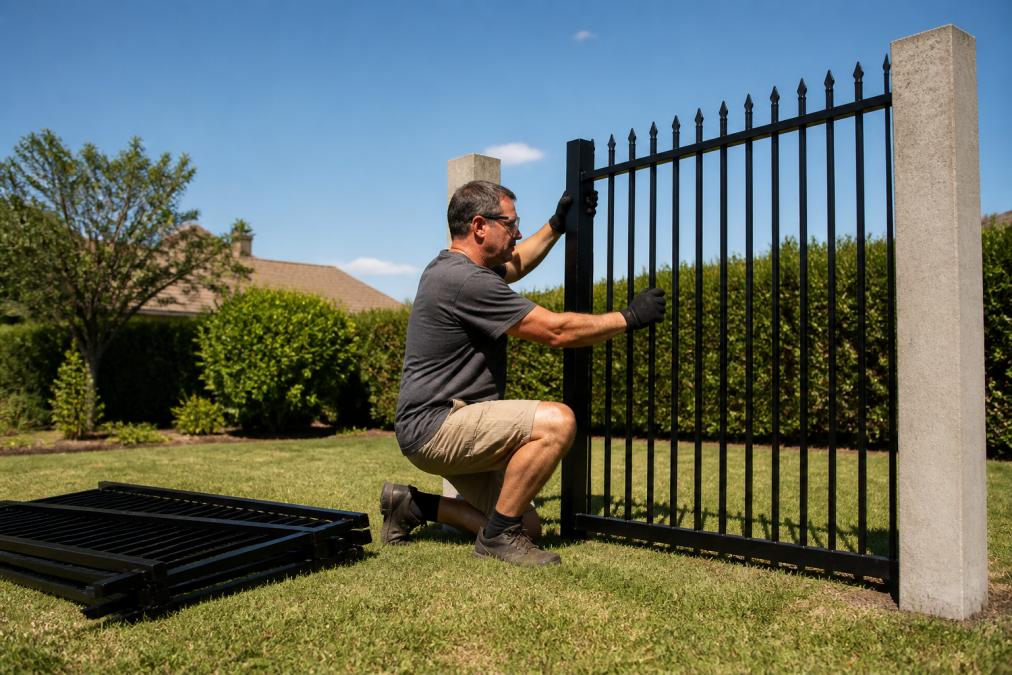
Pre-assembled panels change the DIY calculus entirely. Traditional fencing required cutting, welding, or assembling individual pickets on-site. Pre-assembled sections arrive ready to mount between posts. The process is closer to assembling furniture than performing skilled trades work.
A realistic DIY timeline for a 150-linear-foot yard fence runs one to two weekends for a first-timer. The primary tasks are:
- Marking and digging post holes to the correct depth
- Setting posts in concrete and allowing cure time
- Attaching pre-assembled panels to posts using included hardware
- Hanging and aligning gates
The one area where professional help genuinely pays off is post setting on difficult terrain. Sloped yards, rocky soil, or clay-heavy ground can make post installation far more labor-intensive than flat suburban lots. In those situations, hiring labor for post setting only, while self-installing panels, often represents the best cost-benefit split.
If your yard has significant slope, ask your supplier specifically about racking versus stepping panel configurations before ordering. Racking allows panels to follow the grade continuously; stepping creates a staircase effect between level panel sections. Choosing the wrong configuration before delivery means reordering.
As the Consumer Financial Protection Bureau’s home improvement cost guidance notes, labor costs for skilled trades work vary widely by region and project complexity. Getting multiple contractor quotes before deciding to DIY gives you a concrete savings figure to work with.
Residential vs. Commercial Aluminum Fence Thickness Explained
Residential grade and commercial grade aluminum fencing are not interchangeable, and ordering the wrong specification for your application is an expensive mistake.
Residential grade aluminum fencing uses lighter wall thickness, typically suited for property boundary definition, pool enclosures, and decorative applications where the primary loads are wind and incidental contact.
Commercial grade aluminum fencing uses heavier wall thickness and larger post dimensions, designed for higher-traffic environments, security perimeters, and applications requiring greater structural integrity under sustained lateral loads.
Material Grade and Tensile Strength: What the Numbers Mean
Aluminum fence profiles are specified by wall thickness, typically measured in thousandths of an inch. The difference between a residential-grade picket and a commercial-grade picket may appear small in specification sheets but translates to a meaningful difference in rigidity and long-term structural performance. pool fencing costs.
The metal alloy composition also matters. Most quality aluminum fencing uses a 6000-series aluminum alloy, which offers a favorable balance of tensile strength, corrosion resistance, and workability. Lower-grade alloys may look identical but will show deformation under stress or impact more readily.
| Grade | Typical Application | Post Size | Wall Thickness | Best For |
|---|---|---|---|---|
| Residential | Yards, pools, gardens | Lighter gauge | Thinner wall | DIY homeowners |
| Commercial | Businesses, parks, schools | Heavier gauge | Thicker wall | Contractors, developers |
| Industrial | High-security perimeters | Heaviest gauge | Maximum wall | Infrastructure projects |
When in doubt about which grade your project requires, default to commercial grade for pool enclosures and any application where the fence serves a safety function. The cost difference between grades is modest relative to the total project cost, and the structural margin is worth it.
How to Measure for Aluminum Fencing Before You Order
Measuring incorrectly is the most common and most avoidable wholesale buying mistake. Ordering short means a second freight shipment. Ordering long means material waste and tied-up capital.
How to measure for aluminum fencing accurately:
- Walk the perimeter with a measuring wheel or long tape measure. Don’t estimate.
- Record total linear footage of all fence runs, including gate openings.
- Subtract gate widths from total linear footage to get panel footage needed.
- Identify corner and end posts separately from line posts. Post counts differ by configuration.
- Account for grade changes. Sloped sections may require additional material depending on whether you’re racking or stepping.
- Add a 5% overage buffer for measurement error and any field adjustments.
- Confirm panel width with your supplier. Standard panels are typically 4 or 6 feet wide; your linear footage must divide cleanly or you’ll need cut panels.
Measuring for aluminum fencing is not complicated, but it requires one accurate site measurement and knowledge of your panel width. A 10-minute walkthrough with a tape measure prevents a costly re-order.
Gate placement deserves particular attention. Gates require specific hardware: gate hinges, a latch, and in some cases a drop rod for double gates. These are often sold separately from panel kits. Confirm your gate hardware is included before your order ships.
Durability, Corrosion Resistance, and Long-Term Value
Aluminum fencing does not rust. That single fact separates it from steel and wrought iron alternatives more than any other specification.
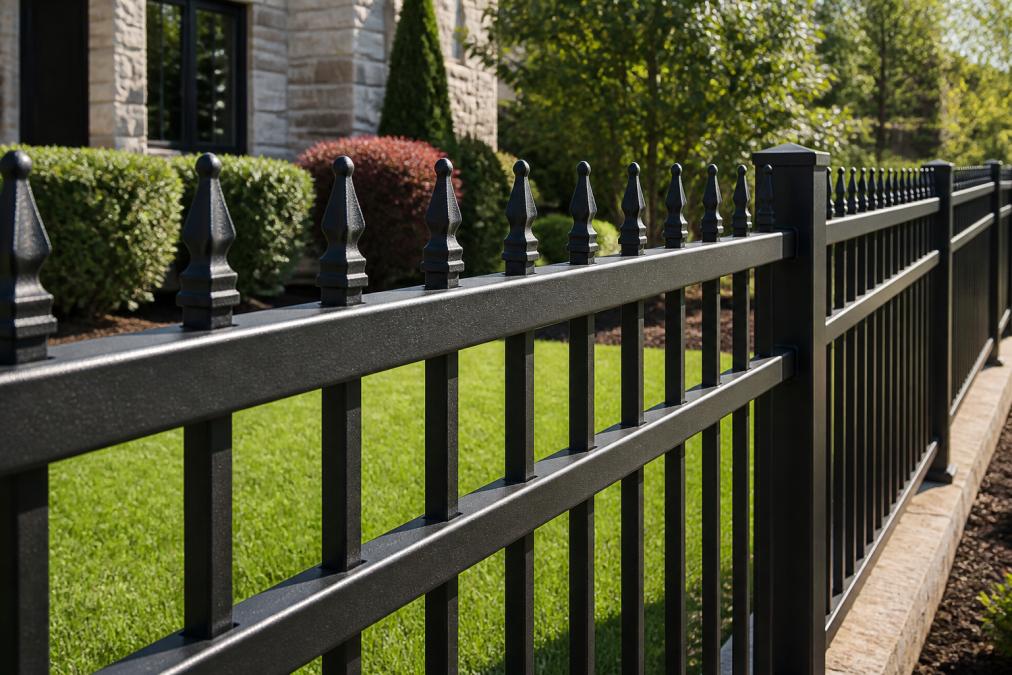
Steel fences require ongoing maintenance: periodic painting, rust treatment, and eventual section replacement as corrosion progresses. Wrought iron, despite its aesthetic appeal, demands the same. Aluminum forms a natural oxide layer that prevents corrosion without any treatment, making it a genuinely low-maintenance material for outdoor applications.
The powder-coated finish applied to quality aluminum fencing adds a second layer of protection. Powder coating is electrostatically applied and oven-cured, creating a surface that resists chipping, UV degradation, and moisture penetration far better than liquid paint. A properly applied powder-coated finish on aluminum fencing maintains its appearance for many years without repainting.
For property value, the calculation is straightforward. A fence that looks the same in fifteen years as it did on installation day contributes to curb appeal continuously. A steel fence that begins showing rust within five years becomes a visual and financial liability. The long-term investment case for aluminum over steel or wrought iron is strong, particularly in humid climates or coastal areas where corrosion accelerates.
According to guidance from the National Association of Realtors on home improvement ROI, fencing consistently ranks among the exterior improvements that contribute to property value and buyer appeal.
Pool Code Compliance and Local Zoning: What Wholesale Buyers Must Know
Pool code compliance is not optional, and it’s the one area where cutting corners has real legal and safety consequences.
The U.S. Consumer Product Safety Commission’s pool barrier guidelines establishes baseline requirements for residential pool barriers, including minimum fence height, maximum picket spacing, and self-closing, self-latching gate requirements. Most jurisdictions adopt these as minimum standards, with some states and municipalities imposing stricter requirements.
Before ordering wholesale aluminum fencing for a pool enclosure, confirm:
- Minimum fence height in your municipality (commonly 48 inches, but some jurisdictions require 60 inches)
- Maximum picket spacing (typically 4 inches or less to prevent child passage)
- Gate requirements: self-closing hinges and self-latching hardware that opens away from the pool
- Permit requirements: most jurisdictions require a permit for pool fencing installation
- Inspection process: understand whether a final inspection is required before the pool can be used
Local zoning can also affect fence height on non-pool sections of your property. Many residential zones cap fence height at 6 feet for rear yards and 4 feet for front yards. Ordering panels at the wrong height for your zone means either a variance application or replacing material.
The permit process is worth treating as a feature, not an obstacle. A permitted and inspected fence installation protects you legally and documents the improvement for future property sales.
Is Wholesale Aluminum Fencing Worth It? The Honest Verdict
Wholesale aluminum fencing is worth it for most homeowners and contractors, with two conditions: you’re buying enough material to offset freight costs, and you’re willing to handle installation yourself or manage the project directly.
The value proposition is clearest when all three of these are true:
- Your project covers at least 100 to 150 linear feet
- You have a weekend or two available for DIY installation
- You want a maintenance-free, long-lasting result without paying contractor markup on both labor and materials
The case weakens if your project is very small, your terrain is unusually complex, or you need installation completed under a tight deadline that doesn’t allow for freight transit time.
Kyle S., a customer who ordered through Aluminum Fences Direct, noted: “The ease of ordering and the great customer service… would definitely recommend.” Jeff S. added that “the fencing material arrived ahead of schedule” and that “quality of the fencing material was excellent.” These aren’t edge cases. They reflect what happens when the supply chain is short and the manufacturer controls quality end to end.
| Factor | Wholesale Direct | Local Contractor Supply | Box Store |
|---|---|---|---|
| Material cost | Lowest | Mid-range | Highest per unit |
| Freight cost | Included in total | Often included | None |
| Quality grade | Commercial/residential | Varies | Often residential only |
| Warranty | Lifetime (varies by supplier) | Varies | Limited |
| DIY suitability | High with pre-assembled panels | Moderate | High |
| Pool code options | Available | Varies | Limited selection |
The honest verdict: for a homeowner replacing old fencing, building a pool enclosure, or securing a property boundary, wholesale aluminum fencing delivers better material at lower total cost than retail alternatives. The savings are real. The installation is manageable. The durability is genuine.
Choosing the right fencing material and supplier involves more than comparing price per foot. You need to account for freight, installation labor, code compliance, and long-term maintenance costs to see the full picture. Aluminum Fences Direct offers 100% American-made aluminum fencing with a lifetime warranty, pre-assembled panels designed for DIY installation, and nationwide shipping direct to your site. Get a quote from Aluminum Fences Direct and find out what your project actually costs before you commit to a contractor.
Frequently Asked Questions
Q: Is it cheaper to buy fence panels wholesale?
A: Buying wholesale aluminum fencing removes the retail markup that local suppliers and big-box stores add to every panel. For a typical residential project, that difference can be substantial. Wholesale pricing also becomes more favorable as your order size grows, which is why contractors and property developers order direct. The key is accounting for freight shipping costs upfront, since those can offset savings on smaller orders. Request a quote with delivery included before comparing against local retail pricing.
Q: What are the downsides of aluminum fences?
A: Aluminum fencing has a lower tensile strength than steel or wrought iron, so it is not the right choice for high-impact security applications. It can dent if struck hard enough. Wholesale purchasing adds freight shipping logistics that retail buyers never deal with, including coordinating delivery windows and inspecting panels on arrival. On sloped terrain, pre-assembled panels require racking or stepped installation, which takes more planning. None of these are dealbreakers, but they are worth factoring into your project timeline.
Q: What is the difference between residential and commercial grade aluminum fencing?
A: The main difference is material thickness and wall gauge. Residential grade aluminum fence panels typically use thinner pickets and rails suited for standard yard enclosures, pet containment, and pool fencing. Commercial grade panels use heavier-gauge aluminum with greater structural integrity, designed for higher-traffic areas, perimeter security, or applications requiring stricter load tolerances. For most DIY homeowners, residential grade meets pool code compliance requirements, but always confirm local fence height requirements and code specs before ordering.
Q: Do aluminum fences increase property value?
A: Fencing generally contributes to curb appeal and perceived security, both of which factor into buyer assessments during a home sale. A powder-coated aluminum fence that still looks sharp after years of exposure holds its appearance better than wood or chain-link alternatives that require repainting or replacement. Maintenance-free materials are a documented selling point for buyers who want low-effort ownership. While appraised value increases vary by property and market, the long-term investment in durable fencing is consistently cited as a positive by real estate professionals.
This article was written using GrandRanker