
Table of Contents
- Minimum Height and Picket Spacing for Aluminum Pool Fencing
- ASTM F2409 Pool Fence Standards Explained
- Pool Fence Gate Latch Requirements: Self-Closing and Self-Latching Hardware
- DIY Aluminum Pool Fence Installation: What Homeowners Need to Know
- National Codes vs. Local Ordinances: Permits, Inspections, and Retrofitting
- Liability, Insurance, and Your Visual Inspection Checklist
- Frequently Asked Questions
Last Updated: September 14, 2026
Minimum Height and Picket Spacing for Aluminum Pool Fencing
Pool code compliant aluminum fencing requirements start with two numbers: 48 inches of height and a 4-inch maximum gap. Get those wrong and your enclosure fails inspection.
This guide from Aluminum Fences Direct covers what inspectors check, where local codes exceed the national baseline, and how to avoid costly mistakes.
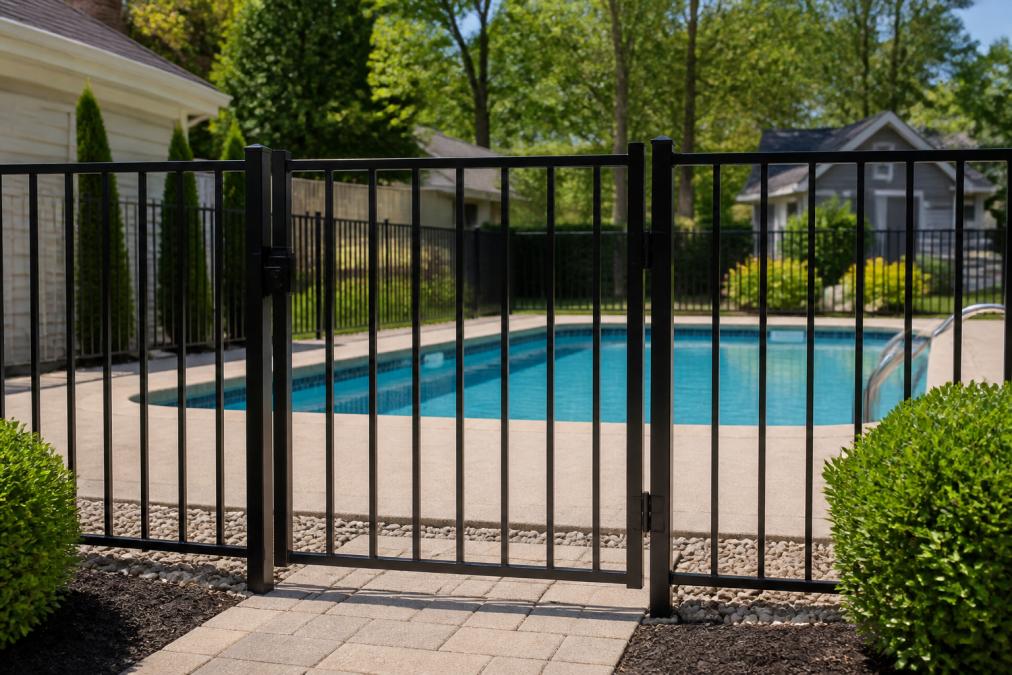
Under the model International Swimming Pool and Spa Code, residential pool barriers must stand at least 48 inches tall, measured from the exterior finished grade to the top of the barrier (ISPSC pool barrier height standards). That measurement point matters. If your yard slopes, the 48 inches is calculated from the ground on the outside of the fence, not the pool deck.
The 48-Inch Standard and When Local Codes Require 60 Inches
Forty-eight inches satisfies the model code in most of the country, but regional amendments routinely raise the bar. Some jurisdictions require a 60-inch minimum measured from the exterior finished grade (regional pool fence height requirements).
Before you order panels, pull your municipal ordinance. The difference between 48 and 60 inches is the difference between passing and re-buying.
The 4-Inch Sphere Rule and 45-Inch Horizontal Rail Limit
The 4-inch sphere test governs picket gaps. Every opening must be small enough to block a 4-inch diameter sphere, preventing small children from squeezing through (picket spacing compliance guidance). Aluminum picket panels are manufactured to pass this test out of the box.
Horizontal rails carry a separate rule. Rails placed less than 45 inches apart create a ladder effect, giving children a foothold to climb (horizontal rail climbability standards). This is the most frequently misunderstood pool code in residential fencing, and it’s the one that fails inspections most often. If your design stacks rails close together for looks, it likely violates the climbability provision.
ASTM F2409 Pool Fence Standards Explained
ASTM F2409 is the voluntary consensus standard covering fence systems for pools, hot tubs, and spas. It isn’t law on its own, but many building departments reference it during plan review.
For buyers, the takeaway is simple: ask whether panels are tested to the relevant standard before you order. A fence built to ASTM specifications is far easier to defend at inspection.
When comparing suppliers, ask for the specific height and picket spacing of the panel you’re buying, not the marketing description. A “pool fence” label means nothing if the panel is 42 inches tall or the pickets are spaced 4.5 inches apart.
Pool Fence Gate Latch Requirements: Self-Closing and Self-Latching Hardware
Every gate in a pool barrier must close and latch on its own. Model code requires self-closing hinges and self-latching mechanisms on all pool gates, and inspectors test them by hand during the final walkthrough ([gate hardware(/options/gates/) code requirements | quickshipaluminumfence.com]). A gate that stays open, even briefly, defeats the entire barrier.
Latch placement matters as much as the hardware. Latches must sit high enough and far enough from the frame that a small child can’t reach over or through the gate to release them, typically on the pool side.
This is also where code-compliant projects get more expensive than standard fencing. Self-closing hinges and self-latching assemblies add cost compared to a plain gate, which is why compliant quotes run higher than generic aluminum fencing (pool fence cost analysis). It’s not markup. It’s hardware.
| Component | Code Requirement | Why It Matters |
|---|---|---|
| Barrier height | 48 in minimum, 60 in in some areas | Blocks climbing and access |
| Picket spacing | 4 in sphere cannot pass | Prevents child passage |
| Horizontal rails | 45 in minimum separation | Eliminates ladder effect |
| Gate hardware | Self-closing, self-latching | Keeps barrier sealed |
DIY Aluminum Pool Fence Installation: What Homeowners Need to Know
Pre-assembled aluminum panels make DIY pool fence installation realistic for most homeowners, but code compliance adds steps a standard fence project doesn’t have. You’re building a barrier that has to pass inspection.
Here’s what the process looks like in practice:
- Pull your local ordinance and confirm the required height, spacing, and setback
- Apply for the fence permit before ordering materials
- Verify panel height and picket spacing against the code you pulled
- Set posts with proper ground clearance and post spacing
- Mount self-closing, self-latching gate hardware
- Schedule the inspection before backfilling or finishing
A common mistake is ordering panels before checking local amendments. A 48-inch panel that satisfies the model code fails where 60 inches is required.
Don’t assume your neighbor’s fence is compliant. Two houses on the same street can fall under different ordinances if a municipal boundary runs between them. Verify your own address, not the one next door.
National Codes vs. Local Ordinances: Permits, Inspections, and Retrofitting
National model codes set the baseline, but your local jurisdiction writes the rules you must satisfy. Municipal ordinances can raise height minimums, tighten spacing, and add setback requirements absent from the model text, so two identical aluminum fences on the same street can differ in compliance depending on which side of a municipal boundary they sit on.
Most jurisdictions adopt one of three frameworks: the International Swimming Pool and Spa Code (ISPSC), the International Residential Code (IRC) Appendix G, or a state-specific pool safety statute layered on a model code. Your building department can tell you which applies to your address in one phone call, worth making before you order a single panel.
Permitting and Inspection Process
Most jurisdictions require a permit for a new pool barrier or a replacement fence around an existing pool. Skipping it isn’t a shortcut, unpermitted barriers can trigger fines, complicate a home sale, and in some jurisdictions result in an order to remove the fence entirely.
A typical permit workflow looks like this:
- Confirm the applicable code. Ask the building department which model code and local amendments apply to your address, and request the specific section numbers in writing.
- Prepare a site plan. Most applications want a scaled drawing showing the pool, fence line, gate locations, swing direction of each gate, and proposed barrier height. Some also want the setback distance from the water’s edge.
- Submit product documentation. Plan reviewers increasingly ask for manufacturer cut sheets showing panel height, picket spacing, and rail spacing, plus evidence the gate hardware is self-closing and self-latching. Having these ready shortens review time.
- Pass plan review before you dig. Posts set before plan review is complete may have to be relocated if the reviewer requires a different fence line or setback.
- Install to the approved plan. Deviations, moving a gate, changing panel height, adding a section, usually require a permit revision.
- Schedule the inspection. Most departments want to inspect after posts, panels, and gate hardware are installed, but before landscaping, decking, or backfill hides the base of the fence.
A common pattern: the inspection is the first time a homeowner learns their local amendment requires 60 inches instead of 48, or that the latch is on the wrong side of the gate. Both are expensive to fix after the fact and cheap to catch during plan review.
Don’t assume your neighbor’s fence is compliant, and don’t assume your neighbor’s permit covers your property. Two houses on the same street can fall under different ordinances if a municipal boundary runs between them. Verify your own address, not the one next door.
Retrofitting an Existing Fence for Code Compliance
Not every non-compliant fence needs to come down. Retrofitting is often cheaper and faster than replacement when the existing posts and panels are sound. The decision comes down to three questions: is the structure solid, is the height close, and is the spacing close?
If all three are yes, retrofit. If the posts are rotted, rusted through, or set in failing footings, replacement is the better call.
Common retrofit fixes and when they apply:
- Height extensions. When the existing fence is 42 or 48 inches and the local minimum is 54 or 60, extension kits or taller pickets can raise the barrier without replacing posts. Works best on aluminum and steel; rarely works on wood.
- Mesh or picket inserts. When picket gaps exceed the 4-inch sphere test, woven mesh or added pickets can close the openings. This is the most common fix for older decorative fences with wide spacing.
- Gate hardware replacement. Swapping standard hinges and latches for self-closing, self-latching assemblies is the single highest-value retrofit. It is also the fix most likely to be flagged at inspection if skipped.
- Bottom rail additions. When the gap between the bottom of the fence and the ground exceeds the allowed clearance, adding a bottom rail or lowering the panels closes the opening.
- Climbability corrections. When horizontal rails sit closer than the allowed separation, adding a vertical picket pattern or replacing the panel section eliminates the ladder effect.
Retrofitting isn’t always cheaper than replacement. Once you’re adding height extensions, mesh inserts, new hardware, and a bottom rail to an older fence, labor and parts can approach the cost of a new pre-assembled aluminum panel. Run the numbers first.
Photograph the existing fence from the pool side and the approach side before you call a contractor or the building department. Inspectors and suppliers can usually tell you in one look whether a retrofit will pass or whether replacement is the cleaner path.
What to Confirm Before You Order Anything
Whether building new or retrofitting, three confirmations prevent almost every compliance failure:
- The exact minimum height your jurisdiction requires, measured from exterior finished grade.
- The maximum allowed picket spacing and horizontal rail separation.
- The gate hardware specification your inspector will test against.
Get those three in writing from the building department, match them to the product cut sheet, and the inspection becomes a formality instead of a negotiation.
Liability, Insurance, and Your Visual Inspection Checklist
A non-compliant pool barrier is a liability exposure, and insurers increasingly ask about pool fencing during underwriting.
How Non-Compliant Fencing Affects Liability
Premises liability law in most states holds a property owner to a standard of reasonable care when a pool is on the property. A barrier that meets the applicable pool code is the clearest evidence of that care; one that fails inspection, or was never permitted, does the opposite. In a lawsuit following a drowning or near-drowning, an out-of-code fence is often the first fact a plaintiff’s attorney puts before a jury.
Two specific exposures are worth understanding:
- Attractive nuisance doctrine. In most states, a pool is an attractive nuisance, meaning the owner can be held liable for injuries to trespassing children if reasonable steps to prevent access weren’t taken. A code-compliant, self-latching barrier is the standard defense; a non-compliant one undermines it.
- Negligence per se. In some states, violating a pool safety statute or ordinance is treated as negligence per se, meaning the code violation itself establishes a breach of duty. The plaintiff need only show the fence did not meet code and a child was injured.
Both exposures turn on whether the barrier met the code in force at the time of the incident.
How Insurers Evaluate Pool Fencing
Homeowner insurance carriers vary in how they treat pools, but a few patterns are common:
- Underwriting questions. Many carriers ask during application or renewal whether the property has a pool and whether it is enclosed by a fence with a self-latching gate. Answering inaccurately can void coverage after a loss.
- Premium adjustments. Some carriers surcharge unfenced or non-compliant pools, and some discount code-compliant barriers with self-closing, self-latching hardware.
- Coverage disputes. After a pool-related claim, an adjuster may inspect the barrier. If it doesn’t meet local code, the carrier may deny the claim, reduce the payout, or reserve the right to subrogate against the homeowner.
- Umbrella policy requirements. Many umbrella liability policies require a compliant pool barrier as a condition of coverage. A non-compliant fence can put the entire umbrella at risk, not just the pool claim.
A single call to your insurance agent, asking whether your policy requires a code-compliant pool barrier and whether a compliant one reduces your premium, is worth more than any generic advice.
Quarterly Visual Inspection Checklist
Run this checklist every few months and before any pool season begins. Gates drift, latches wear, and landscaping grows, a five-minute check catches the failures inspections punish.
- Barrier height still measures at or above the local minimum from exterior finished grade
- No picket gaps exceed the 4-inch sphere test
- Horizontal rails remain at least 45 inches apart
- Gate closes and latches on its own every time, from a full open position
- Latch sits out of reach from the approach side and cannot be released by a small child
- No climbable objects (AC units, planters, benches, pool equipment, tree limbs) sit within reach of the fence
- Posts and panels show no damage, shifting, or corrosion at the base
- Ground clearance under the fence has not increased due to erosion or settling
- Self-closing hinges still return the gate fully closed without assistance
- No gaps have opened at gate posts, corners, or where the fence meets a wall or structure
If any item fails, fix it before the next pool season. A gate that sticks open in July is a code violation in July, regardless of what it did in April.
Compliance isn’t a one-time event. It is a maintenance obligation that protects your family, your coverage, and your legal position. The five minutes you spend on this checklist each quarter is the cheapest insurance you will ever buy.
Frequently Asked Questions
What is the standard height requirement for a pool fence?
The model International Swimming Pool and Spa Code requires a minimum height of 48 inches (4 feet) measured from the exterior finished grade. Some local jurisdictions, such as Los Angeles, mandate 60 inches. Aluminum fence panels are commonly manufactured in 48-inch and 54-inch heights to meet varying regional pool code requirements. Always check your local municipal ordinance before ordering, because the building inspector will measure from the exterior finished grade, not from the pool deck.
How does the 4-inch sphere rule apply to aluminum pool fences?
The 4-inch sphere rule requires that no opening in the fence allow passage of a 4-inch diameter sphere. For aluminum fencing, this means vertical pickets must be spaced no more than 4 inches apart. This standard prevents small children from squeezing through fence panels. When shopping for pool code compliant aluminum fencing requirements, confirm the picket spacing on the spec sheet. Most quality aluminum panels are designed to pass this test, but verify before you buy.
Are self-closing and self-latching gates required for pool fences?
Yes. BOCA/ICC and the International Swimming Pool and Spa Code require all pool gates to have self-closing hinges and self-latching mechanisms. The latch must be positioned so a child cannot easily reach it, typically on the pool side of the gate. Code-compliant aluminum installations prioritize this specific hardware. For pool fence gate latch requirements, check that your gate hardware meets the current ISPSC standard before installation.
Can I install a code-compliant aluminum pool fence myself?
Yes, pre-assembled aluminum panels and gates are designed for DIY installation. You will need to set posts in concrete, level each panel, and mount self-closing gate hardware. Most homeowners with basic tools can complete a typical residential pool enclosure over a weekend. For DIY aluminum pool fence installation, order panels sized to your exact measurements, confirm the 48-inch or 54-inch height meets your local code, and schedule your inspection before backfilling. If your yard slopes, adjustable post brackets can accommodate uneven ground.
Pool fencing codes vary enough that guessing costs money. The homeowners who get it right pull their local ordinance first, order panels that match, and install hardware that satisfies inspection on the first pass. Aluminum Fences Direct builds pre-assembled, American-made aluminum fencing with the height options, picket spacing, and self-closing gate hardware pool codes demand, backed by a lifetime warranty. Get a quote and confirm your panel specifications before you dig.