
Table of Contents
- How the Supply Chain Makes Wholesale Aluminum Fences Cheaper
- Aluminum Fence Installation Cost vs. Total Project Cost
- DIY Aluminum Fence Installation: Real Savings and Hidden Costs
- Aluminum vs. Wood Fence Cost Comparison: Upfront and Long-Term
- The ‘Wholesale’ Myth vs. Reality: What Buyers Should Know
- Quality Grading Standards: Why Not All Wholesale Aluminum Fences Are Equal
- Conclusion
- Frequently Asked Questions
Last Updated: September 16, 2026
How the Supply Chain Makes Wholesale Aluminum Fences Cheaper
Wholesale aluminum fences are cheaper because they skip the distributor markup: buying directly from the manufacturer removes at least one layer of resale profit, and aluminum’s low weight keeps freight and fabrication costs down. That combination is why aluminum typically runs 30% to 50% below steel or wrought iron (aluminum fencing cost analysis).
The math is simple once you see who gets paid. A traditional purchase passes through a manufacturer, a regional distributor, a local retailer, and an installer. Each one adds margin. At Aluminum Fences Direct, we sell pre-assembled panels straight to homeowners and contractors, so only the manufacturer and the freight company get paid.
Cutting Out the Middleman
Every party between the factory and your yard takes a cut. Distributors typically add 15% to 30% to the price of goods, and retailers mark up again before the product reaches a shelf. Wholesale pricing collapses those steps into one transaction: you buy at or near factory cost, and the savings land in your budget instead of four separate invoices.
Here is the mechanism in plain terms. A panel that leaves the factory at $100 does not arrive at a retail counter at $100. It arrives at roughly $115 to $130 after the distributor’s cut, then $150 to $190 after the retailer’s markup, then higher again once the installer bundles in a materials surcharge. Wholesale removes the middle two steps, so the same panel reaches you closer to the factory number. The savings are not a discount the seller is eating, they are margin that never gets created in the first place.
Material and Manufacturing Cost Advantages
Aluminum is lighter and easier to fabricate than steel, which reduces both production and transportation costs ([how aluminum fence(/is-diy-aluminum-fencing-worth-it/) panels are priced | aluminum-fence.com]). Those savings compound at the wholesale level. Material-only costs for aluminum fencing run from $15.50 to $72 per linear foot depending on grade and height (fair price guide for fence materials), and a typical panel costs $116 to $231 compared with $293 to over $600 for steel (panel pricing comparison).
Three manufacturing realities drive that spread:
- Extrusion, not welding. Aluminum pickets and rails are pushed through a die in continuous runs, which is faster and cheaper per foot than the cut-and-weld process steel fencing requires.
- Powder coating, not painting. A powder-coated finish is applied electrostatically and cured in one pass, so the coating cost per panel is low and consistent, no brush labor, no drying racks.
- Weight, not bulk. Aluminum weighs roughly a third of steel for the same profile. That single fact lowers every downstream cost: fewer trucks, cheaper freight class, easier handling at the dock, and less damage in transit.
Why Order Size Changes the Per-Foot Price
Wholesale pricing is not a flat rate, it is a function of how much you buy at once. Manufacturers set up an extrusion run, a coating line, and a freight load for a given order, and those setup costs are fixed. Spread them across 50 linear feet and they dominate the price. Spread them across 500 linear feet and they nearly disappear.
That is why a homeowner ordering a single gate often pays close to retail, while a contractor ordering a full property line pays meaningfully less per foot.
Wholesale savings come from three stacked sources: eliminated distributor and retailer margin, lower aluminum production and freight costs, and fixed setup costs spread across a larger order. Miss any one of them and the “wholesale” price starts looking a lot like retail.
Aluminum Fence Installation Cost vs. Total Project Cost
Installation is where budgets quietly double. Professional aluminum fence installation runs $25 to $45 per linear foot, or roughly $20 to $50 per foot in labor alone (installation cost comparison). On a 200-foot property line, that labor bill alone can exceed the cost of the materials.
What Installation Actually Costs
| Cost Component | Typical Range | Who Controls It |
|---|---|---|
| Material (wholesale panels) | $15.50-$72 per linear foot | Your supplier |
| Professional labor | $20-$50 per foot | Your contractor |
| Freight and delivery | Varies by distance and order size | Your supplier |
| Total installed project | $3,000-$8,500 | Mix of both |
Professional installation is the single largest line item most homeowners never question. Total project costs for aluminum fencing land between $3,000 and $8,500 when a contractor handles everything (residential fence cost guide).
Shipping and Logistics: The Overlooked Line Item
Freight is the cost nobody quotes upfront. Aluminum’s low material weight works in your favor here: panels ship in compact, stackable bundles rather than the heavy, awkward loads that steel or wood require, so carriers charge less per panel. Ordering a full project at once spreads that freight across more linear feet, which lowers the per-foot shipping cost. Ordering in dribs and drabs is where DIY budgets quietly bleed.
DIY Aluminum Fence Installation: Real Savings and Hidden Costs
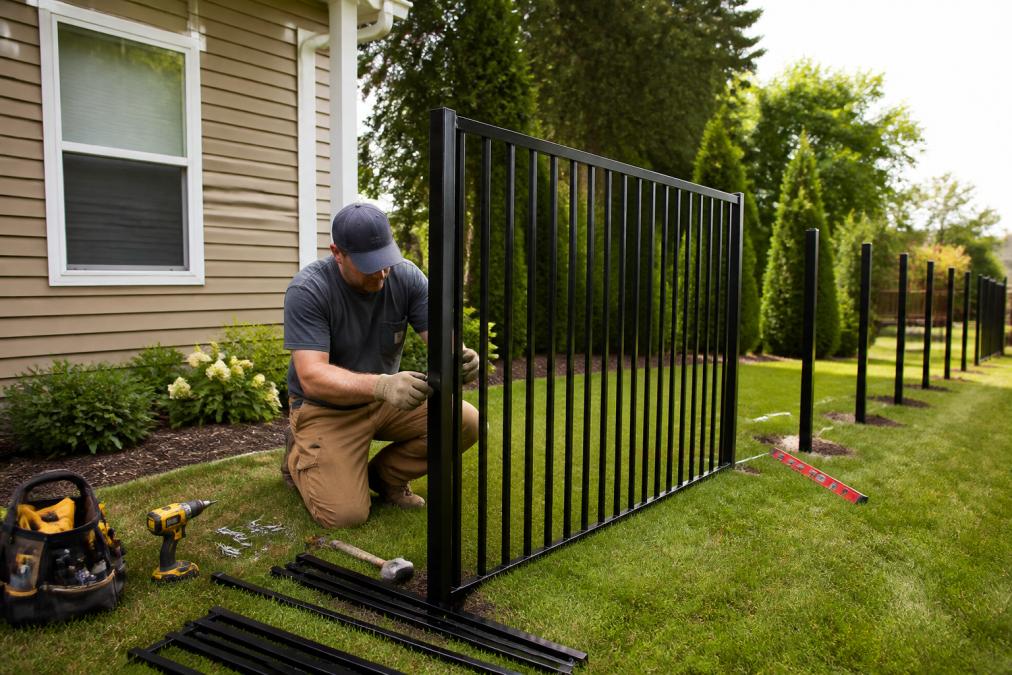
DIY aluminum fence installation saves the $20 to $50 per foot labor charge, which is the biggest single lever on total project cost. Pre-assembled panels and gates turn a week-long contractor job into a weekend project for most homeowners.
The Hidden Costs Nobody Quotes Upfront
- Specialized tools. Specialized tools, such as a post-hole auger or a rotary hammer for drilling into concrete or rocky soil, may be needed. A laser level or string line, a tamper, and a good set of clamps round out the list.
- Concrete. Each post needs a footing. Each post needs a footing. Concrete costs will vary based on the project size and local prices.
- Permits. Many jurisdictions require a fence permit, and fees will vary. Skipping the permit can mean a fine or a forced removal.
- Shipping. Freight on a full pallet of panels can run several hundred dollars, and it is rarely included in the advertised per-foot price. Remote addresses and liftgate delivery add more.
- Waste and reorders. Miscuts, mis-measured post spacing, and panels damaged in handling all trigger reorders, and a second shipment rarely gets the same freight discount as the first.
- Time. A weekend project is a weekend for a straight, level, small run. Sloped yards, rocky soil, or a pool enclosure can stretch it to multiple weekends, and that time has a cost even if it is not on an invoice.
Running the Real Numbers
Before you order panels, confirm post spacing, fence height, and setback requirements against your local pool code and HOA rules. Pool enclosures in particular have strict height and self-latching gate requirements that vary by jurisdiction, and a non-compliant fence can force a full reorder. Measure twice, order once.
The honest trade-off: you save thousands in labor, but you spend a weekend with a shovel, and you absorb the risk that a contractor would otherwise carry. For a straight, level, modest run, DIY is a clear win. For a sloped, rocky, or code-sensitive property, the hidden costs can eat most of the wholesale advantage, and paying a professional is often the cheaper decision in hindsight.
Aluminum vs. Wood Fence Cost Comparison: Upfront and Long-Term
Wood wins on the sticker price and loses on everything after it. Aluminum costs more upfront than wood or chain link, but it carries near-zero maintenance requirements and decades of structural integrity, which is why it is increasingly favored over traditional wood (aluminum versus wood for bulk buyers).
The ‘Wholesale’ Myth vs. Reality: What Buyers Should Know
Not every “wholesale” price is wholesale. Plenty of retailers advertise wholesale rates while still protecting a healthy margin, and some restrict true wholesale pricing to contractors with established accounts, leaving individual homeowners shut out (fence buyer discussion on wholesale access). The word gets used as a marketing hook rather than a pricing structure.
Here is how to tell the difference:
- Ask who the seller is. A manufacturer or direct distributor can sell at wholesale. A reseller cannot.
- Check the minimum order. True wholesale often has quantity thresholds; a fake one just has a lower-looking sticker.
- Compare the per-foot math. If the “wholesale” price sits within a few dollars of a big-box retailer, you are paying retail with better branding.
Quality Grading Standards: Why Not All Wholesale Aluminum Fences Are Equal
Cheap panels and inexpensive panels are not the same thing. Fence grade matters: residential-grade aluminum uses thinner pickets and rails than commercial-grade, and the difference shows up in structural integrity, wind load, and how the fence looks after five years.
Watch for these quality markers:
- Picket and rail thickness. Thicker walls resist bending and hold up to pets and pool-code inspections.
- Powder-coated finish. A proper coating resists chalking and fading; a thin one scratches down to bare metal.
- Warranty length. A lifetime warranty signals the manufacturer stands behind the material.
Conclusion
The gap between a contractor quote and a wholesale order can be thousands of dollars, and the only thing standing between you and that savings is a weekend of installation work. Aluminum Fences Direct ships pre-assembled, American-made aluminum panels directly to your property, with wholesale pricing for DIY homeowners and contractors, maintenance-free construction that will not rust or rot, and a lifetime warranty on every fence.
Frequently Asked Questions
How much does 100 feet of aluminum fence cost?
Material-only costs for aluminum fencing vary depending on height, grade, and finish. Installation costs also vary if you hire a contractor, or you can save that labor by installing pre-assembled panels yourself. Shipping and gate hardware are separate line items. Request a quote from Aluminum Fences Direct for exact pricing on your project.
What are the downsides of aluminum fences?
Aluminum may have a higher upfront cost than some other materials. It is not the best choice if you want total privacy without adding slats, and very thin grades can feel less rigid than steel. Some retailers also restrict wholesale pricing to contractors with established accounts, so individual homeowners may not always access true wholesale rates.
Where can I buy aluminum fence panels wholesale?
True wholesale pricing is available from direct distributors that sell factory-direct to both DIY homeowners and contractors. Aluminum Fences Direct offers wholesale pricing on 100% American-made panels with nationwide shipping. Be cautious of sellers advertising wholesale prices on small quantities, since some buyers report receiving lower-quality material when ordering small volumes at deep discounts.
Is it cheaper to buy fencing materials directly from a manufacturer?
Buying direct eliminates the retailer markup and can save thousands in labor costs, especially when you install pre-assembled panels yourself. Going direct-to-consumer can reduce the total project cost. Just factor in shipping logistics and confirm the quality grade before ordering, since low-cost wholesale options are not always equal.