
Table of Contents
- Wrought Iron Fence Costs: What to Expect in 2026
- Wrought Iron vs. Aluminum: Strengths and Weaknesses
- Aluminum Fence Installation: A Simpler Path for DIY Homeowners
- Wrought Iron Fence Maintenance: What It Really Takes
- Pool Fence Safety Standards: What Your Fence Must Meet
- Regional Climate Suitability and Permitting
- Conclusion
- Frequently Asked Questions
Last Updated: September 26, 2026
Wrought Iron Fence Costs: What to Expect in 2026
A wrought iron fence remains the benchmark for ornamental metal fencing, and in 2026 the numbers are sobering. According to Angi’s 2026 wrought iron fence cost data, professional installation runs between $1,421 and $5,138, with the typical homeowner paying about $3,171. At Aluminum Fences Direct, we hear the same reaction every week: that’s a lot of money for a fence. Below, we break down where those dollars actually go, what you can realistically do yourself, and how aluminum compares once you stop comparing price tags and start comparing total cost of ownership.
A wrought iron fence is built from iron or steel bars, typically joined with welded finials and decorative ironwork, and finished with a protective coating to resist rust. That definition matters, because most “wrought iron” sold today isn’t wrought iron at all.
Professional Installation Pricing
Installed wrought iron typically runs $50 to $85 per linear foot, according to HomeGuide’s 2026 fencing cost guide, with full residential projects landing between $10,000 and $17,000. Height, picket style, ornamental detail, and custom dimensions all push the number up. Custom fabrication, welded finials, and hand-forged decorative ironwork sit at the top of that range.
| Cost Factor | Typical Range | What Drives It |
|---|---|---|
| Per linear foot, installed | $50-$85 | Height, style, ornamentation |
| Average project total | $3,171 | Angi 2026 average |
| Full residential project | $10,000-$17,000 | Property perimeter, gates |
| DIY material only | Varies by supplier | Panels, posts, hardware |
DIY vs. Professional Installation
Labor is frequently 40-60% of an installed wrought iron quote, and if you’re handy, that’s the money you keep. The catch: traditional wrought iron arrives as raw bar stock needing cutting, welding, and on-site finishing, fabrication work, not weekend work.
Pre-assembled panels change the math entirely. The deciding factor isn’t your skill, it’s whether the product ships ready to bolt together.
Skipping a professional install on traditional wrought iron without welding experience usually ends badly. Poorly joined panels fail at the posts first, and a leaning fence is a security barrier that doesn’t secure anything.
Wrought Iron vs. Aluminum: Strengths and Weaknesses
The honest answer to wrought iron vs. aluminum is that each material wins on different criteria. Wrought iron wins on weight, rigidity, and prestige; aluminum wins on maintenance, cost, and installation simplicity. What most comparisons skip is why: the two metals behave differently at the molecular level, which drives how each fence ages, fails, and costs to maintain.
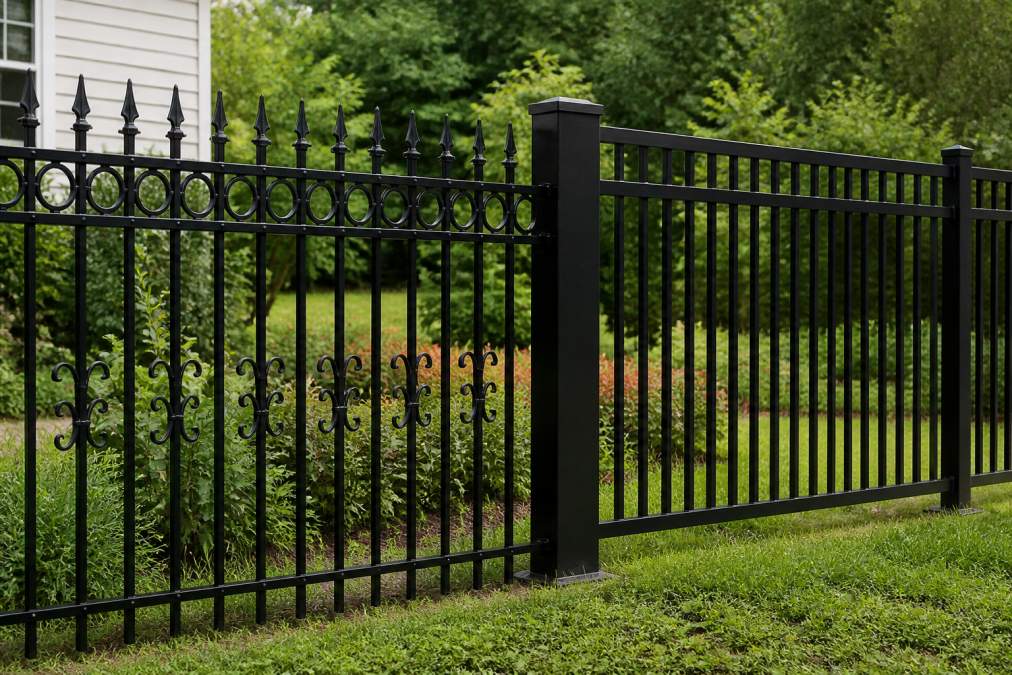
Where Wrought Iron Wins
Traditional iron fencing delivers unmatched structural integrity. It’s heavy, it’s rigid, and it holds its shape for decades when properly maintained. For historic restoration work, nothing else matches the look. Alpha Gate and Door’s case studies show how wrought iron fencing in historical districts preserves architectural significance in a way modern substitutes can’t replicate.
It also takes a beating. A determined intruder has a much harder time bending or cutting through solid iron than through lighter metals. If perimeter security is your only metric, iron is the tougher material.
The mechanism behind that strength is density.
Where Aluminum Wins
Aluminum fencing is the practical choice for most homeowners. It doesn’t rust, doesn’t need repainting every few years, and weighs roughly a third of what iron does, one person can position a panel without a crew.
Head-to-Head: How the Two Materials Compare
| Criterion | Wrought Iron | Aluminum |
|---|---|---|
| Weight | Heavy; 2-3x aluminum per panel | Light; one person can handle a panel |
| Corrosion behavior | Rusts; corrosion spreads once started | Forms protective oxide layer; resists rust |
| Finish durability | Paint or powder coat; needs recoating every 2-3 years | Powder coat; typically lasts many years |
| Structural rigidity | Highest; resists deflection across long spans | Good; may need reinforcement on wide or tall runs |
| Maintenance burden | High; inspection, spot repair, periodic repainting | Low; occasional rinse and hardware check |
| Repair approach | Welding or forge work; specialist labor | Panel or picket replacement; DIY-friendly |
| Aesthetic ceiling | Hand-forged authenticity; unmatched in historic settings | Convincing ornamental look; less heft up close |
| Installation complexity | Fabrication, welding, on-site finishing | Pre-assembled panels; bolt-together assembly |
| Best-fit buyer | Historic properties, maximum-security perimeters | Most residential projects, coastal and humid climates |
The Failure Modes Nobody Talks About
Iron and aluminum don’t fail the same way, and knowing how each gives out tells you more than any spec sheet.
Lifespan and Total Cost of Ownership
A properly maintained iron fence can last generations, 50 years or more when recoating stays on schedule. An aluminum fence with a quality powder coat carries a multi-decade finish warranty and a structural lifespan in the same range, with far less intervention.
For 8 out of 10 residential projects, aluminum delivers the wrought iron look at a fraction of the lifetime cost. Iron wins only when authenticity or maximum security is non-negotiable, and only if you’re prepared to maintain it.
Aluminum Fence Installation: A Simpler Path for DIY Homeowners
Aluminum fence installation is a straightforward weekend project because panels arrive pre-assembled and predrilled. You set posts in concrete, slide panels into place, and secure hinges and latches on gates, no welding, no fabrication, no specialty tools beyond a post-hole digger and a level.
Wrought Iron Fence Maintenance: What It Really Takes
Wrought iron fence maintenance is the hidden cost that never shows up in the installation quote. Iron rusts, not a question of if but when, and the answer depends on the coating and how well you keep up with it. Understanding why makes the schedule make sense: iron oxidizes in the presence of moisture and oxygen, and the resulting rust is porous, flaking off and exposing fresh metal.
A Realistic Annual Routine
A realistic annual routine for traditional wrought iron includes:
- Inspecting for rust spots, especially at welds and ground contact points
- Sanding and spot-priming any corrosion before it spreads
- Repainting or touch-up coating every 2-3 years
- Re-tightening hinges and latches as seasonal movement loosens them
- Clearing vegetation that traps moisture against the fence posts
That list is the floor, not the ceiling. Inspection matters most: catching rust early is the difference between a ten-minute touch-up and a weekend of grinding and repainting. Walk the fence line twice a year, spring after the freeze-thaw cycle, fall before winter, and check welds where pickets meet rails, the base of each post, and gate hardware where movement wears through finishes.
Surface Rust vs. Structural Rust
Not all rust is an emergency, and knowing the difference saves you from overreacting, or underreacting.
Coating Choices Change the Schedule
The coating determines how often you’re out there with a brush, and not all coatings are equal.
What Neglect Actually Costs
Skip the maintenance and a $15,000 fence starts looking tired in five years. Keep up with it and you’ll pass it to your kids.
Pool Fence Safety Standards: What Your Fence Must Meet
Buying a pool fence before confirming your local code is the most expensive mistake in this category. Requirements vary by state and municipality, and non-compliant fencing can fail inspection, delay your pool opening, and in some cases void insurance coverage.
Your fence supplier should tell you which specifications their panels meet in writing. If they can’t, walk away. Ask specifically about picket spacing, panel height, and gate hardware before you order.
Regional Climate Suitability and Permitting
Climate should drive your material choice more than aesthetics does. In coastal and humid regions, salt air and moisture attack iron relentlessly, and aluminum’s corrosion resistance becomes decisive. In arid climates, both hold up well, though iron still needs repainting. In freeze-thaw regions, ground movement stresses posts, and powder-coated steel or aluminum handles the flex better than rigid iron.
- Local building permit requirements and height limits
- HOA architectural review rules for material and color
- Setback requirements from property lines and easements
Conclusion
The real question isn’t whether wrought iron is better than aluminum. It’s whether you want to pay for iron’s weight and prestige, then maintain it for the next 30 years, or get the same look with almost none of the upkeep. For most homeowners, aluminum wins on total cost of ownership.
Frequently Asked Questions
What are the primary maintenance differences between wrought iron and aluminum?
Wrought iron requires regular inspection for rust and repainting every few years, especially in humid climates. Aluminum fences come with a powder-coated finish that resists rust and corrosion, needing only occasional cleaning with soap and water. For homeowners who want a maintenance-free option, aluminum is the clear winner. A wrought iron fence can last decades but demands ongoing care to stay looking its best.
Is aluminum fencing as durable as traditional wrought iron?
Aluminum fencing offers excellent durability and will not rust like iron. While it lacks the heavy, solid feel of wrought iron, modern aluminum alloys are strong enough for residential security and pool enclosures. Both materials can last decades, but aluminum requires far less upkeep. If you want the look of iron without the rust risk, aluminum is a smart choice.
Which material is better suited for pool safety compliance?
Both wrought iron and aluminum can meet pool fence safety standards if they are at least 4 feet tall with self-closing, self-latching gates and gaps no larger than 4 inches. Aluminum is often preferred for pool areas because it resists rust from splashing and humidity. Always check your local code requirements before installing. Aluminum Fences Direct offers pre-assembled panels that can be configured to meet these standards.
How does the installation process differ for wrought iron versus aluminum?
Wrought iron panels are heavy and often require welding or specialized tools, making professional installation common. Aluminum fence installation is more DIY-friendly because panels are lighter and pre-assembled. You can typically set posts in concrete and attach panels with basic tools. For homeowners looking to save on labor, aluminum is the more practical choice. Always follow manufacturer instructions for proper post spacing and gate alignment.